Before the pound: a gateway between two seas
Long before a British monarch appeared on locally issued money, Gibraltar belonged to the trading networks of Iberia and the Strait. There is no ancient “Gibraltar pound”: the long history of the place must be distinguished from the much more recent history of its monetary issues.
The name recalls Ṭāriq ibn Ziyād and the crossing of 711. Gibraltar’s museum nevertheless places the development of a permanent town in the twelfth century. The Rock came under Castilian control in 1462 and received its castle-and-key arms in 1502. That emblem therefore predates the Anglo-Dutch capture of 1704 by two centuries. The Treaty of Utrecht formalised the cession to Great Britain in 1713.
A change of government did not instantly replace the habits of merchants. Buying provisions, paying a craftsman or supplying a ship required coins acceptable to people arriving from several shores. Local monetary history becomes clearer when we separate three things: the authority governing the territory, the unit used to keep accounts and the actual coins changing hands. These did not always follow the same political map.
Gibraltar National Museum — Fortifications · Ministry for Heritage — Timelines
1802: Robert Keeling’s promise to pay
In the early nineteenth century, having money was not enough: small denominations were needed to give change. Merchant Robert Keeling addressed the shortage by issuing copper tokens in 1802. He was neither inventing Gibraltar’s banknote nor founding a central bank. His initiative belonged to a commercial tradition also familiar in Britain.
The 1802 quart held at Greenwich combines a view of the Rock, the sea and a three-masted vessel with a promise of payment at Keeling’s business. Its legend even spells the place “GIBRALTER”. The other face shows a three-towered castle above a key and states the value of one quart. The object was both small change and a merchant’s sign: it identified the business standing behind it.
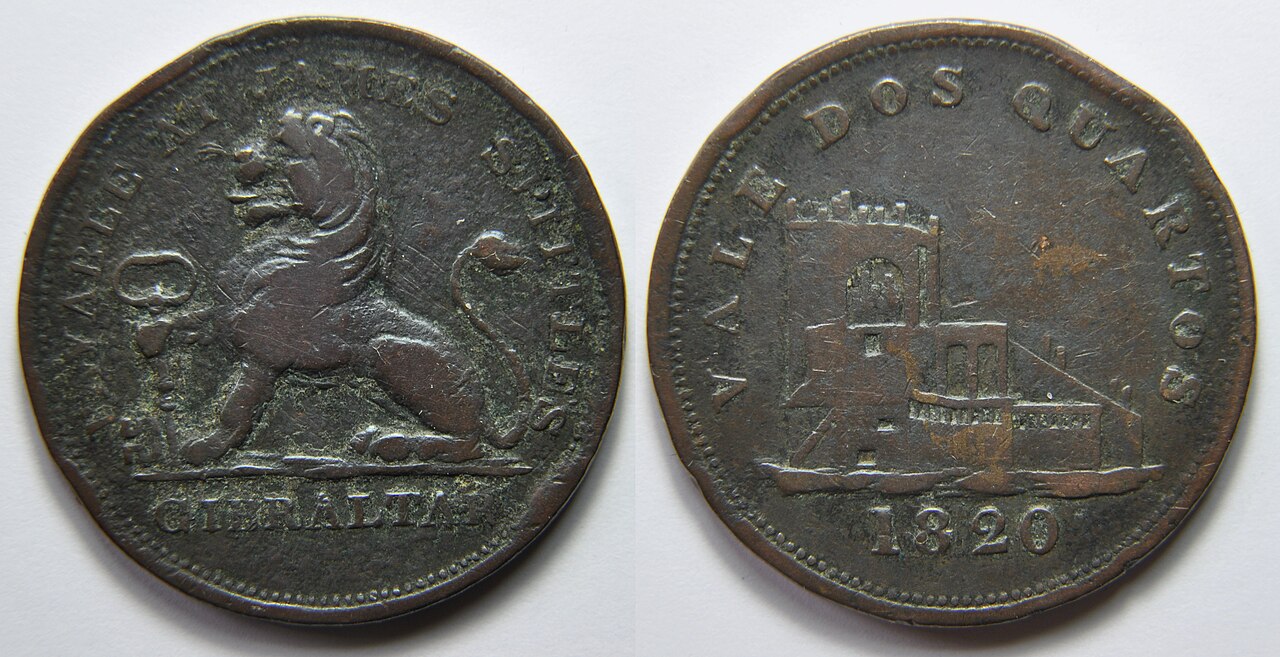
A further Keeling issue in 1810 named Robert Keeling & Sons and depicted a lion holding the fortress keys. The photograph of a two-quartos token dated 1820 supplies another material witness to this period of private issues. These coppers bring monetary history down to the shop counter, where a piece became useful because a local network trusted it. Their denominations should not be confused with the pence of today’s decimal pound.
Jean-Michel Moullec · CC BY 2.0 · Licence

Gibraltar National Mint — Early Gibraltar Coinage · Royal Museums Greenwich — Quart token, MEC2012
1842: Victoria, the castle and the key
Local small change next acquired an official character. Following discussions begun by the colonial administration in 1839, the Royal Mint prepared copper half-quart, one-quart and two-quart pieces. They entered use in 1842. Their manufacture left evidence that collectors can read: dies prepared with earlier dates were altered for issue, producing the overdates recorded on some pieces.
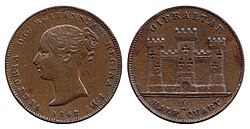
The photographed half-quart places the young Queen Victoria on the obverse and Gibraltar’s arms on the reverse. The portrait expresses royal authority; the castle and key make the copper recognisably local. The relationship becomes apparent when both sides are considered together. This is a territorial image carried by an everyday object, rather than a change in the value of the metal itself.
These coins did not begin an uninterrupted annual series. Proofs dated 1860 and 1861 survive, but a proof is not the same as an issue released for ordinary transactions. The long gap that followed makes the arrival of a local circulating range in 1988 especially significant. Gibraltar possessed its own monetary imagery long before its modern decimal coinage.
Петров Эдуард · CC0 · Licence

1898: sterling becomes the standard
Nineteenth-century Gibraltar cannot be reduced to a simple choice between Spanish and British money. Coins in use, accounting conventions and administrative decisions did not always change together. Describing the entire period as the use of a “GIP” already comparable to today’s would impose a modern category on a more complicated past.
A decisive step is recorded in the Order in Council of 9 August 1898: British currency became Gibraltar’s sole legal tender. The United States Department of Commerce’s 1930 account explicitly identifies this measure. Sterling provided the framework within which the government’s subsequent local note issues developed.
The continuity matters. In 1914 the authorities did not introduce a unit whose price floated independently against the British pound. They issued paper denominated in sterling. Today the Gibraltar pound can have the identifying code GIP and its own physical currency while retaining equality of value with the pound sterling. A territorial name, a separate issuer and a shared value are compatible features. The distinction explains why currency history here is as much about the form and issuer of money as about its unit.
U.S. Department of Commerce — Foreign Currency and Exchange (1930), Gibraltar · Gibraltar Philatelic Bureau — Banknotes
1914–1927: paper money born of an emergency
The First World War marks the real beginning of government banknotes. In 1914 a run on the banks prompted intervention to help the Anglo-Egyptian Bank and the Government Savings Bank meet withdrawals. Emergency Ordinance No. 10 of 1914 authorised the first issues. Quoting 1927 as the sole starting date therefore hides an essential earlier chapter.
The Philatelic Bureau reconstructs the circumstances through a minute written by Treasurer W. A. Bowring on 2 February 1925. Paper money served a practical purpose: maintaining a means of payment when demand for cash put banking institutions under pressure. Its credibility rested on the issuer’s undertaking, its recognisable form and people’s willingness to accept it.
The Secretary of State approved the arrangements on 21 October 1915. The Currency Notes Ordinance of 1927 subsequently supplied a legislative framework. The movement from emergency response to lasting institution is the important thread. Local notes did not suddenly come into existence in 1927; legislation consolidated a practice that had begun thirteen years earlier. This chronology also separates the origin of the paper issues from the earlier adoption of sterling.
U.S. Department of Commerce — Foreign Currency and Exchange (1930), Gibraltar · Gibraltar Philatelic Bureau — Banknotes
Issuing notes and backing their value
The issuer named on the notes is the Government of Gibraltar. Issuing authority belongs to the government, rather than to a Gibraltarian central bank comparable to the Bank of England. The issuer must also be distinguished from the printer: a company manufactures the note on behalf of the public authority without thereby becoming the institution backing its value.
The system uses a Note Security Fund. The Philatelic Bureau explains that local notes supplied to banks require a deposit of equivalent value with the government. The deposits are invested in that fund. This helps explain how a local note issue can remain part of the sterling system without imagining a hoard of gold coins standing behind each piece of paper.
The Auditor General’s account describes the 2011 reform: if the face value of notes outstanding exceeds the fund’s value at the financial year end, a transfer from the Consolidated Fund must make up the difference. These arrangements govern backing and the treatment of income. They do not give Gibraltar an independent policy rate with which to alter the pound’s value against sterling at will.
Gibraltar Philatelic Bureau — Banknotes · Currency Notes Act 2011 · Gibraltar Audit Office — Annual Accounts 2010–11, §2.7
1971 and 1988: new arithmetic, local coinage
Before decimalisation, one pound contained twenty shillings and each shilling twelve pence: 240 old pence made a pound. The 1971 decimal reform retained the pound but divided it into one hundred new pence. It changed the subdivision rather than devaluing the unit. Amounts expressed in old and new pence therefore cannot be compared without conversion.
For the public, the change affected written prices, the arithmetic of giving change and the recognition of denominations. New arithmetic did not yet mean an entirely Gibraltarian range of coins. Local note issues and the origin of the coins used alongside them are related but separate histories.
In 1988 Gibraltar launched its first modern range of circulating coins. The government also dates the Christmas coin tradition to that year, when a 50p piece was sold with a greeting card. A denomination could consequently function as payment or become an object to give and keep. Historians and collectors alike need to identify the particular issue and presentation being discussed: a face value alone does not tell the whole story of an object’s use.
Royal Mint Museum — A history of decimalisation · Government of Gibraltar — 2020 Christmas Coin Minted
The 2010–2011 notes: reading a historical landscape
The family announced for 2010–2011 paired Elizabeth II’s portrait with five views of Gibraltar’s heritage. It arrived in two stages: £10 and £50 in 2010, followed by £5, £20 and £100 in 2011. The launch brochure presented £100 as a new denomination. The table describes that historical family rather than claiming to list every note currently valid.
The reverses evoke several versions of Gibraltar: medieval fortress, British military position, naval haven and civilian town. The Moorish Castle recalls the deeper past; the Great Siege scene points to General Eliott’s defence in 1779–1783; Victory recalls Trafalgar and the ship’s return to Gibraltar in 1805 carrying Nelson’s body.
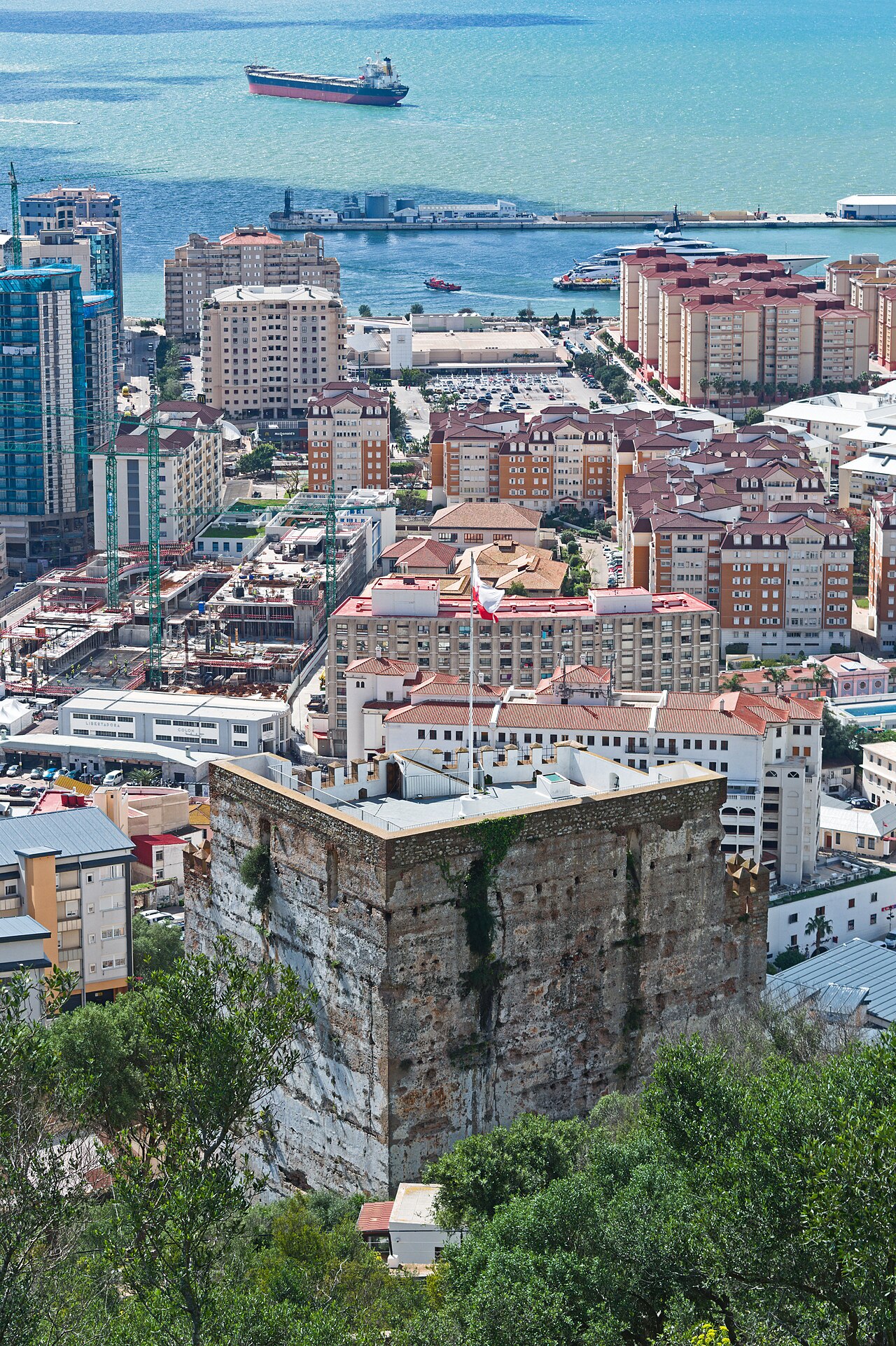
Casemates Square and King’s Bastion also connect military architecture to places used by the civilian community. Choosing a monument is more than adding decoration: it selects episodes that the issuer wishes to make familiar. A banknote becomes a small journey through collective memory, encountered whenever it is handled. The photograph of the castle shows the actual place behind the 2011 £5 design, rather than reproducing the protected banknote.
| Value | Introduction | Reverse motif |
|---|---|---|
| £5 | 2011 | Moorish Castle |
| £10 | 2010 | Great Siege, General Eliott |
| £20 | 2011 | HMS Victory after Trafalgar |
| £50 | 2010 | Casemates Square |
| £100 | 2011 | King’s Bastion |
Ymblanter · CC BY-SA 4.0 · Licence

Government of Gibraltar — Know Your New Gibraltar Banknotes (2011)
From design to banknote: security and accessibility
An attractive image alone does not make a banknote. The launch material explains raised printing, watermarks, security threads and elements that form a complete design when viewed against the light. Different sizes, large numerals and tactile marks also help users distinguish denominations. Manufacture serves two needs at once: making genuine notes recognisable and making counterfeiting harder.
On 1 December 2021 the government introduced a new £5 note printed by De La Rue. It retained Elizabeth II on the front, while the Windsor Suspension Bridge replaced the castle on the back. The change went beyond the illustration: the announcement specified a slightly smaller format and new security features.
The B/AA prefix distinguishes this issue from the withdrawn A/AA notes. The announcement provided for the older notes to cease being legal tender after January 2022 while remaining redeemable at the Treasury. A portrait and denomination are consequently insufficient to identify a note precisely. Date, series and sometimes the serial-number prefix also matter. The bridge photograph illustrates the real structure selected for the new design; it is not a photograph of the banknote itself.

Rockysantos · CC BY-SA 4.0 · Licence

Government of Gibraltar — Know Your New Gibraltar Banknotes (2011) · Government of Gibraltar — New £5 note, 1 December 2021
Mints, keepsakes and changing portraits
A “Gibraltar coin” is identified by its issuing authority; it need not have been manufactured on the Rock. The Royal Mint produced the nineteenth-century coppers. In the contemporary system, Gibraltar National Mint is an organisation managed through the Treasury, while partner workshops can undertake the physical striking.
The 2020 Christmas coin announcement places a striking in London. The February 2025 report from the Berlin World Money Show mentions Gibraltar National Mint and Tower Mint alongside the launch of new Charles III coinage. It announces Gibraltar’s first twelve-sided pound, dated 2024, with collector presentations available from April 2025.
The gap between the date on a coin and its public presentation is instructive: the year impressed on the metal need not be the year in which a buyer encounters it. Similarly, commemorative packaging, a limited edition or a precious metal does not by itself reveal how many pieces enter everyday payments. A history of currency should make room for collecting without treating the collectors’ market as identical to ordinary circulation. Issuer, manufacturer, denomination, date and intended audience each tell a different part of the story.
Government of Gibraltar — 2020 Christmas Coin Minted · Government of Gibraltar — Berlin World Money Show, 14 February 2025 · Gibraltar Coinage Act 1990 · Gibraltar National Mint — About us
One pound, several identities
Gibraltar’s distinctive achievement lies less in breaking away from sterling than in giving it a local face. A medieval castle, the Great Siege, a town square and a modern bridge can share the same language of pounds and pence. Through these choices, the government puts a selection of the territory’s history and landscape into circulation.
Three ideas must remain separate: equal value, legal tender and commercial acceptance. The Tourist Board states that local government notes and coins are legal tender in Gibraltar and that British cash is also welcome. This does not establish that Gibraltar notes automatically have legal-tender status in the United Kingdom, or that a merchant anywhere is obliged to accept them.
Proximity to Spain helps explain the use of euros, but does not make the system “bimetallic”. Historically, bimetallism means a monetary standard based on two metals, rather than the commercial coexistence of two currencies. The Rock’s history instead shows how a small community can retain its own physical money within a wider monetary framework. From Keeling’s tokens to changing royal portraits, the relationship between trust, practical use and local representation is what gives this currency its particular interest.
Gibraltar Philatelic Bureau — Banknotes · Gibraltar Tourist Board — General information
Sources and credits
Research checked on 15 October 2026. The references below document the narrative; detailed image credits are also preserved in the local manifest.
- Gibraltar National Museum — Fortifications
- Ministry for Heritage — Timelines
- Gibraltar National Mint — Early Gibraltar Coinage
- Royal Museums Greenwich — Quart token, MEC2012
- U.S. Department of Commerce — Foreign Currency and Exchange (1930), Gibraltar
- Gibraltar Philatelic Bureau — Banknotes
- Royal Mint Museum — A history of decimalisation
- Government of Gibraltar — 2020 Christmas Coin Minted
- Government of Gibraltar — Know Your New Gibraltar Banknotes (2011)
- Government of Gibraltar — New £5 note, 1 December 2021
- Government of Gibraltar — Berlin World Money Show, 14 February 2025
- Currency Notes Act 2011
- Gibraltar Audit Office — Annual Accounts 2010–11, §2.7
- Gibraltar Coinage Act 1990
- Gibraltar National Mint — About us
- Gibraltar Tourist Board — General information