In 1899, paper promised relief from cumbersome silver payments. In 2025, a transparent window took the shape of a penguin. Between those two changes, the currency of an island community tells a story of resourcefulness, continuity and memory.
History and numismatics · Research cut-off: 15 October 2026.
- c. 1829Vernet’s peso vouchers
- 1899Regular government banknotes begin
- 1971 / 1974Decimalisation, then local coins
- 2025 / 2026Polymer and the renewal of cash
01 / MONETARY HISTORYBefore the pound: Atlantic sea routes
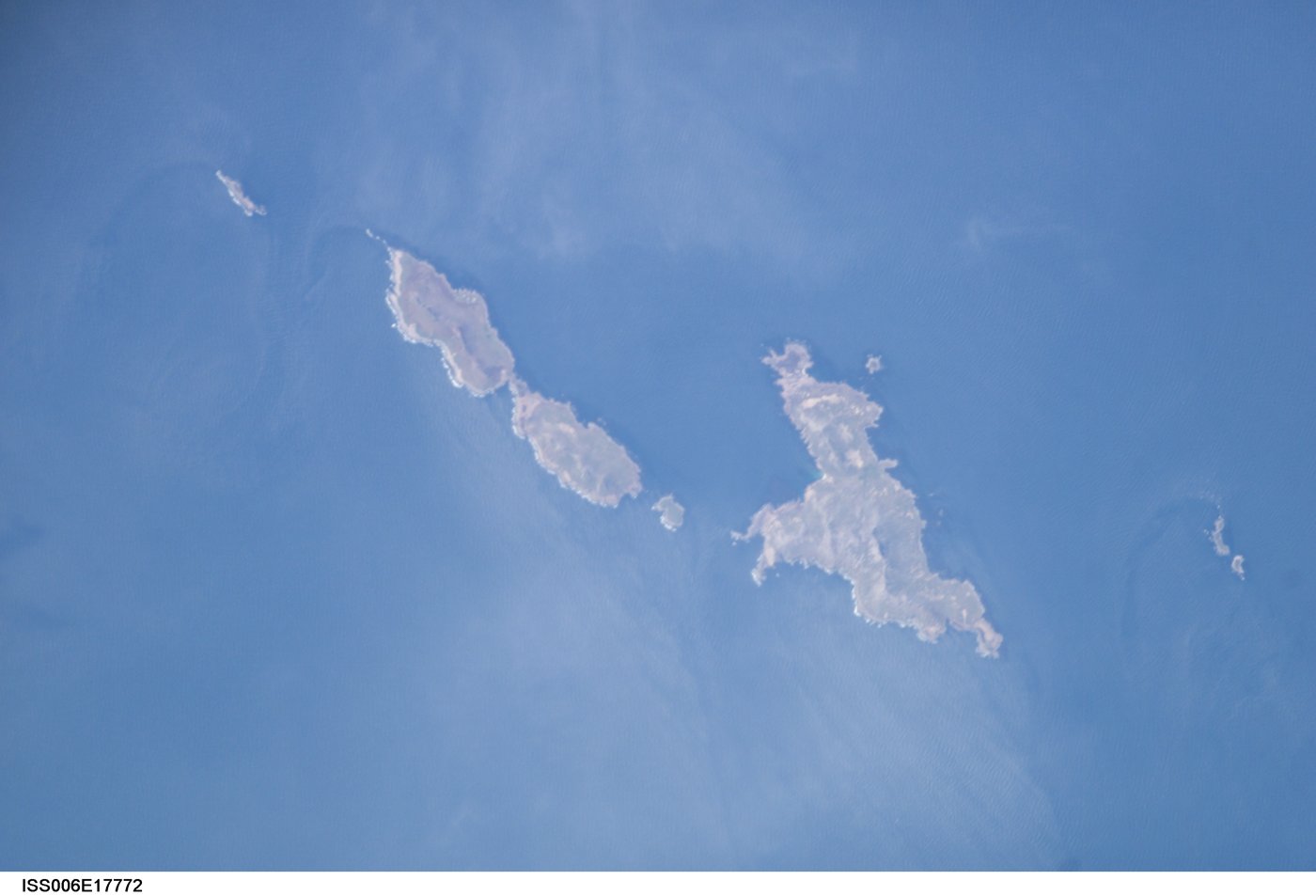
In the South Atlantic, money often began its journey aboard a ship. A crew bought provisions, a merchant paid for a cargo and an administrator waited for a consignment of cash. The same coin could serve different purposes as it moved between ports. The monetary history of the Falklands belongs to that world of sea passages, long before banknotes carried the islands’ name.
The French settlement at Port Louis in 1764 and the British settlement at Port Egmont in 1765 preceded Spanish administration at Port Louis. France transferred its settlement to Spain in 1767; Britain withdrew from Port Egmont in 1774. These were small settlements dependent on shipping, rather than a neat sequence of national currency systems of the kind a modern map might suggest.
The islands’ names also preserve this maritime history. French uses îles Malouines, recalling seafarers from Saint-Malo; English uses Falkland Islands and Spanish Islas Malvinas. The islands are administered by the United Kingdom, while Argentina claims sovereignty. The United Nations identifies this as a sovereignty dispute. Following the money means describing the objects, their users and the institutions that issued them, without treating a banknote as an adjudication of that dispute.

02 / MONETARY HISTORYAround 1829: Luis Vernet’s promise
Before local pounds came paper denominated in pesos. Luis Vernet’s settlement at Port Louis/Puerto Luis used vouchers to support provisioning and local exchange. The historical and numismatic museum of Argentina’s central bank reproduces examples in its study of Patagonia; the collection record for the ten-peso voucher shown here places it at about 1829.
These were vouchers associated with a settlement and an issuer, rather than modern central-bank notes. Their appeal lies in that closeness. Lettering, signatures and the promise to honour a payment make visible the credit attached to a person and a business. Paper could help transactions continue when metal currency was scarce, provided its recipient could spend it again or have the promise fulfilled.
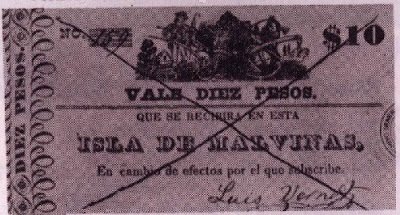

The surviving documents prevent the story from beginning abruptly in either 1833 or 1899. Local paper money existed before both dates, but these vouchers were not the first Falkland pound series. Denomination, issuing authority and purpose matter: a peso voucher should not be described as an early FKP note simply because it was used in the same islands.
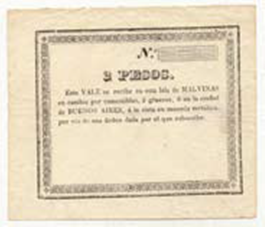
Looking at several denominations is also useful. It reveals a family of payment instruments rather than an isolated curiosity. The small two-peso image below records another value, although its limited resolution makes close reading impractical.

Documentary references: [3].
03 / MONETARY HISTORY1833–1890: sterling accounts, whatever coins arrived
The establishment of British administration in 1833 did not replace earlier payment practices overnight. Robert Chalmers, a British Treasury official writing in 1893, described silver dollars and gold doubloons brought from Rio de Janeiro or received from ships. Accounts could be expressed in sterling even when payment involved coins from elsewhere.
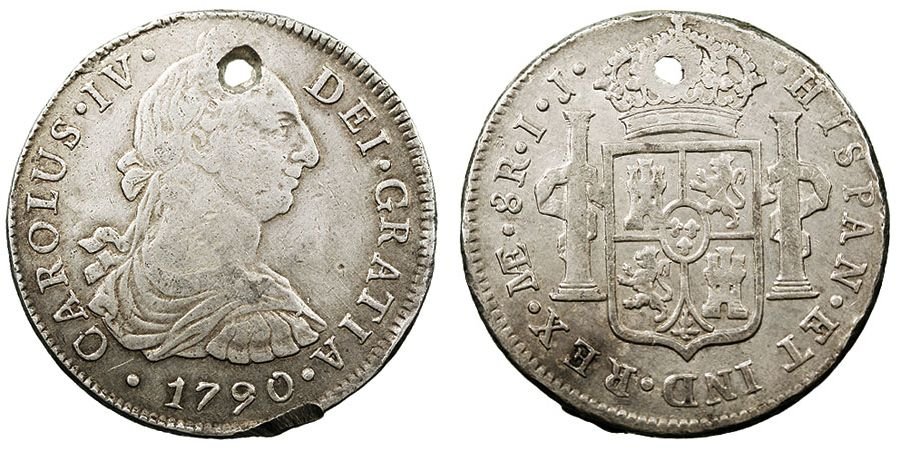

A shortage of specie drove Governor Richard Moody to an emergency solution. Chalmers records that in 1844 he issued temporary paper, mainly in dollar denominations, amounting to £1,000 in the accounts. The handwritten notes allowed government payments to continue. Their withdrawal was envisaged when fresh coin arrived: this was an expedient, rather than the regular issue established in 1899.
British coins became more firmly established around the middle of the century. Shipping cash to the islands was only part of the problem, however. Keeping it there mattered too. Gold might be hoarded or carried to the mainland while silver and bronze remained in local tills. A currency shipment could arrive in apparent abundance and still fail to provide a lasting supply of everyday change.
These were practical questions: paying wages, making change and buying provisions. Distance was measured in the wait for a bag of coins as well as nautical miles. Chalmers wrote from within the colonial administration of his time. His monetary observations are valuable evidence, while his terminology and assumptions require historical context.
Documentary references: [4].
04 / MONETARY HISTORY1899: government paper enters regular circulation
16 October 1899 marks the decisive beginning of regular government note issue. The Currency Note Order came into operation and the government released its own notes. The register summarised by the National Archives records one hundred £5 notes and five hundred £1 notes in that first year, together worth £1,000.
The 1899 colonial report explains why: silver payments were cumbersome and gold circulated little. Government paper, redeemable in specie at the Treasury, was readily accepted for goods and services. What changed was the physical means of payment and its backing arrangements, with the pound continuing as the unit of reference.
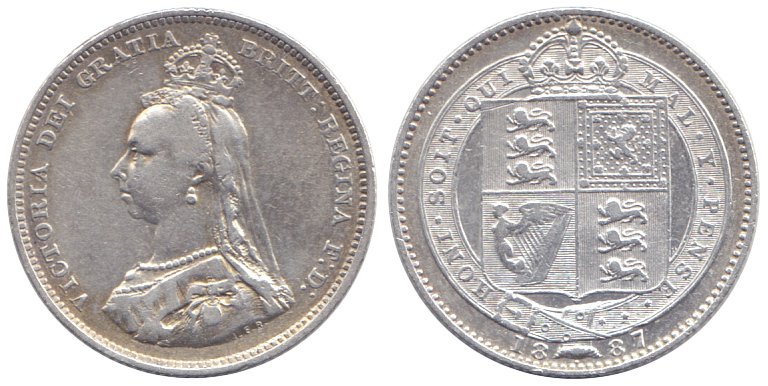

Reading older accounts takes a moment’s adjustment. One pound contained twenty shillings; a shilling contained twelve old pence. There were therefore 240 pence to the pound. Five shillings represented a quarter of a pound and ten shillings half a pound. Decimal currency still lay decades ahead.
The serial-number registers reveal another side of a note’s life. They track issue, circulation and withdrawal. A printed date is not automatically the day a particular piece of paper left the reserve. For a collector, date, signature and serial number work together as evidence, rather than merely decorating a design.
The backing arrangements also left a paper trail. The Gazette of 1909 lists metal holdings and investments in the note guarantee fund. Behind the promise printed on a note stood a continuing administrative task: accounting for the assets supporting it.
Twentieth-century portraits and guilloches
One-pound notes dated 1921 introduce the George V portrait series; the 1938 issue depicts George VI. Their guilloche reverses underline the role of security engraving: regular interlacing patterns complicated copying while framing the denomination. The five-pound notes of 1960 depict Elizabeth II, before the later landscape compositions.
A curiosity accompanies decimalisation. A fifty-pence note already carries the date 25 September 1969, with another issue dated 20 February 1974. Its value corresponds to the old half-pound. The first type’s printed date thus precedes decimalisation in 1971: a date on an object cannot, by itself, date an entire monetary reform.
Documentary references: [5], [6], [7], [28], [29], [30], [31].
05 / MONETARY HISTORY1971–1974: a hundred pence and an engraved wildlife survey
Decimalisation in 1971 retained the pound but changed its subdivision to one hundred new pence. Half a pound was therefore 50p. A conversion looks straightforward in a table; at a counter or in a ledger it required people to read prices differently and distinguish old pence from new.
| Old value | Fraction of a pound | Decimal equivalent |
|---|---|---|
| 1 shilling | 1/20 | 5p |
| 2 shillings | 1/10 | 10p |
| 10 shillings | 1/2 | 50p |
| 20 shillings | 1 pound | £1 |
The islands acquired their own decimal coins in 1974. The proclamation published on 31 December specified metals, denominations and designs. Bronze coins showed a trout on the halfpenny, two penguins on the penny and a goose on the twopence. The cupro-nickel fivepence carried a flying albatross and the tenpence sea lions. The same proclamation provided for gold coins, so the programme extended beyond the five small everyday denominations.
The first coins were made by the Royal Mint. On the 1974 penny, Arnold Machin’s portrait of Elizabeth II accompanies William Maving Gardner’s penguin reverse. The monarch identifies the authority behind the money; the animals locate it in a particular landscape. Small change becomes a wildlife survey that can be held in the palm of a hand.
06 / MONETARY HISTORY1982: institutions under the pressure of war
Argentine forces took control of the islands on 2 April 1982. Britain sent a naval task force; the fighting ended at Stanley on 14 June with the surrender of Argentine forces. The war left lasting memories among islanders and the families of those who died on both sides.
Money offers a view of these events from the counter rather than the battlefield. Harold Theodore Rowlands had joined the Treasury in 1948 and become Financial Secretary in 1972. He was a senior local official who remained in the islands. His biography by Harold Briley describes his work keeping the savings bank operating and resisting Argentine access to its vaults. His signature had appeared on the notes since 1974.
A signed banknote thus becomes less anonymous. It points to a person responsible for deposits, records and the continuity of payments. That human connection helps explain attachment to local currency beyond its use as a symbol of public authority.
The chronology remains essential. The war created neither the 1899 note issue nor the 1974 coinage. Local pounds already had a substantial history. Commemoration could add new meanings to coins and notes after the fighting, while their original purpose remained the familiar business of payment.
07 / MONETARY HISTORYA currency board behind the parity
The arrangement rests on an easily understood relationship: the Falkland Islands pound has the same nominal value as sterling. The government states that its currency issue is fully backed by realisable sterling assets. Locally distinctive money can therefore draw on an external monetary anchor.
The Currency Ordinance 1987 provides the legal framework. A note in the consolidated text explains that commencement of the coinage provisions required rectification in 1989, taking effect on 31 January 1990. This legal transition should be distinguished from the first issues. Manufacturing an object, releasing it and defining its legal status are not necessarily simultaneous events.
The Commissioners of Currency issue money on behalf of the government. They are distinct from the banknote printer, the mint and commercial banks. Those roles matter: a manufacturer makes the physical object, the public authority issues it and its users put it to work.
Sterling cash is accepted in local practice, without merging the two issues into a single currency. The Royal Mint explains that Overseas Territory coins are legal tender in the territory concerned, but do not automatically have that status in the United Kingdom.
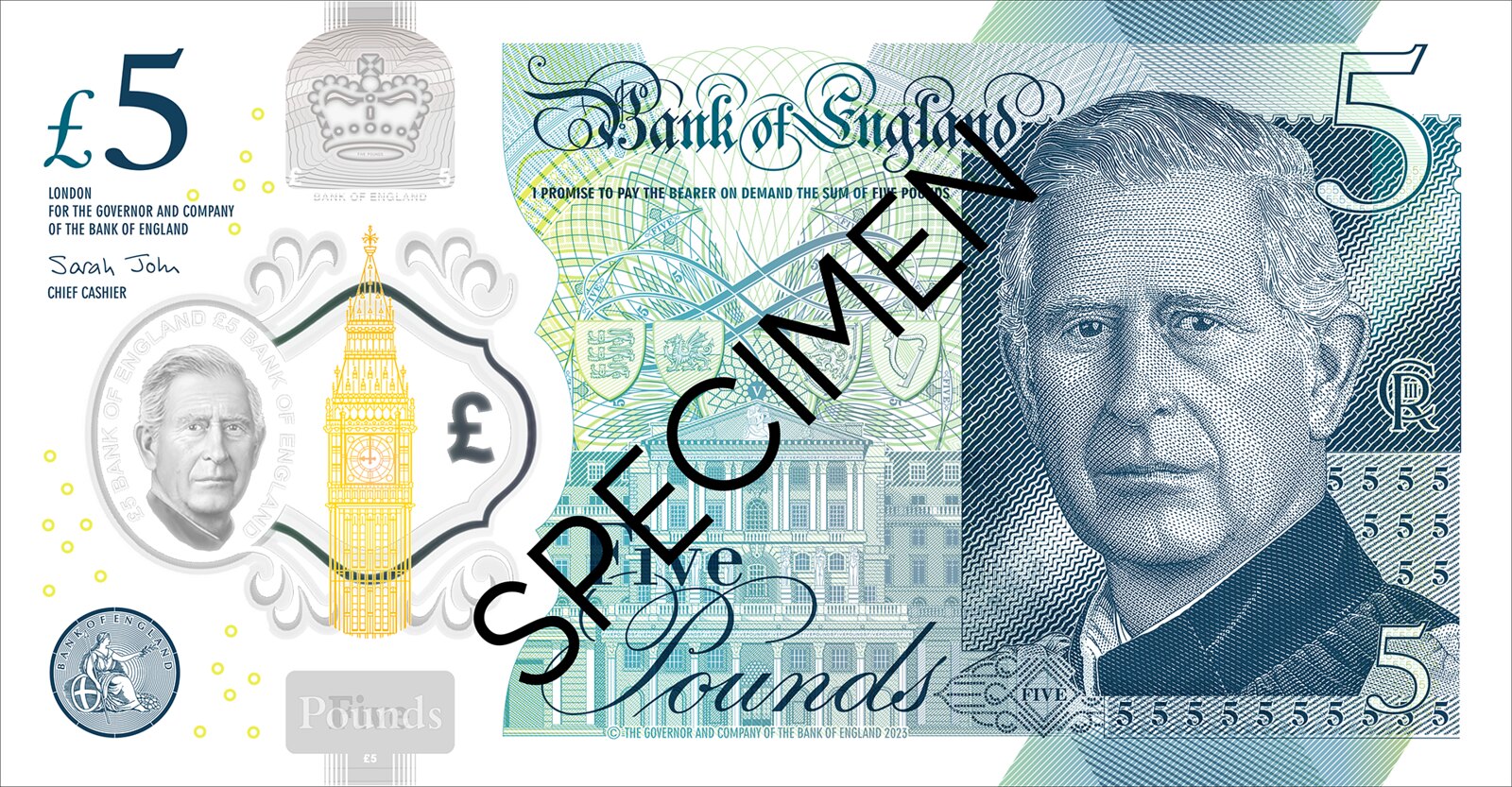
In this comparison image, the wording Bank of England identifies the sterling issuer. FKP notes identify their own government authority: equal face values and the same monarch are insufficient to identify a currency issue.
08 / MONETARY HISTORYCirculating coins, commemoratives and their makers
The wildlife vocabulary grew to include sheep, the extinct warrah, the islands’ coat of arms and a map of the archipelago. Each motif opens a different part of local history: farming, natural history, navigation or geography. Coin relief demands economy. A design succeeds when its subject remains recognisable on a small surface gradually worn by handling.
Attributing all Falklands coinage to a single manufacturer would be misleading. The Royal Mint produced the first series, while later regulations name Pobjoy Mint for particular issues. The 2018 regulations, for example, specify a series of 50p coins with penguin heads; the 2020 regulations describe, among other pieces, a one-pound coat-of-arms coin using a Pobjoy effigy.
Collectors also need to read commercial terminology carefully. Face value alone is insufficient. A cupro-nickel piece intended for payments, a specially finished version and a precious-metal striking can serve very different markets. Regulations record composition, diameter, weight, shape and sometimes issue limits. These details, together with a specimen’s actual condition, support reliable identification.
Collector issues can extend the islands’ visual history without representing the contents of everyday purses. A series prominent in dealers’ catalogues is not necessarily what people handle most often in Stanley. Distinguishing an authorised design, a manufactured object and a piece encountered in circulation is part of the pleasure and discipline of numismatics.
09 / MONETARY HISTORYRoyal portraits and the landscape of paper money
A banknote gives a designer more space than a coin, but portrait, security features, denomination and local imagery still have to share it. Users need to recognise the value quickly, while visual storytelling must coexist with protection against counterfeiting.
The later twentieth-century paper family brought together Elizabeth II, the islands’ map and coat of arms, wildlife and Stanley buildings. Christ Church Cathedral and Government House were among its landmarks. Denominations followed related compositions, distinguished by their numbers and colours. The family resemblance let a user recognise local money first and a particular value next.
Colour aids recognition without replacing the need to read the denomination. Format, date and signature carry further information. A series may evolve through fresh printings or changes of signatory before a complete redesign. Treating the design date, printed date and manufacturing date as interchangeable would erase much of that history.
Polymer would bring another chapter, but earlier paper retains a particular heritage value. It preserves an image of Stanley as a port capital whose familiar buildings became shared landmarks throughout the islands through their repeated appearance on everyday notes.
Documentary references: [13], [25].
Recent notes are described from issue documents. Reproductions are omitted where rights to both the image and the currency design could not be established; the wildlife photographs below help explain their subjects.
10 / MONETARY HISTORY2025: Charles III, penguins and a transparent window
The banknote renewal answered a production need: replenishing stocks and providing a family suited to a long period of use. The paper submitted to Executive Council in June 2024 proposed commissioning De La Rue to produce polymer £5, £10 and £20 notes. Design selection, portrait approval and security requirements all formed part of the preparation.
The new family entered circulation on Falklands Day, 14 August 2025. De La Rue announced its SAFEGUARD substrate. Charles III appears on the front; black-browed albatrosses, penguins, the pale maiden flower and Steeple Jason provide the local visual narrative. The portrait expresses institutional continuity while the wildlife and landscape locate the notes firmly in the islands.


The move to polymer also changes the way a note is viewed. Transparency becomes part of the design: a king-penguin window contributes to recognition. Instead of placing every image on an opaque sheet, the note uses the material’s properties as both a security feature and a compositional element.


Production nevertheless encountered a regulatory problem. An October 2025 Executive Council paper identified discrepancies between the printed wording and placement of serial numbers and the requirements of the regulations, and put forward a validation bill. The episode shows the precision required: a seemingly small graphic alteration can call for a change to the written framework. It should not be presented as a collapse of the currency or a failure of its sterling parity.
On 30 October 2025, the Legislative Assembly passed the Currency Notes Validation Bill 2025 to recognise retrospectively the lawful issue and legal-tender status of the £5, £10 and £20 notes issued on 14 August. The record also states that the regulations had been amended to prevent such discrepancies. Official record, pp. 81–82
11 / MONETARY HISTORY2025–2026: withdrawing cash, preserving its history
Modernisation also reached the smallest coins. Following consultation and an Executive Council decision, 1p and 2p coins were withdrawn from 1 January 2025. Manufacturing cost, the supply of blanks and the rate at which these coins were disappearing from payments had prompted a reassessment of their usefulness.
The Treasury accompanied the transition with a voluntary convention for rounding cash payments. Rounding a transaction total does not change the currency unit or individually reprice every item. Prices can still be expressed in pence; the convention concerns the final amount paid in cash.
Another transition followed the introduction of polymer. The official announcement of 4 December 2025 specified that older paper £5, £10 and £20 notes would cease to be legal tender from 30 April 2026. It retained the paper £50 note and provided for exchange of the old smaller denominations at the Treasury. Withdrawal from ordinary payments should therefore not be confused with the immediate loss of every redemption route.
| Denomination | Material / portrait | Position |
|---|---|---|
| £5, £10, £20 | Polymer, Charles III | New family introduced in August 2025 |
| Older £5, £10, £20 | Paper, Elizabeth II | Legal-tender withdrawal in April 2026; Treasury exchange announced |
| £50 | Paper, Elizabeth II | Retained alongside the polymer family |
This coexistence reflects the rhythm of a small currency issue. A change of monarch need not replace every physical form at the same moment. History also survives in what remains: an earlier portrait, adequate stocks and a denomination that continues while its companions are renewed.
12 / MONETARY HISTORYWhat a small monetary object can reveal
The Falkland Islands pound brings together histories that began at different times: maritime exchange, local credit vouchers, government banknotes and a distinctive coinage. Describing it only as a pound linked to sterling would lose the objects and people that gave the system its character.
A specimen can be read in a simple sequence. Start with issuer and denomination; then identify monarch, date and any signature; finally examine metal or substrate, relief, wear and imagery. Comparison becomes an investigation. What initially looks unchanged across a series can reveal a different technique, purpose or moment in its history.
A dollar brought by ship, a Vernet voucher and a wildlife coin do not embody the same promise. The first belongs to trade between ports and the value attached to precious metal; the second depends on a settlement and its credit; government issues rely on institutional backing. Polymer adds another technology to that long history of confidence in payment.
At this scale, a penguin is more than an attractive picture. It becomes a familiar sign handed over in change, recognised on a note and sometimes kept long after withdrawal. A small territory’s currency can hold a remarkably substantial history.
Sources and credits
Dates are checked against institutions, archives and issue documents. British and Argentine publications are read in context; their sovereignty positions are not adopted as editorial conclusions. The government’s general Currency page retains an inventory predating some withdrawals: dated 2024–2026 notices take precedence for recent transitions.
- Nations unies — Falkland Islands (Malvinas), statut et différend / UN: status and sovereignty dispute
- Nations unies — A/AC.109/L.98/Add.2, repères historiques, p. 19 / historical background
- BCRA, musée historique et numismatique — Numismática de la Patagonia Argentina (2007), p. 18–20 : bons de Vernet / Vernet vouchers
- Robert Chalmers — A History of Currency in the British Colonies (1893), chap. XI, p. 147–149, document ancien du domaine public / historical public-domain work
- Jane Cameron National Archives — Treasury, premier registre des émissions / first issue records
- Colonial Annual Report 1899, rubrique Currency, p. 7 du rapport / Currency section
- Falkland Islands Gazette 1909, 1er février, p. 37 : Note Guarantee Fund / backing assets
- Falkland Islands Gazette, 31 décembre 1974, p. 97–98 : proclamation du monnayage / coinage proclamation
- Numista — 1 penny, portrait d’Arnold Machin, revers de William Gardner / portrait and reverse attribution
- Royal Navy Museums — Falklands Conflict Exhibition, repères de 1982 / 1982 chronology
- Dictionary of Falklands Biography — Harold Theodore Rowlands, par Harold Briley / by Harold Briley
- Currency Ordinance 1987, consolidation du 24 juillet 2025 : ss. 3–6, 10, 12–20 ; note de rectification 1989 / consolidated text and 1989 rectification note
- Falkland Islands Government — Currency, inventaire iconographique historique / currency arrangements and historical design inventory
- Currency (Commemorative Coins) Regulations 2020 : pièce de £1 et rôle de Pobjoy / £1 design and Pobjoy involvement
- Currency (Commemorative Coins) (No 3) Regulations 2018 : 50p Penguin Series / penguin coin specifications
- Royal Mint — Coinage from United Kingdom Overseas Territories, cours légal / legal tender
- Executive Council — Paper 123/24, Falkland Islands New Banknotes, 25 juin 2024 / new banknote procurement
- Executive Council — suivi de conception : date imprimée du 14 août 2025 / design progress and printed issue date
- De La Rue — annonce de la famille SAFEGUARD, 2025 / manufacturer’s announcement
- Executive Council — Paper 205/25, Currency Notes Validation Bill 2025 : écarts de conformité / design compliance discrepancies
- Falkland Islands Government — Withdrawal of Old Paper Banknotes from Circulation, 4 décembre 2025 / withdrawal notice
- Treasury — Rounding of Cash Transactions: Why? When? How?, retrait des 1p/2p et arrondi / low-value coins and rounding
- Executive Council — Minutes, 23 avril 2024, retrait des 1p/2p / withdrawal decision
- Legislative Assembly — Budget meeting, 16 juillet 2025, p. 8, retrait effectué et introduction des billets / completed coin withdrawal and new notes
- Numista — £10 papier de 1986, identification des motifs / 1986 £10 note design identification
- Falklands Radio — Falklands debuts new banknotes design, 9 janvier 2025 : fenêtre et iconographie / window and imagery
- Bank of England — Using images of banknotes, autorisation conditionnelle et bibliothèque officielle / conditional permission and official image library
- Numista — £1 George V, 1921–1932 / George V note
- Numista — £1 George VI, 1938 / George VI note
- Numista — £5 Elizabeth II, 1960–1975 / Elizabeth II note
- Numista — 50 pence, dates portées 1969 et 1974 / printed dates
Local illustrations
All eight illustrations are stored locally in assets/. Each figure supplies a credit and source; the manifest records licences, files and modifications. Comparison coins are not presented as specimens known to have circulated in the islands.