01 — One island, many kinds of money
For generations, a French coin and a British coin could meet on a St Peter Port shop counter without belonging to the same accounting system. That is where Guernsey’s monetary story begins: trade crossed the Channel, while ways of reckoning prices passed from one generation to the next.
Guernsey belongs to the Anglo-Norman world. It is a Crown Dependency with its own institutions, outside the United Kingdom. That constitutional position helps explain why its cash has distinctive names and imagery. Yet the island never lived in a closed monetary world: money arriving from France, England and other trading countries circulated together.
The Priaulx Library preserves William Berry’s account, published in 1815, of contracts and accounts still expressed in livres, sols and deniers tournois. A livre was therefore a way of measuring a sum as well as a word associated with money. The library also records the older “freluques” mentioned in Royal Court orders. Local small money existed centuries before the States began issuing notes, although the precise identification of these early pieces remains debated.
Almanac conversion tables mattered because a familiar denomination did not guarantee a fixed metal content or the same monetary standing everywhere. To understand an old price, the reader needs its date, the money involved and the accounting unit. Translating every historical livre as “pound sterling” would erase the very distinctions that made island commerce possible.
Evidence: Priaulx Library, Guernsey Currency and Coins.
02 — 1816: paying for works, planning repayment
After the Napoleonic Wars, the States faced public improvements with limited financial resources. The practical problem was how to pay people working on the island’s roads and other projects when revenue did not arrive at the same time as expenditure. Publicly issued notes became one answer.
Two decisions must be kept apart. In March 1816, a proposal to issue up to £6,000 in notes for a market scheme was rejected. On 17 October, the States authorised 4,000 one-pound notes for the works then contemplated, with repayment dates spread across 1817 and 1818. The surviving-note catalogue records examples dated from December 1816. The date of an authorising vote is not necessarily the date written on an individual note.
The signatures of Nicolas Maingy, Jean Lukis and Daniel de Lisle connected these papers to people accountable to the States. Numbering, registration and the cancellation of redeemed notes were part of the arrangement. A monetary document is more than its printed design: it is also an organised process for establishing trust.
Documents: J. Theodore Harris, An Example of Communal Currency, 1911, chapters II–III; catalogue of the earliest issues.
03 — The 1822 market: paper becomes a building
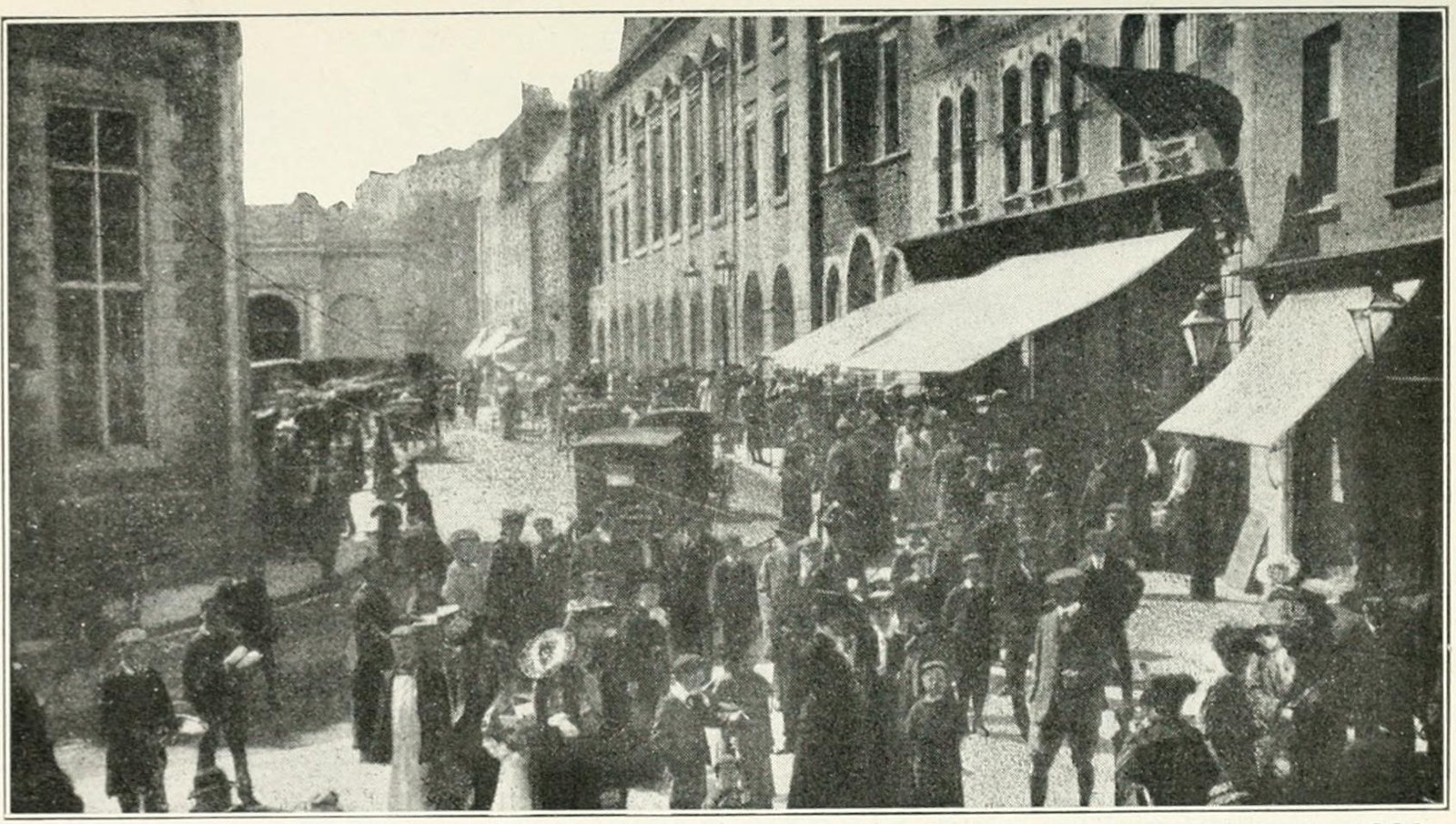
St Peter Port’s market makes it possible to follow a financial instrument into a public building. Before the improvements, crowding and inadequate shelter made life difficult for buyers and sellers. Rebuilding the market was about the conditions of everyday trade as much as the appearance of the town.
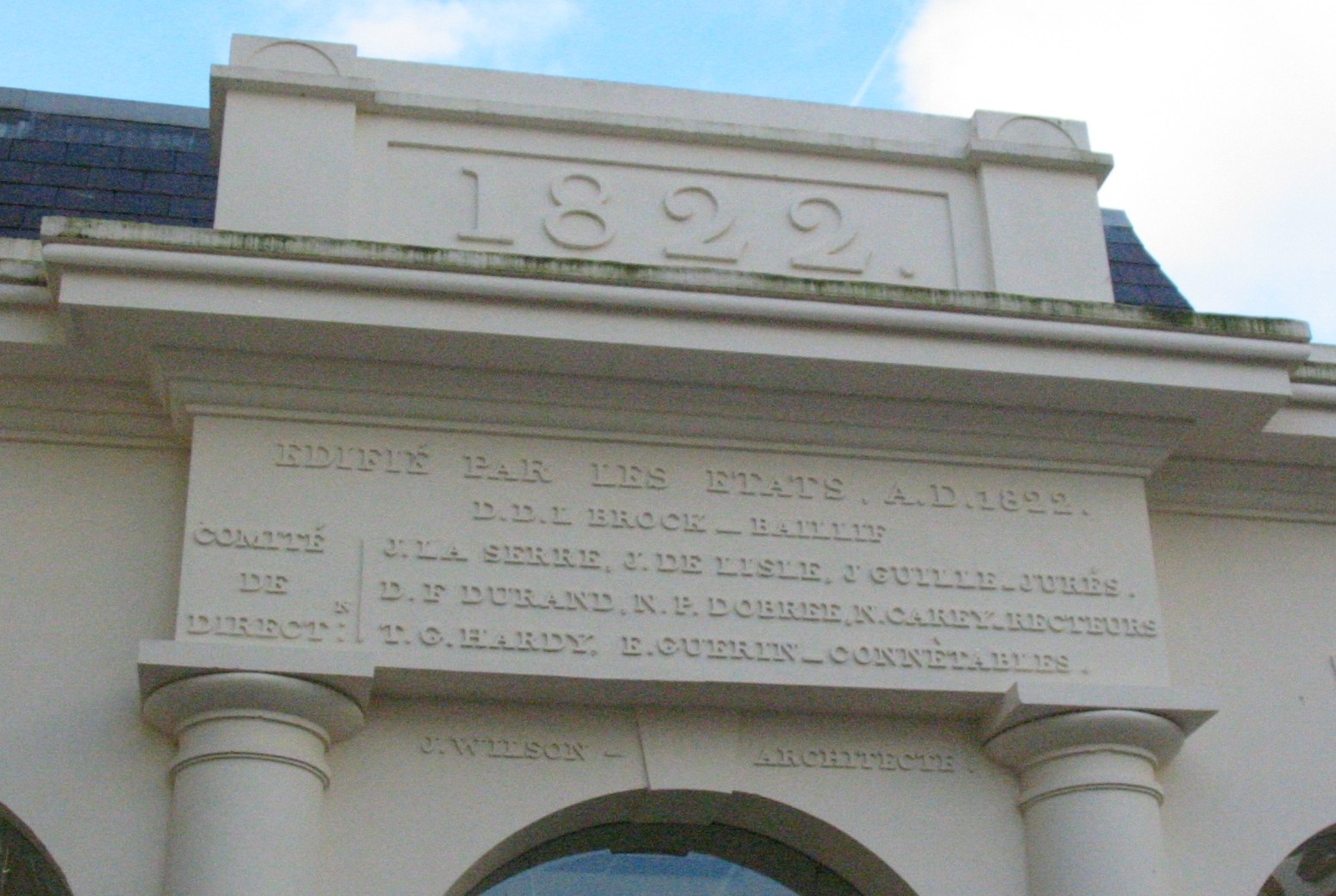
The scheme approved in May 1820 budgeted £5,500 for construction: £1,000 in anticipated resources and £4,500 in twenty-shilling notes. Income from the stalls was combined with a States contribution to withdraw notes over time. Completed in 1822, the market became the enduring symbol of the experiment.
Daniel de Lisle Brock, who became Bailiff in 1821, championed the States’ role in island affairs. His place in monetary history belongs within that wider public career. The British Museum holds a medal designed by Thomas Halliday in 1835 celebrating another of his achievements: defending the Channel Islands’ trading interests in London. His image on money is therefore a compressed account of a much broader institutional story.
A completed and useful market does not, by itself, establish that the note issues caused no increase in prices. Sidney Webb’s introduction to Harris’s 1911 book already drew attention to the lack of adequate evidence on that question. The experiment remains striking without being treated as universal proof that issuing money can solve every public-finance problem.

Reading: Harris, Sidney Webb’s introduction and chapter III; British Museum, Daniel de Lisle Brock medal.
04 — Doubles: French words cast in bronze
From 1830, coins of 1, 2, 4 and 8 doubles gave the island a regular small coinage. Their name recalls the French double denier, but a shared word does not establish an unchanging value between objects made centuries apart.
In the nineteenth-century franc-based system, 80 doubles equalled one franc and 8 doubles made a Guernsey penny. Twelve local pennies made a shilling and twenty shillings a pound, so that pound represented 24 francs. The accounting structure resembled Britain’s, while the two pounds were not then equal in value. This distinction is essential when reading old island records.
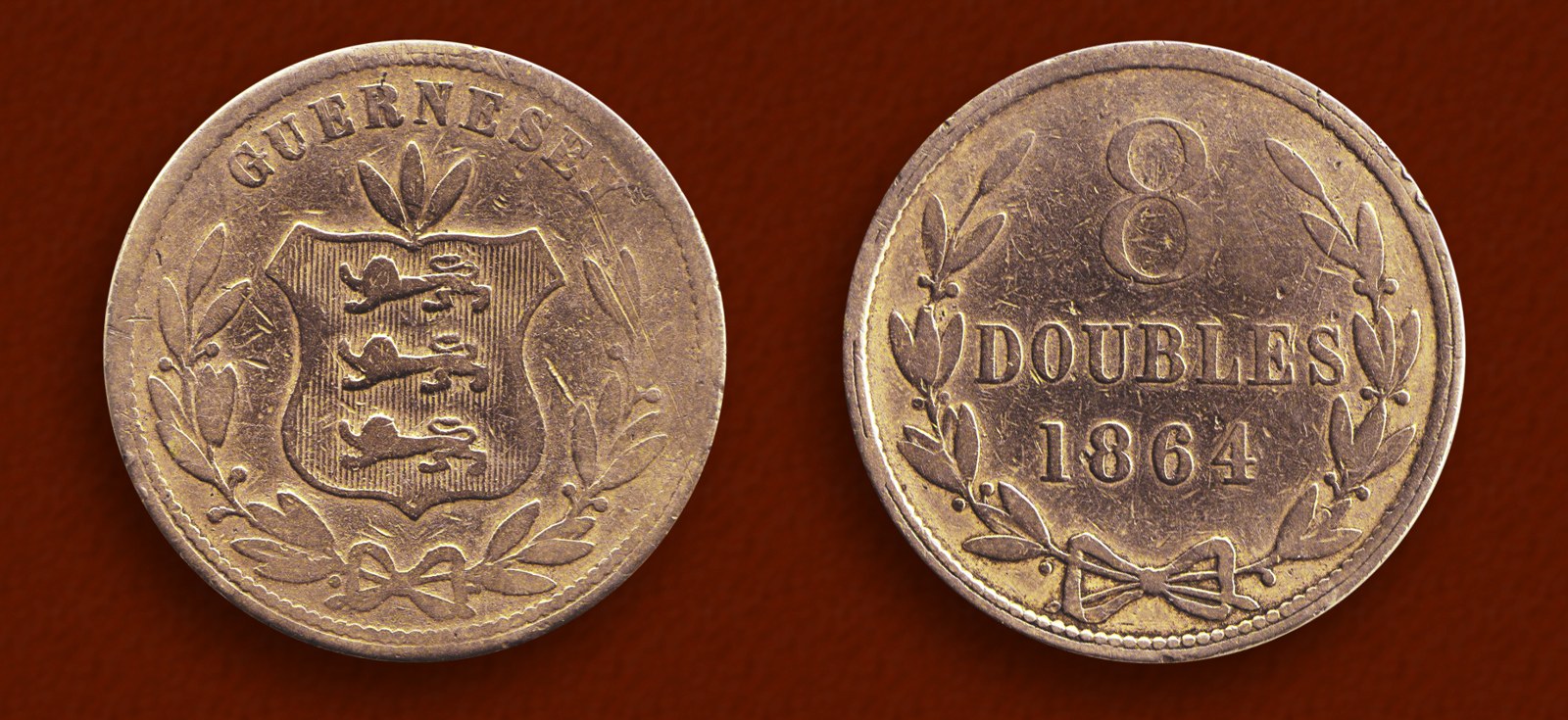

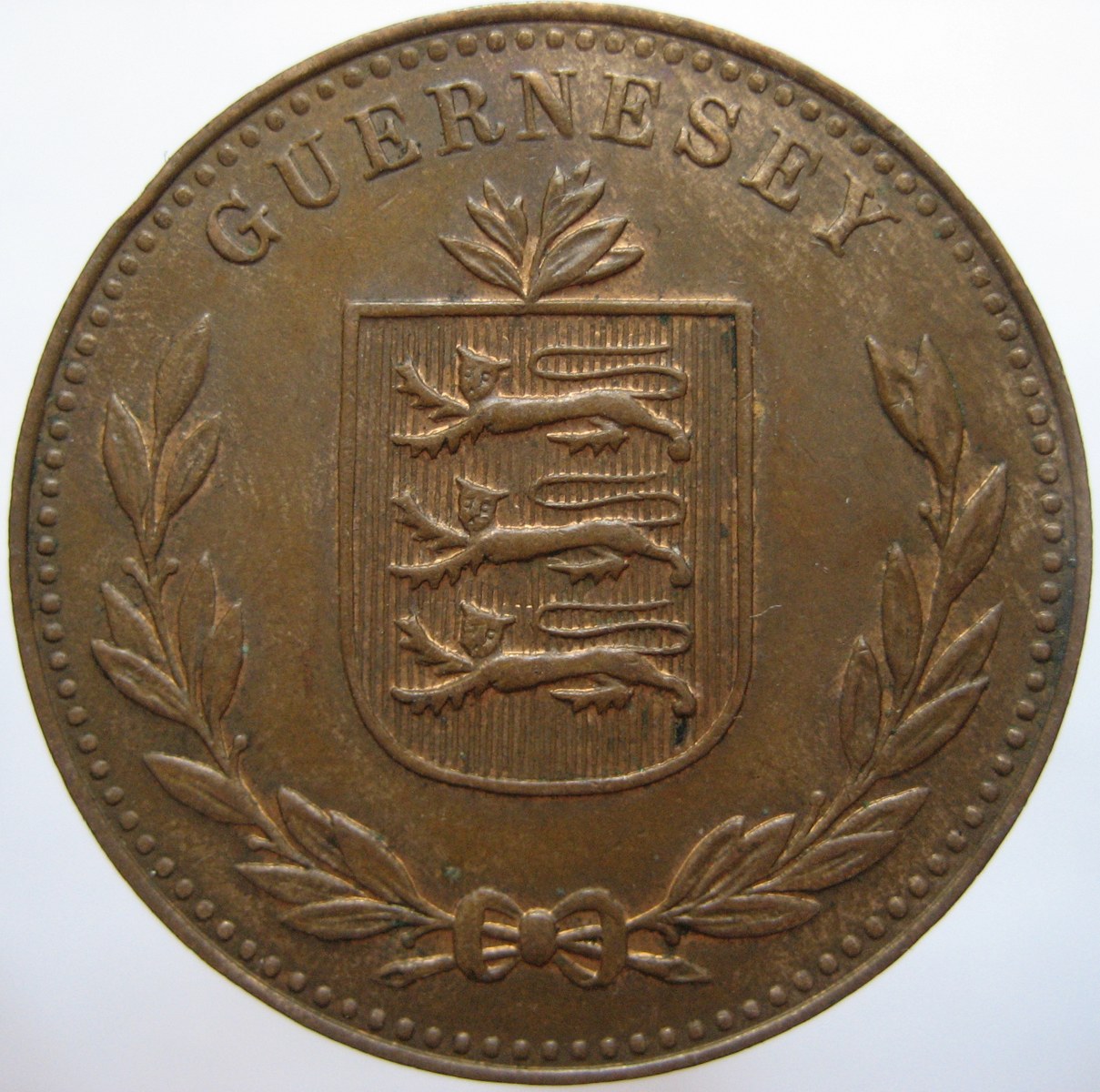
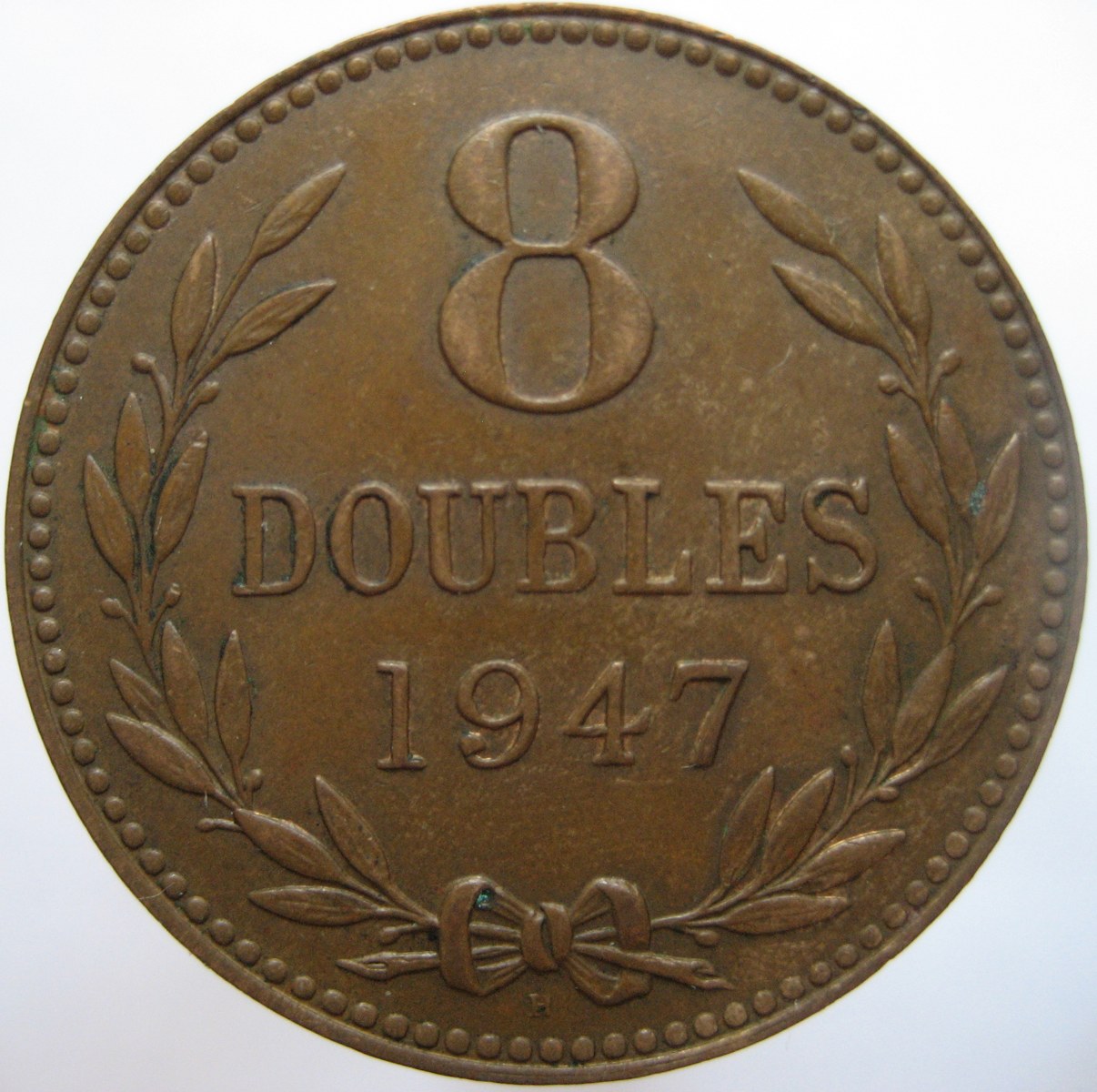
The 1864 coin displays a remarkably consistent identity: three lions on a shield, branches, the French spelling GUERNESEY, and a prominent denomination on the reverse. The absence of a royal portrait is noticeable. Local authority is expressed through arms and the island’s name, with clear lettering suited to money that would change hands repeatedly.
Where were the coins made?
Guernsey money was not necessarily struck in Guernsey. Nineteenth-century orders drew on the British minting industry. Museums Victoria attributes the 1830-dated four doubles to Boulton, Watt & Co.’s Soho Mint, and the 1864 eight doubles to Henry Jay & Co. in Birmingham. Attribution depends on the date and sometimes a mintmark; assigning every double to one manufacturer would be misleading. Overseas industrial manufacture and the island’s decision to issue coinage were separate functions.
A worn double is also evidence of use. Its surviving lettering may tell us more reliably about denomination and date than a polished modern illustration could. For this reason, the photographs here retain the objects’ surfaces, rather than attempting to restore them digitally to an imagined original appearance.
Evidence: accounts collected by the Priaulx Library; monetary chronology with references to States decisions; Museums Victoria, 1830 four doubles and 1864 eight doubles.
05 — Public notes and private banks
States notes tell only part of the nineteenth-century story. In 1827, merchants Thomas Priaulx, John Le Marchant and Hilary Rougier established the business that became Guernsey Banking Company. It drew and cashed bills on London and Paris, made advances and issued its own notes. After a rival opened in 1835, it was also known as the Old Bank.
For someone receiving payment, several different paper issues meant several issuers to recognise. A promise signed by a commercial bank and a promise made by the States did not bind the same institution. Names, signatures, numbers and payment terms therefore interest a historian as much as a banknote’s decorative engraving.
NatWest’s surviving archive includes note registers from 1847 to 1918 and a 1923 banknote pull. Such records place the issues within an actual banking business, with accounts, branches and customers. In 1924 the company was acquired by National Provincial & Union Bank of England. Island banking history was becoming part of the development of larger British networks.
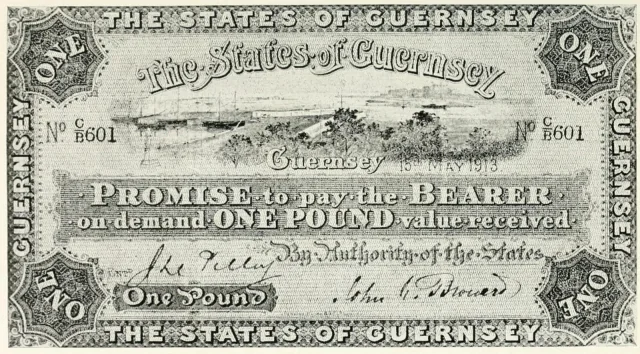
The States £1 note dated 15 May 1913 shown here comes from a plate published in 1915. Its harbour scene connects the promise to island commerce, while the English wording and signature identify the obligation. It illustrates the survival of public note issue almost a century after the first authorisations. It should never be passed off as a picture of an 1816 note.
Archives: NatWest Heritage Hub, Guernsey Banking Co Ltd; R. H. Howe, The Evolution of Banking, 1915, plate following page 64.
06 — 1921: adopting sterling, keeping the doubles
The First World War and the subsequent depreciation of the franc made the older monetary relationships harder to maintain. In 1921, Guernsey adopted sterling as its monetary basis. A local pound now belonged to the same unit as the British pound. The change did not abolish island institutions or bring local issues to an end.
Small change survived the transition: 8 doubles equalled one British penny. Coins with older designs could therefore continue in a system whose reference unit had changed. The 1947 piece makes that continuity visible. Its arms and language resemble nineteenth-century coinage, but its monetary setting is sterling.


| Period | Accounting structure | What matters |
|---|---|---|
| Nineteenth-century franc-based system | £1 = 20 shillings = 240 local pennies = 1,920 doubles | 24 francs; do not automatically read this as £1 sterling. |
| After 1921, before decimalisation | £1 sterling = 20 shillings = 240 pence; 8 doubles = 1 penny | The reference changed while some coins remained. |
| Since decimalisation in 1971 | £1 = 100 pence | The pound retained its value; its subdivision changed. |
Checks: Krus and Schuler, Guernsey entry and ordinance references; chronology of monetary changes.
07 — 1940–1945: small notes under occupation
The German occupation cut Guernsey off from its usual relationship with the United Kingdom. Cash circulation had to function under constraint, with difficult supplies of notes and coins and the presence of occupation money. The shortage of change explains paper denominations that can seem unusual today.
In 1941 the States issued, among others, notes for sixpence, one shilling and threepence, two shillings and sixpence, and five shillings. In a pre-decimal system these were practical amounts: half a pound meant ten shillings, while a few pence could be an important fraction of a purchase. The small notes were working means of payment, rather than miniature objects produced for future collectors.
Another documentary trace is the withdrawal overprint applied to certain Bank of England notes in 1941. It must be read as a withdrawal marking in particular circumstances, rather than the creation of a new face value. Numismatic research distinguishes dates, overprint positions and the series involved.
These objects show why the physical form of money matters when normal connections are severed. Available paper, a printer, a signature and an immediately recognisable denomination become part of daily resilience. They also require careful attribution: Edmund Blampied’s occupation banknote designs belong to Jersey’s issues and should not be transferred into Guernsey’s story.
Objects and research: catalogue of the 1941 issues; overprint research, Pam West British Notes; Jersey Heritage on Blampied.
08 — 1971: a hundred pence and a pocket landscape
On 15 February 1971, Guernsey adopted decimal accounting. The pound was divided into 100 new pence instead of 240 old pence. A new penny was therefore worth 2.4 old pence: decimalisation did not simply exchange each old penny for one new penny.
Preparations began earlier. Five- and ten-new-pence coins appeared in 1968, followed by the fifty-new-pence piece in 1969. The half-, one- and two-new-pence coins completed the range in 1971. Their dimensions and composition matched their British equivalents, easing their use within the same monetary environment.
The designs evoke the Bailiwick: a gannet on the penny, Sark’s windmill on the twopence, the Guernsey lily on the fivepence, a Guernsey cow on the tenpence and the Duke of Normandy’s cap on the fifty-pence piece. Small change became a portable geography. The “Guernsey lily”, Nerine sarniensis, is a cultural emblem; its familiar name should not be mistaken for proof that it originated on the island.
The original decimal coins carried the Bailiwick’s arms instead of the Queen’s portrait. Elizabeth II’s effigy first appeared on Guernsey coins intended for circulation in 1985. Circulating issues and commemorative pieces must therefore be distinguished: their portrait chronologies do not necessarily coincide.
The change brought an old vocabulary to an end without discarding the pound itself. A denomination could disappear, a motif could survive and the underlying unit could remain constant. These are different kinds of monetary change, all visible in the transition from doubles to decimal pence.
Sources: Museums Victoria, 1971 penny and transition chronology; Guernsey Post, fifty years of decimalisation; National Museums Scotland, Royal Mint production at Llantrisant.
09 — Banknotes as a portrait of a community
Guernsey’s banknotes connect the States’ promise to a memory of places. The paper range described by Guernsey Post includes £1, £5, £10, £20 and £50. Changes of signatory or security features create varieties which should be distinguished from a complete redesign.
One pound: Daniel de Lisle Brock
The green £1 note retains Brock and the Royal Court. The dates 1762–1842 are his lifespan, rather than the length of his tenure: he became Bailiff in 1821. This corrects an ambiguity sometimes found in sales descriptions. The continuing £1 banknote is itself distinctive beside the pound coins familiar in the United Kingdom.
Five pounds: saving lives at sea
The type introduced in March 1996 shows Elizabeth II and the Town Church, with Fort Grey and Les Hanois Lighthouse on the back. The lifeboat Euphrosyne Kendal adds another maritime thread. Here the sea is a place of work and collective protection, as well as a horizon.
Ten pounds: crossing the centuries
The March 1995 type sets Elizabeth College alongside Saumarez Park, Les Niaux Watermill and Le Trépied dolmen. Education, a cultivated landscape and prehistoric depth meet on one note. These subjects are not all from one period: their juxtaposition constructs a cultural portrait of the island.
Fifty pounds: memory older than printing
The July 1994 type brings together the Royal Court, St Andrew’s Church and La Gran’mère du Chimquière, the stone figure belonging to the island’s heritage. The ship L’Invention and a letter of marque add maritime history. The highest denomination in this range moves from institutions to objects far older than paper currency.
Commemoration in circulating notes
Special issues extend this visual language: a millennium £5 in 2000, a Diamond Jubilee £20 in 2012 and a De La Rue £1 in 2013. The £20 released on 8 November 2018 commemorates the end of the First World War. Poppies, the seal and the TGW serial prefix bring remembrance into a means of payment. A commemorative issue need not be a note intended only for a collector’s album.
Guernsey Post, Treasury announcement of the 2018 £20.
These notes are designed and printed by De La Rue, whose founder Thomas De La Rue came from Guernsey. The issuing authority remains the States; the printer contributes manufacturing and technical expertise. A company name in a production record should never be confused with the institution that stands behind the money.
Issuer descriptions distributed by Guernsey Post: £1, £5, £10, £50; De La Rue production.
10 — An island pound within sterling
The Guernsey pound is a local sterling issue, equal in value to the British pound. Its notes and coins carry a distinctive identity without establishing a separate floating exchange rate between two accounting units. “GGP” is a convenient label used to distinguish the local cash; it is not a separate official ISO 4217 code. The maintenance agency SIX lists Guernsey under GBP, Pound Sterling.
Issuing cash does not mean having a separate central bank setting its own policy interest rates. The States provide physical means of payment and bear the associated obligations. Their accounts treat currency in circulation as a liability and describe redemption at face value. This modern framework must be distinguished from the particular terms of the 1816 issues.
Equal value does not ensure universal acceptance of every note. Guernsey Post explains that island cash is mainly recognised within the Channel Islands. That limitation reflects the identity of the issuer and familiarity with its notes; it does not turn a Guernsey pound into a fraction of a sterling pound.
The story therefore preserves two continuities: participation in a wider monetary space and the ability to represent the island on locally issued cash. French wording on doubles, handwritten obligations on old notes and the landscapes of later series each express a different way of making trust visible.
References: SIX, ISO 4217 list; Bank of England, issuing authorities; States of Guernsey, currency accounting policies.
Sources, images and method
This feature draws on institutional archives, object catalogues and descriptions distributed by Guernsey Post. References appear at the end of each chapter. Specialist numismatic research supplements institutional material where the original records are not directly available.
All six photographs and reproductions are stored locally. Contemporary notes and decimal coins are described without reproducing images whose underlying monetary-design rights have not been sufficiently established. The 1864 and 1947 coins document continuity in small change; the 1913 note is an identified historical reproduction, not an artificial reconstruction. Documentary links need an internet connection, but the article and illustrations can be read offline.