A cedar on a coin, a harbour on a note, a changing bank name: the Lebanese pound tells a story much broader than its crises. Its objects, mints and institutions reveal how money took shape.
01 / History of the poundBefore the pound: the coinage of Phoenician ports
On the eastern Mediterranean coast, money has a history much older than the modern Lebanese state. Tyre, Sidon and Byblos were cities with their own institutions, religious traditions and trading networks. Their coins were not early “Lebanese pounds”: they belonged to different societies within a region whose boundaries changed repeatedly. Keeping that distinction in view makes their achievements more interesting, without inventing twenty-five centuries of uninterrupted national currency.
The Banque du Liban’s numismatic gallery includes coins dating back to the fifth century BCE. Silver, bronze and gold served different purposes, from substantial payments to everyday purchases and the holding of wealth. Where money depended on its metal content, weight and quality mattered alongside the design. A term such as shekel originally belonged to a vocabulary of weights. Identifying a coin therefore requires a city, a period and a specific type, rather than a denomination alone.
The designs made political and religious allegiances visible. Ships, deities, animals and royal emblems connected transactions with the life of a city and the larger powers around it. Lettering was more than decoration: it could identify an issuing authority, express a claim or help date a particular issue. [1]
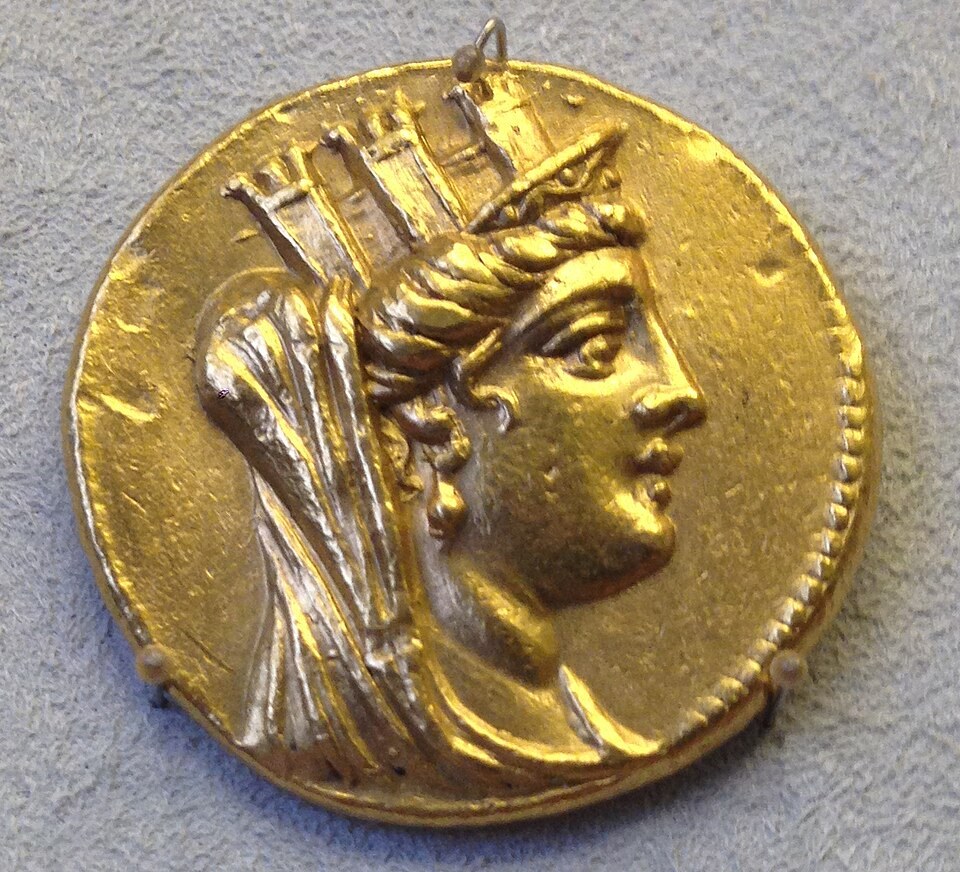

The gold coin from Tyre illustrated here is dated to 104–103 BCE in the catalogue of Berlin’s Münzkabinett. Its female head wears a crown of towers: Tyche, the protective personification of the city. Face and fortifications bring community and protection together in a compact image. “Double shekel” follows the museum’s classification; the object should not be confused with the better-known silver shekels bearing Melqart’s head. [2]
02 / History of the poundFrom ancient mints to imperial currencies
A change of ruler did not instantly erase local traditions. A bronze coin struck at Tyre in 94–95 CE and held by the British Museum still combines Heracles-Melqart with a club and Phoenician letters meaning “of Tyre”. Yet it belongs to Roman provincial coinage under Domitian. It also carries a shell-shaped countermark, a small impression added after the original striking. [3]
This example explains why the mint is an essential part of a coin’s identity. Tyre could manufacture money without being an independent state. The authority permitting the issue, the imagery retained by the city and the people using the coin did not necessarily coincide. In the Banque du Liban Museum, a bronze of Sidon under Trajan, dated to 117 CE, shows Cadmus on a ship’s prow. A city’s mythical past could continue to circulate within an empire. [1]
Lebanese collections also follow the Byzantine, Arab and Islamic periods and the Crusader states. Treating these as a mere list of successive rulers misses changes in monetary language, denominations and trading connections. Portraits and inscriptions, different metals and overlapping currencies all offer evidence for everyday history. These objects preceded the pound in the same broad geographical region; they do not form an unbroken sequence of currencies convertible into it at a single chain of fixed rates. [1]
03 / History of the poundA pound before the pound: the Ottoman inheritance
From the early sixteenth century to the First World War, the territories of present-day Lebanon belonged to the Ottoman world. Their monetary history was that of a region within a large empire, using gold, silver and copper coins and, later, banknotes. Metal and paper did not inspire confidence in exactly the same way: a coin’s material value and the promise printed on a note rested on different foundations.
The Banque du Liban Museum’s Ottoman collection includes banknotes used between 1861 and 1918. Their dimensions, scripts and layouts trace the development of paper money. The issuer’s identity becomes crucial. Accepting a note means trusting an institution to sustain payment, rather than relying solely on a piece of metal’s weight. [1]
Monetary vocabulary survived these transitions. In Arabic, the Lebanese pound is the līra lubnāniyya; in French it is the livre. English uses “pound”, a familiar translation within an old family of names associated with weights and Mediterranean monetary traditions. The word does not establish that Lebanon’s currency originated as a British creation. At the end of Ottoman rule, the Turkish pound was followed by Egyptian money linked to sterling, and then by issues under French mandate. Distinguishing these successive arrangements helps explain the name without confusing it with the currency’s political origins. [4]
04 / History of the pound1919–1939: a shared currency acquires a Lebanese name
The collapse of the Ottoman Empire transformed the means of payment. Egyptian currency initially circulated under Allied authority. France then entrusted note issue to the Banque de Syrie, an institution connected with the Ottoman Bank. The first issues in this new phase date from 1919, while the mandate’s monetary arrangements were established in 1920. The date printed on a banknote, its actual release and the legislation giving it legal currency are distinct pieces of evidence. [4] [5]
A 1924 convention organised the issuing privilege of the Banque de Syrie et du Grand-Liban. Notes intended for Greater Lebanon and Syria belonged to a shared monetary system. One pound corresponded to twenty French francs, with redemption arrangements in francs. “Pound” therefore did not mean a fraction of sterling. Coins dated 1924 and notes naming Greater Lebanon gave this monetary structure a tangible presence. [5]
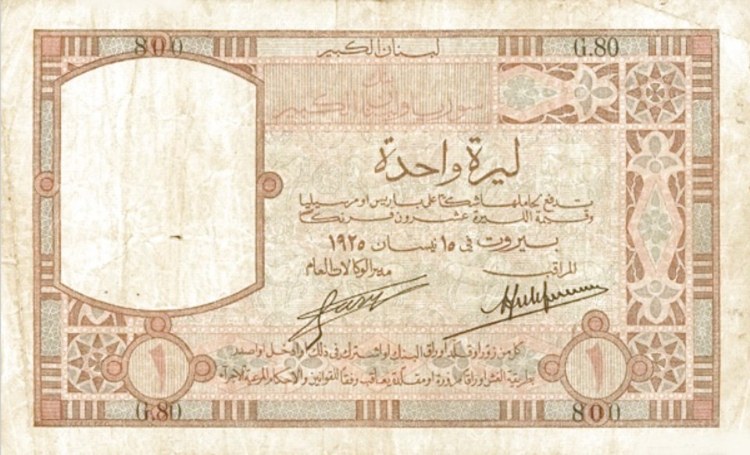

The one-pound note of 1925 illustrated below makes the bank’s name and its inscriptions particularly prominent. It also answers a common misunderstanding: notes intended for Lebanon existed well before its central bank. An institution with an issuing concession could supply banknotes without being the later national monetary authority.
The 1937 convention prepared for a separate Lebanese issue while money remained usable across the two territories. “Banque de Syrie et du Liban” appears in the sequence of issuing institutions from 1939. There was consequently no single moment in 1924 at which every feature of the modern pound emerged. Names, backing arrangements and institutions developed in stages. [5] [1]
05 / History of the poundPiastres: the small change of everyday life
The pound is divided into one hundred piastres. This straightforward relationship supports a wide range of small payments: coins can represent fractions of a pound, while notes hold larger sums. Denominations make sense in relation to one another. Twenty five-piastre coins equal one pound; so do four twenty-five-piastre pieces.
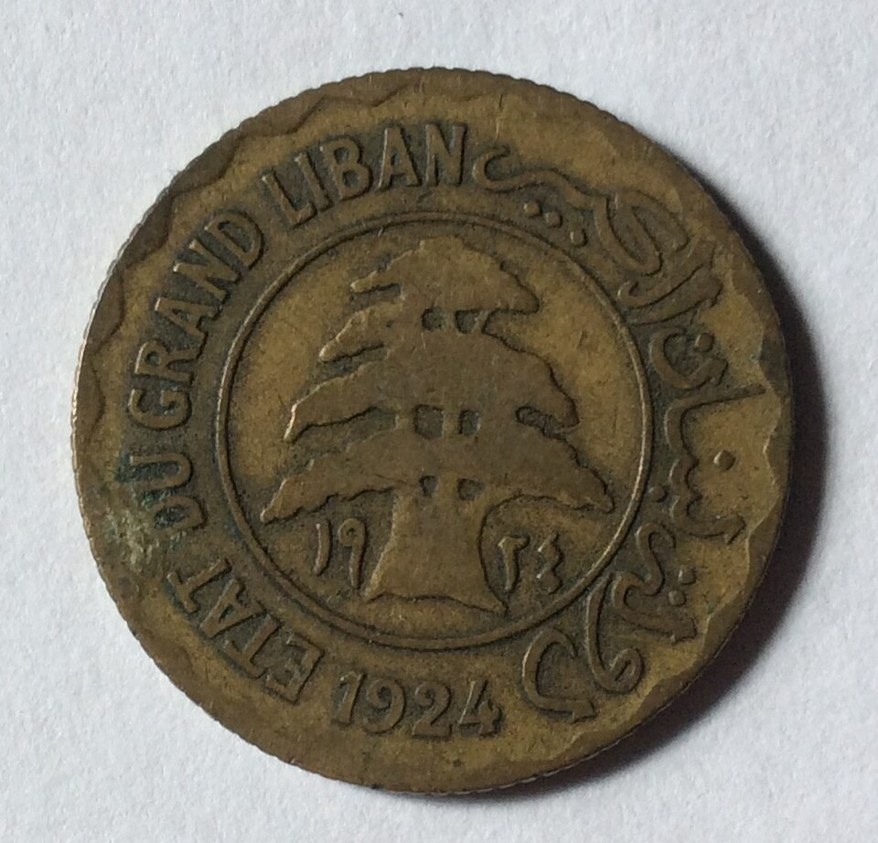
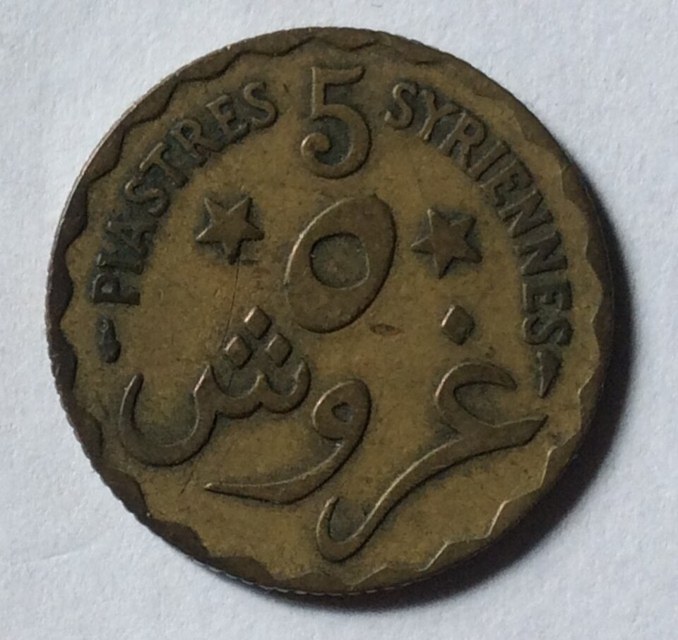
The five-piastre coin of 1924 combines French and Arabic inscriptions. The cedar side names Greater Lebanon, while the other side states the denomination. Its date and territorial designation associate it with Greater Lebanon. The cedar takes the place that a ruler’s portrait might occupy. Identifying an individual coin properly requires both sides: the state’s name, denomination and date may be distributed between them. The two photographs allow a direct comparison between the territorial emblem and the denomination used for payment. [6]


Manufacture must also be distinguished from issue. A state or bank authorises a monetary system; a mint makes its coins. French Mint archives contain files for “Syrie (Grand Liban)”, including the manufacture and issue of silver ten-, twenty-five- and fifty-piastre coins in 1929–1930. Such workshop records reconnect the objects with the industrial contracts and administrative machinery of the mandate. They do not justify assigning every later Lebanese issue to Paris without checking it individually. [7]
For a present-day reader, piastres evoke a vanished scale of everyday prices. A subdivision can survive in a currency’s definition after inflation has removed it from ordinary transactions. The accounting relationship and the practical use of small coins are separate questions. [8]
06 / History of the pound1941–1964: building monetary sovereignty
The Second World War altered the currency’s external connections. In 1941, following Allied intervention in the Levant, sterling replaced the franc as the reference in the monetary arrangement described by Banque du Liban. Independence in 1943 then opened a new political chapter. It did not immediately abolish the concessionary bank or replace all earlier notes. [4]
The Franco-Lebanese monetary agreement of 1948 and the law of 24 May 1949 detached the national currency from the French franc. This sequence matters as much as changes of flag: it concerned the pound’s backing and its place in international payments. Monetary sovereignty required legal decisions and institutional capacity, alongside the images printed on money. [4]
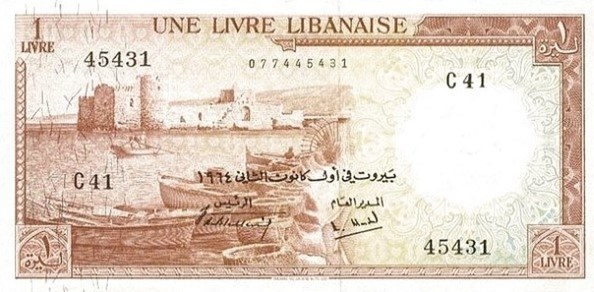

A note dated 1964 offers a useful exercise in identification. The one-pound example shown here still names the Banque de Syrie et du Liban. The year alone therefore cannot make every 1964 note an issue of Banque du Liban. The issuer must be read first, followed by the design, signatures and precise date. [9]
The 1963 Code of Money and Credit established Banque du Liban; the institution began operations on 1 April 1964. These dates answer different questions: when was the bank legally created, and when did it begin functioning? In the pound’s history, they mark the transition from a privilege granted to a bank to national central-bank issuance. Independence, monetary separation and central-bank operation belong to related but distinct stages. [10]
07 / History of the poundThe first Banque du Liban notes: a country in pictures
In 1964, Banque du Liban issued notes for one, five, ten, twenty-five, fifty and one hundred pounds. Together they made a usable scale: smaller denominations supported everyday payments, while larger ones concentrated more value. Viewed decades later, the same numbers no longer represent the same purchases. A note’s historical significance cannot be measured by its face value alone. [11]
The reverse of the 1964 hundred-pound note illustrated here presents a large cedar against a mountain landscape. The foreground tree, distant slopes and engraved frame turn the sheet into a heritage landscape. Alongside the ancient sites featured on other banknote types, the mountains offer another way to represent the country. The image invites the holder to recognise a shared inheritance, alongside the denomination. [12]
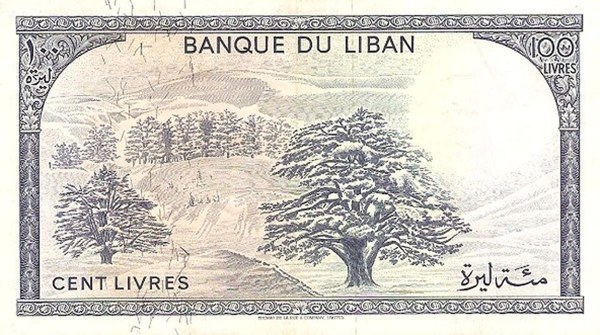

These notes can be read at several levels. A prominent numeral enables quick recognition; the bank’s name identifies the issuer; signatures and dates locate the object within a series. Fine engraving serves an aesthetic purpose while also making imitation harder. Public imagery and secure manufacture meet on the same surface.
Monuments and landscapes also offered ways to represent the country without making an entire series depend on the portrait of a political leader. For a population with many affiliations, heritage can provide a common visual vocabulary. This is an interpretation of the imagery, rather than a claim to know an undocumented political intention of its designers. Looking carefully at the object helps separate what is visible from what a historian may reasonably infer.
08 / History of the pound1975–1994: war and a changing scale of money
The civil war of 1975–1990 disrupted markets, incomes and banking relationships. Its monetary consequences should not be pictured as one smooth fifteen-year curve. The pound’s deterioration became particularly severe during the 1980s, changing price expectations and payment habits. Money remained an everyday object even within a society experiencing prolonged violence.
The sequence of denominations makes that changing scale tangible. Two hundred and fifty pounds appeared in 1978; five hundred and one thousand in 1988; ten thousand in 1993; and five thousand, twenty thousand, fifty thousand and one hundred thousand in 1994. This official chronology explains more than a single sweeping description of collapse. It shows when the note system had to accommodate larger nominal payments. [11] [10]
Introducing a larger denomination does not, by itself, cause the conditions it accompanies. It can make payments more manageable when increasing numbers of smaller notes would otherwise be required. Equally, knowing that a hundred-thousand-pound note exists tells us little about what it buys without a date, prices and monetary context.
The US dollar acquired a significant role in saving, accounting and payment. Those practices did not automatically eliminate the pound. A national and a foreign currency can coexist, with different roles in different transactions. This overlapping use, rather than an instantaneous replacement of one currency by another, shaped the monetary history of the post-war years. [13]
09 / History of the poundReconstruction: larger denominations and the cedar
Reconstruction in the 1990s took place within a changing monetary landscape. The larger-denomination series introduced in 1993–1994 provided values suited to the period’s prices. Coins denominated directly in pounds also replaced the earlier scale of small change: one hundred, two hundred and fifty, and five hundred pounds appear in the 1995 issues, fifty pounds in 1996, and twenty-five pounds in 2002. [14]
The two-hundred-and-fifty-pound coin of 2000 and the five-hundred-pound coin of 2009 show the cedar. Its compact form and layered branches remain recognisable at small scale. An emblem that works on a flag must stay legible on a small metal disc, despite reflections and wear. Simplifying the tree is consequently a manufacturing choice as well as an expression of national identity. [15]
From late 1997, the official reference rate was fixed at 1,507.5 pounds to the US dollar. For more than twenty years, the peg provided a familiar framework for prices and contracts. Lebanon nevertheless remained highly dollarised: a stable quoted rate and extensive use of dollars could exist together. Banks, public finances and the central bank developed close financial connections that would become central to the subsequent crisis. [13]
Objects and institutions need to be considered together. A coin carries an enduring emblem; a banknote makes a payment convenient; a fixed rate embodies a promise of stability. All concern confidence, but each supports it through a different mechanism. That distinction helps explain why an unchanged design can survive a profound change in monetary conditions.
10 / History of the pound2013–2015: when banknotes commemorate
Commemorative issues give banknotes a different rhythm from ordinary cash payments. Between 2013 and 2015, Banque du Liban devoted three fifty-thousand-pound notes to anniversaries: seventy years of independence in 2013, fifty years of the central bank in 2014, and seventy years of the army in 2015. They were made on polymer, a synthetic substrate distinct from traditional banknote paper. [16]
The first connects independence with Rashaya Citadel and the flag. The second depicts Banque du Liban’s buildings, making the issuing institution itself the subject. The third celebrates the army. These are more than different dates printed on the same denomination: each chooses a different form of collective memory. A commemorative note should therefore be identified by its occasion, year and material as well as its face value.
The 2014 note also provides a specific example of industrial collaboration. In its announcement of 9 April 2014, De La Rue described production on its Safeguard substrate, including a transparent window bearing a cedar in ink that changes colour when tilted. Security depends here on the optical properties of the material, alongside the complexity of the printed image. [17]
These collector-oriented issues did not mean that all Lebanese notes had become polymer notes. Their particular interest lies in combining an occasion, a visual programme and a manufacturing technique. The official catalogue distinguishes them from ordinary series; they should not be presented as evidence of a complete replacement of the country’s banknotes.
11 / History of the poundSince 2019: a note’s value and access to savings
The crisis that opened in 2019 affected the currency, banks and public finances together. Access to deposits was restricted while the pound lost much of its market value. Households faced two related problems: a pound-denominated income bought fewer goods, and a bank balance was not necessarily accessible as cash. A dollar credited to a restricted account and a physical dollar note no longer functioned as equivalent means of payment in practice. [13]
Multiple exchange rates made comparisons especially difficult. The change in the official rate to fifteen thousand pounds per dollar in February 2023 did not describe the rates applied to every transaction. The informational annex to the IMF’s 2023 report distinguishes the official rate, authorised Sayrafa transactions and the market. Quoting a number without explaining its use can therefore misrepresent the crisis. [18]
The chronology must also allow for change. In May 2024, IMF staff reported that certain measures had helped contain depreciation and inflationary pressures, while emphasising frozen deposits and the banking sector’s unresolved difficulties. This dated assessment was neither a resolution of the crisis nor a forecast. It does, however, rule out describing the entire period as an identical, uninterrupted deterioration. [19]
A further 2024 milestone concerns central-bank accounting: Banque du Liban adopted a rate of 89,500 pounds per dollar in its balance sheet from 31 January 2024, under a decision of 15 February. This is a historical accounting fact, rather than an exchange quotation offered to the reader. [20]
More prices being expressed in dollars did not mean that the pound had legally vanished. It showed how money’s functions—setting prices, making payments and holding value—could become divided among different instruments. For people still paid in pounds, that division had immediate consequences. Monetary history is about the ability to buy goods and withdraw savings, alongside the number printed on a banknote.
12 / History of the poundReading money: five details that change the story
The issuer. Banque de Syrie, Banque de Syrie et du Grand-Liban, Banque de Syrie et du Liban and Banque du Liban are not interchangeable versions of one name. Their succession places an issue within an institutional history. An old note can illuminate a political transition, provided it is not dated solely by its appearance.
The date. A coin’s year or a note’s printed date is not always the date when its type first entered circulation. A series can be reissued with different signatures while retaining its principal design. Official issue lists provide a framework for comparison; the individual object supplies the detail.
The material. Metal, paper and polymer meet different requirements. On a note, a watermark formed within the paper must be distinguished from a printed motif or a transparent window. These observations explain manufacturing techniques. An on-screen photograph cannot authenticate a physical banknote.
The denomination. One hundred piastres make one pound, but a hundred pounds in 1964 did not have the purchasing power of a hundred pounds in another period. The numeral alone cannot establish a comparison of real value. Keeping a coin after it has ceased to be useful for everyday purchases changes its role from payment to remembrance.
The image. A cedar, ancient columns, a flag or an institutional building expresses a way of representing the country. Their persistence gives the pound a depth that exchange-rate charts alone cannot convey. From port-city coinage to a commemorative note, these small objects preserve traces of everyday actions, technical skills and collective attachments.
Chronology
| Date | Milestone |
|---|---|
| 5th century BCE | Coinage of Phoenician city-states. |
| 1919–1920 | Banque de Syrie issues; establishment of the mandate monetary system. |
| 1924–1925 | Coins and notes naming Greater Lebanon. |
| 1937–1939 | Convention preparing a separate Lebanese issue; change in the bank’s name. |
| 1943 | Political independence. |
| 1948–1949 | Agreement with France and separation from the franc. |
| 1963–1964 | Legal establishment, then opening of Banque du Liban. |
| 1978 / 1988 | 250-pound notes, followed by 500- and 1,000-pound notes. |
| 1993–1994 | Introduction of larger denominations from 5,000 to 100,000 pounds. |
| 1997 | Official peg fixed at 1,507.5 pounds per dollar. |
| 2013–2015 | Three commemorative polymer notes. |
| 2019 | Beginning of the banking and currency crisis. |
| 2023–2024 | Changes in official and accounting reference rates. |
Sources and credits
- Banque du Liban — Collections du musée / Museum collections
- Münzkabinett Berlin — Tyr, 104–103 av. J.-C. / BCE, objet / object 18202643
- British Museum — Bronze de Tyr sous Domitien / Tyre bronze under Domitian, G.5149
- Banque du Liban — Historical Development of the Lebanese Pound
- Bechara Karam, Revue juridique de l’USEK, 2020 — genèse monétaire, note 26 / monetary origins, note 26
- Padres Hana — Cinq piastres de 1924 / Five piastres of 1924
- Archives économiques et financières françaises — Monnaies, série H, H-21, 215
- Banque du Liban — Banknotes & Coins
- Banque de Syrie et du Liban — Une livre de 1964 / One pound dated 1964
- Banque des règlements internationaux / Bank for International Settlements — Payment systems in Lebanon, 2003
- Banque du Liban — List of Banknotes Issuances
- Banque du Liban — Cent livres de 1964, revers / 1964 hundred pounds, reverse
- FMI / IMF — Lebanon: 2023 Article IV Consultation, rapport / report 23/237
- Banque du Liban — List of Lebanese Coin Issuances
- STJMLCC — Pièce de 250 livres, 2000 / 250-pound coin, 2000 (notice uniquement / record only)
- Banque du Liban — Commemorative Banknotes, 2013–2015
- De La Rue — Communiqué du 9 avril 2014 / Release of 9 April 2014, reproduit par / carried by MarketScreener
- FMI / IMF — 2023 Article IV, Informational Annex
- FMI / IMF — Staff Concludes Visit to Lebanon, 23 mai / May 2024
- Banque du Liban — Monthly Bulletin 361, juin / June 2024, notes méthodologiques / methodological notes
