Illustrated historical feature · English
A nineteenth-century Jersey penny carries an unexpected fraction: one-thirteenth of a shilling. That small number tells the story of an island attached to the British Crown, yet long accustomed to French sous. Patient adjustments produced a currency whose coins and notes preserve the island’s languages, places and memories.
Before the pound: an island of hoards
Long before Victoria’s portrait or the States’ banknotes, coins were crossing the seas around Jersey. The Grouville hoard, discovered in 2012 by Reg Mead and Richard Miles, provides a remarkable witness. Tens of thousands of late Iron Age coins were buried with jewellery and other precious objects. Coriosolite coins in particular connect the island with neighbouring Armorica, across the water in what is now France.
This deposit does not mark the birth of a “Celtic Jersey pound”. It shows that a place’s monetary history begins with the objects moving through it, often struck somewhere else. Why was this wealth buried? Disruption around the Roman conquest provides a possible context; the identity and intentions of those who buried it remain subjects for research.
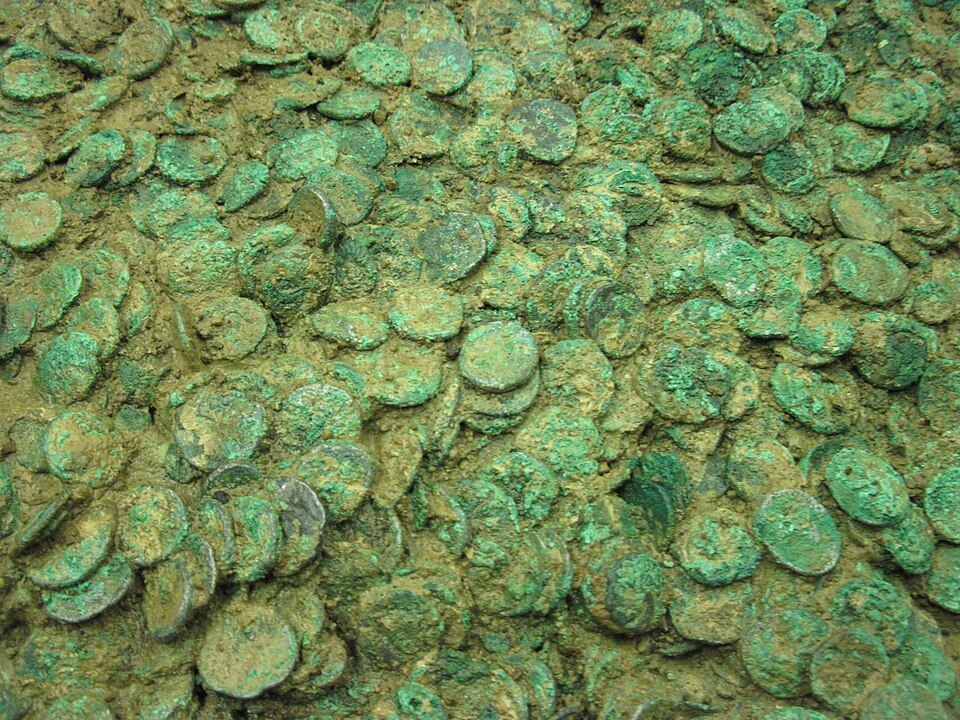

The Roman coin hoard found at Les Quennevais in the nineteenth century, in St Brelade’s parish, adds another chapter. Imperial coins bear witness to contacts with the Gallo-Roman world. A coin was metal and a means of settlement, but also a message: its portrait and lettering asserted the issuer’s authority even on an island at the edge of larger trading networks.
Reckoning in livres, paying in French coins
Constitutional history helps explain the island’s distinctive position. In 1204, when King John lost mainland Normandy, the islands remained attached to the English Crown. Jersey retained institutions and customs of its own. Political allegiance did not instantly transform the money in its markets: trade with the French coast continued to supply the coins people used.
For centuries, the livre tournois provided a reference for accounts. A livre was divided into twenty sous, each sou into twelve deniers. This accounting unit must be distinguished from the coins actually handed over a counter. Accounts could be expressed in livres without anyone carrying a coin worth exactly one livre.
The authorities therefore had to set local values for different coins, consider their weight and condition, and respond to changes across the sea. A French écu and a sum of livres written into a contract could not be equated without calculation. Rents, debts and payments due to the Crown made these relationships particularly sensitive.
It was a monetary landscape once familiar across Europe: the unit used for reckoning, the metal available for payment and the authority to which a community owed allegiance did not necessarily coincide. Modern Jersey inherited this practical experience of accommodating different connections.
From the liard dispute to the 1834 reform
The Six-au-Sou disturbances of 1730 show how an apparently technical change could affect ordinary lives. The contested shift from four liards to six for a sou reduced the value of the small coins people held. For someone whose savings consisted chiefly of copper but whose debt was fixed, the consequence was immediate: more coins were needed to discharge the same obligation.
This was more than an argument about names. It concerned the distribution of losses between debtors and creditors, decisions by local authorities and their relationship with the Crown. Money was a shared convention; changing it could unsettle a community’s existing arrangements.
In the early nineteenth century, difficulties obtaining older coins and growing connections with Britain encouraged a different solution. A reform effective on 1 October 1834 established English money as the legal standard. The legislation survives under the title Loi (1835) sur la monnaie: that documentary date should not be mistaken for its effective date.
A new rule did not instantly erase established habits. Small payments continued to reflect French sous. The transition would soon be written into the coinage itself.
1841: why thirteen pennies made a shilling
The copper coins dated 1841 provided a particularly ingenious answer. The local penny represented two sous, or one-thirteenth of a shilling. A halfpenny was one sou, or one-twenty-sixth; a farthing was half a sou, or one-fifty-second. These unusual fractions were neither collectors’ fantasies nor engraving errors: they maintained a bridge between two payment systems.
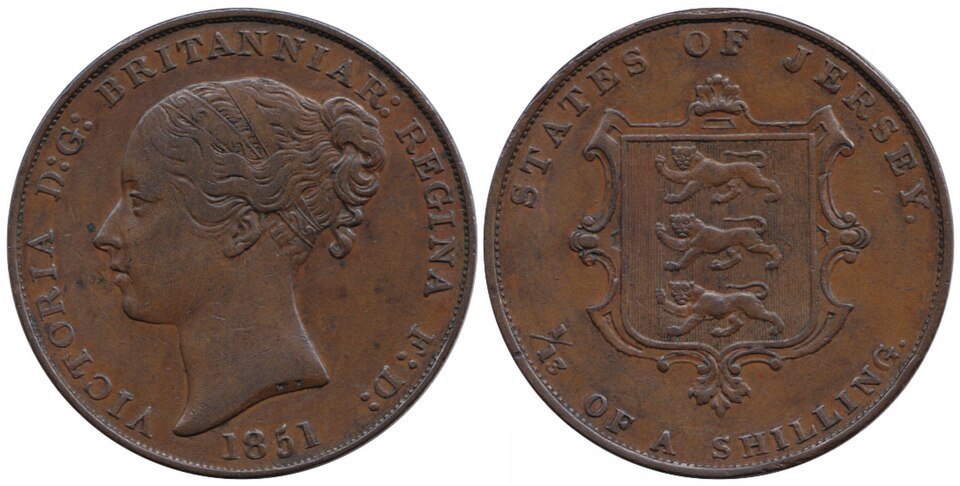

Victoria’s portrait and Jersey’s arms brought two aspects of authority together on the copper. The sovereign appeared on the obverse; the three-lion shield and the words States of Jersey identified the local issue on the reverse. The illustrated 1851 example makes this dual identity tangible without implying a currency wholly independent of sterling.
Bronze replaced copper in the issues of 1866. Technique changed, as did the portrait design, with Leonard Charles Wyon involved in the new presentation. Yet the thirteenth and twenty-sixth fractions continued. To someone reading a coin, its date, metal and inscription reveal developments that did not all happen at once.
A humble small coin conveys this transition better than the notion of an overnight replacement. The authorities chose to bring familiar local payments and sterling reckoning together gradually, preserving a practical link with the money people already understood.
1877: alignment and the marks of the mints
Small change moved into alignment in 1877: the penny now represented one-twelfth of a shilling, the halfpenny one-twenty-fourth and the farthing one-forty-eighth. A petition by traders dated 25 February 1876, recorded by the numismatist B. Lowsley, preceded the change. Shopkeepers’ practical needs therefore helped shape the denominations.
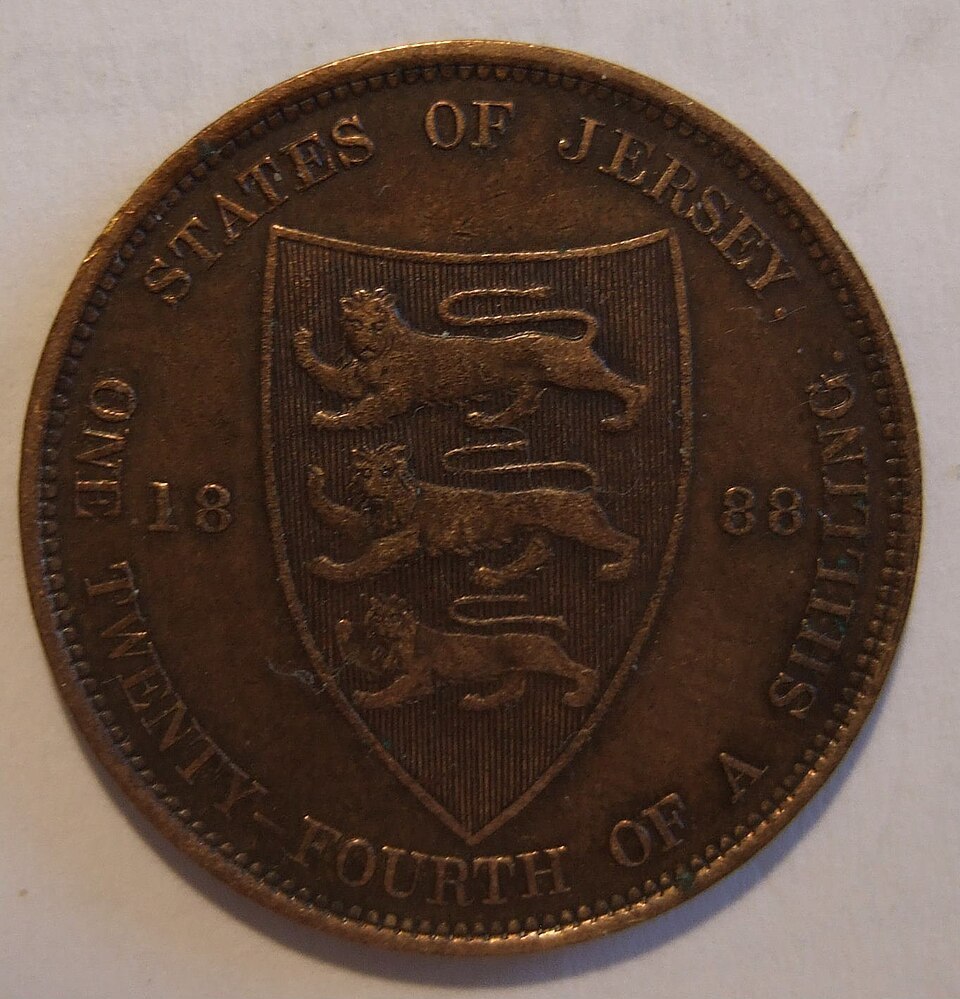

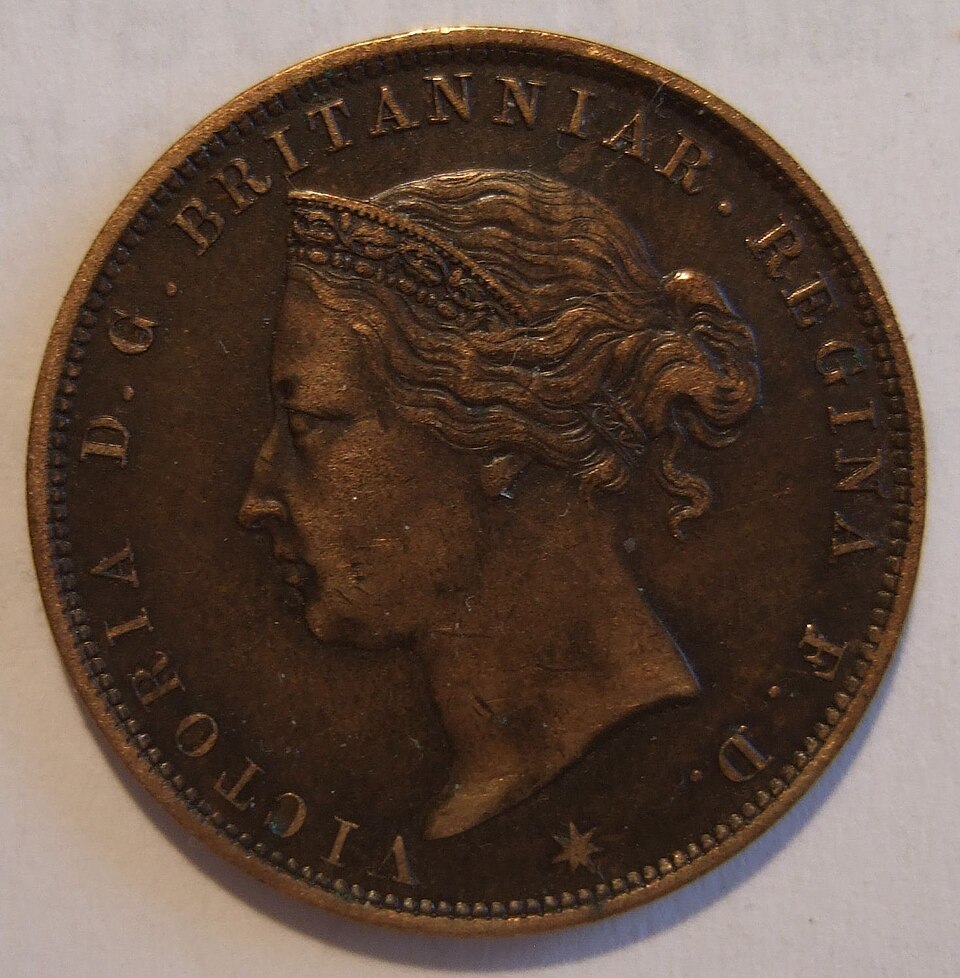

Fractional wording survived even though the values now matched British pennies. The illustrated 1888 halfpenny retains “one twenty-fourth of a shilling”: a local way of expressing a shared value.
The authority to issue money also needs to be distinguished from its manufacture. Jersey could determine its coinage without operating an island mint to produce it. For the 1877 order, Lowsley records that the coins were ordered through the Royal Mint but actually struck by Ralph Heaton in Birmingham. The letter H, where present on these issues, identifies that mint; it is not a parish initial.
This distinction is fundamental to reading coins. The issuer’s name answers “who stands behind this piece?”; the mint mark answers “who made it?”. The engraver adds another signature, sometimes reduced to a few letters below a portrait. Numismatic observation brings those clues together instead of stopping at the face value.
Bankers, promises and paper obligations
Jersey’s monetary story is not confined to copper. In 1797 the wine merchant Hugh Godfray opened a bank and issued one-pound notes. Other institutions emerged alongside maritime commerce, including trade with Newfoundland. Paper circulation depended on confidence in a particular firm, its partners and their ability to redeem its promises.
Where coins were scarce, a written promise could make trade easier. It also introduced another risk: the holder had to recognise the issuer and assess its reliability. Requirements imposed on note issuers in 1813, followed by a demand for guarantors in 1831, show that the growth of paper came with regulation.
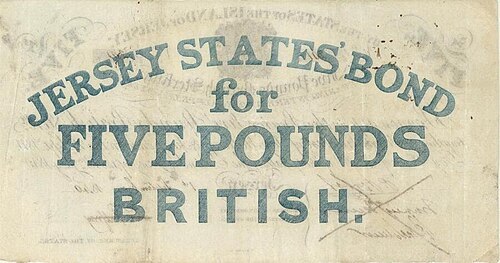

The illustrated States instrument of 1840 explicitly calls itself a bond. It is an interest-bearing debt document, rather than simply an early version of a modern cash note. The distinction matters: a sterling face value and an official name do not make every printed financial instrument a circulating banknote.
The nineteenth century also saw the three-shilling and eighteen-pence silver tokens of 1813, struck at the Royal Mint to alleviate a shortage of specie. Private paper, public debt instruments and metal tokens all belong to the history of payment needs, but did not perform identical functions. Difficulties among local banks in the 1870s further demonstrate how confidence in a signature could become fragile.
1941–1945: paper in place of coins
The German Occupation again transformed the practical conditions of payment. Silver coins became scarce; Jersey’s government attributes part of their disappearance to occupying soldiers taking them as souvenirs. The difficulty reached beyond large purchases: without small change, giving the right amount back became a problem.
A law of 29 April 1941 authorised an issue of two-shilling notes. The first response was plain and functional. Examples held by Jersey Heritage show the island arms, blue lettering and a red printed underlay. Paper replaced a value that people would otherwise expect to receive in metal.
Broader authority granted late in 1941 prepared the way for notes designed by Edmund Blampied, issued from 1942. The series comprised sixpence, one shilling, two shillings, ten shillings and one pound. At the scale of a household budget, a sixpenny note demonstrates how a shortage of coins could transform the physical form of money.
Blampied gave this emergency currency a distinct island artistic presence. His connection with the issue is tangible: Jersey Heritage also preserves examples and printing plates. Design, production technique and wartime circumstances form parts of the same historical record.
Liberation in May 1945 brought this emergency issuing phase to an end. It did not immediately lead to a permanent peacetime series of Jersey banknotes. Another step separated the improvised answer to wartime scarcity from regular post-war currency provision.
1963: a local issue with a sterling value
In July 1963 the States resumed the regular issue of notes. The framework was the 1959 law, now titled the Currency Notes and Currency Fund (Jersey) Law. Island paper money became a permanent feature of daily life. It could carry its own designs without Jersey acquiring a separate monetary policy.
The mechanism is straightforward. Banks obtain notes from the Treasury by paying their sterling face value. Receipts from the issue go into the currency fund; investments can earn income for the island after expenses and redemption obligations have been allowed for. Printing local money does not give the issuer its face value for nothing.
This also explains the distinction between value and acceptance. Jersey notes are legal tender in Jersey under local law. Parity does not automatically give those notes the same legal status elsewhere in the sterling area. The value of a unit and the recognition of a particular piece of paper are separate questions, central to the history of territorial currency.
The object is documented in the sources below; its image is not reproduced here.

1971: the shilling leaves the accounts
On 15 February 1971, Jersey adopted a pound divided into one hundred new pence. The date is explicitly stated in Jersey’s legislation. The pound itself remained the pound: its subdivision changed. The previous system had twenty shillings of twelve pence, making 240 pence to the pound.
The object is documented in the sources below; its image is not reproduced here.

One new penny therefore represented 2.4 old pence. A shilling became five new pence, and ten shillings became fifty. Those equations were exact, but conversion and rounding required rules for small sums. The law addressed bank balances, written financial instruments and periodic payments: the change extended well beyond the contents of purses.
| Period | Small unit | Reference |
|---|---|---|
| Coins dated 1841–1871 | Local penny = 1/13 shilling | Two old sous |
| Coins from 1877 | Penny = 1/12 shilling | 240 old pence per pound |
| From 15 February 1971 | New penny = 1/100 pound | 100 pence per pound |
The photographed 1971 penny preserves the arms and royal portrait, while “New Penny” signals a different way of reckoning. Jersey adopted sterling’s shared simplification and retained its visual identity on the objects. The journey from thirteen to twelve, then from 240 to one hundred, provides an unusually clear thread through a collection of island coins.
Reading the landscape through small change
A coin design has to remain legible inside a circle only a few centimetres across. The three-lion shield works particularly well in that space: a readily recognised device that can outlast changes of monarch and monetary system. Heritage designs introduce another register, the places islanders can recognise.
The object is documented in the sources below; its image is not reproduced here.

The illustrated two-pence coin depicts the hermitage associated with St Helier. Its small image brings together a name, a location and a religious story. A coin’s documentary interest extends beyond its principal portrait: the reverse can provide an introduction to an island’s geography and memory.
Commemorative issues extend that function. They do more than supply change for purchases: they recall events, anniversaries or people and are directed towards collectors. The government also identifies promoting Jersey and generating revenue as purposes of the programme.
The object is documented in the sources below; its image is not reproduced here.

A collector coin therefore needs to be described according to its actual role. Face value, metal content, finish and selling price are different things. Treating every commemorative issue as a piece routinely encountered in market change would mislead readers. Equally, ignoring these objects would overlook what their designs reveal about the subjects a territory chooses to present.
Banknotes: an atlas in three languages
The series introduced in April 2010 turns money into a compact cultural atlas. English appears on the front; French and Jèrriais express the denomination on the back alongside the arms of the twelve parishes. Giving a pound several written forms brings Jersey’s linguistic history into daily view.
Elizabeth II’s portrait accompanies monuments, houses and works of art. Coastal towers connect the denominations as a family. The design supports two kinds of reading: quickly recognising a value from colour and large numerals, then exploring the island through its details.
| Value | Colour | Main designs, front / back | Tower on back |
|---|---|---|---|
| £1 | Green | Monument to Freedom / La Hougue Bie | Le Hocq |
| £5 | Blue | Le Rât Cottage / Les Augrès Manor | Archirondel |
| £10 | Sienna | The Hermitage / Lalique glass at St Matthew’s | Seymour |
| £20 | Violet | States building / Assembly interior | La Rocco |
| £50 | Red | Mont Orgueil / houses on La Marmotière, Les Écréhous | Ouaisné |
These pairings bring different timescales together. The one-pound note links the memory of Liberation with a Neolithic site; the twenty-pound note depicts the parliamentary institution. The territory presents itself through landscapes as well as government.
Security is part of that visual language. The Jersey cow watermark gives a familiar emblem a technical role; raised printing and progressively larger formats help people recognise notes by sight and touch. The ten-, twenty- and fifty-pound denominations have holograms. Graphic design is also a matter of usability, particularly for people with impaired vision.
Commemorations can prompt exceptional denominations. In January 2012 the minister approved the proof for a hundred-pound note celebrating Elizabeth II’s Diamond Jubilee, with manufacture entrusted to De La Rue. That issue should be distinguished from the regular five-denomination series.
What the Jersey pound preserves
Jersey’s story is one of transitions: from the livre tournois to sterling, from sous to fractions of a shilling, from scarce metal to emergency paper and from old pence to decimal reckoning. Each stage required new practices to coexist with local memory.
That memory does not vanish with a change of reign. In September 2022 the government explained that the death of a sovereign did not automatically remove legal-tender status from existing currency. Portraits belong to historical series whose replacement is an issuing decision; they do not by themselves provide an expiry date.
To hold a Jersey coin is therefore to encounter several histories at once. A fraction can preserve the memory of a French sou; a letter can identify a Birmingham mint; a landscape or a Jèrriais word can recover another aspect of island life. Sterling parity provides a common unit of value, while the physical objects give that value a Jersey identity.
Sources and credits
References consulted on 15 October 2026. Numbers following the chapters point to the documents below. The 1897 book is used for monetary descriptions and records; its ancient-history interpretations are checked against Jersey Heritage’s research.
- Ancient coin hoard: discovery and conservation
- Roman coin hoard from Les Quennevais
- Government of Jersey — constitutional history
- B. Lowsley, The Coinages of the Channel Islands (1897), pp. 9–33
- Loi (1835) sur la monnaie — effective 1 October 1834
- States Assembly — P.2/2021, historical account of the 1730 riots
- Government of Jersey — On Demand, historical and design booklet (2010)
- Jersey Heritage — 1941 two-shilling notes, State/0002/00038/0704/145
- Currency Notes and Currency Fund (Jersey) Law 1959 — consolidated law
- Decimal Currency (Jersey) Law 1971 — articles 1 and 2
- Government of Jersey — issue and backing, FOI response of 24 November 2015
- Government of Jersey — how the note issue generates revenue
- Government of Jersey — the April 2010 banknote series
- Government of Jersey — banknote design, accessibility and security
- Government of Jersey — approval of the £100 note proof, 23 January 2012
- Government of Jersey — why commemorative coins are issued
- SIX — official ISO 4217 list (JERSEY entry: GBP)
- Government of Jersey — replacing currency, statement of 26 September 2022
- Reims Museums — 1841 one-twenty-sixth shilling, inventory 929.16.78
Photographs are stored locally and remain visible offline. Each image carries its credit; the manifest records licences and processing. Occupation and modern notes are described without reproductions whose reuse rights remain uncertain. The 1840 debt instrument is identified as such. External references require an internet connection. Image manifest.