In the late eighth century, the subjects of King Offa of Mercia paid with silver pennies. Twelve centuries later, people in Britain use decimal coins and polymer notes bearing the portraits of Elizabeth II or Charles III. Between these periods, the pound accompanied the Norman Conquest, the Plantagenets’ wars, the Tudors’ alterations to the coinage, the foundation of the Bank of England, the expansion of the British Empire and both world wars.
The pound sterling is generally described as the oldest currency still in use. This longevity refers to the continuity of a name and a system of account: no coin from Offa’s reign could, of course, be used to make a purchase today. Its metal weight, subdivisions, banknotes and exchange arrangements have changed many times.
Long before it became an international currency, the pound was a unit of weight and then a unit of account. For several centuries, someone could owe a pound without ever having seen a one-pound coin: the amount was counted in pennies.
1 The Anglo-Saxon kingdoms from the eighth to the eleventh century
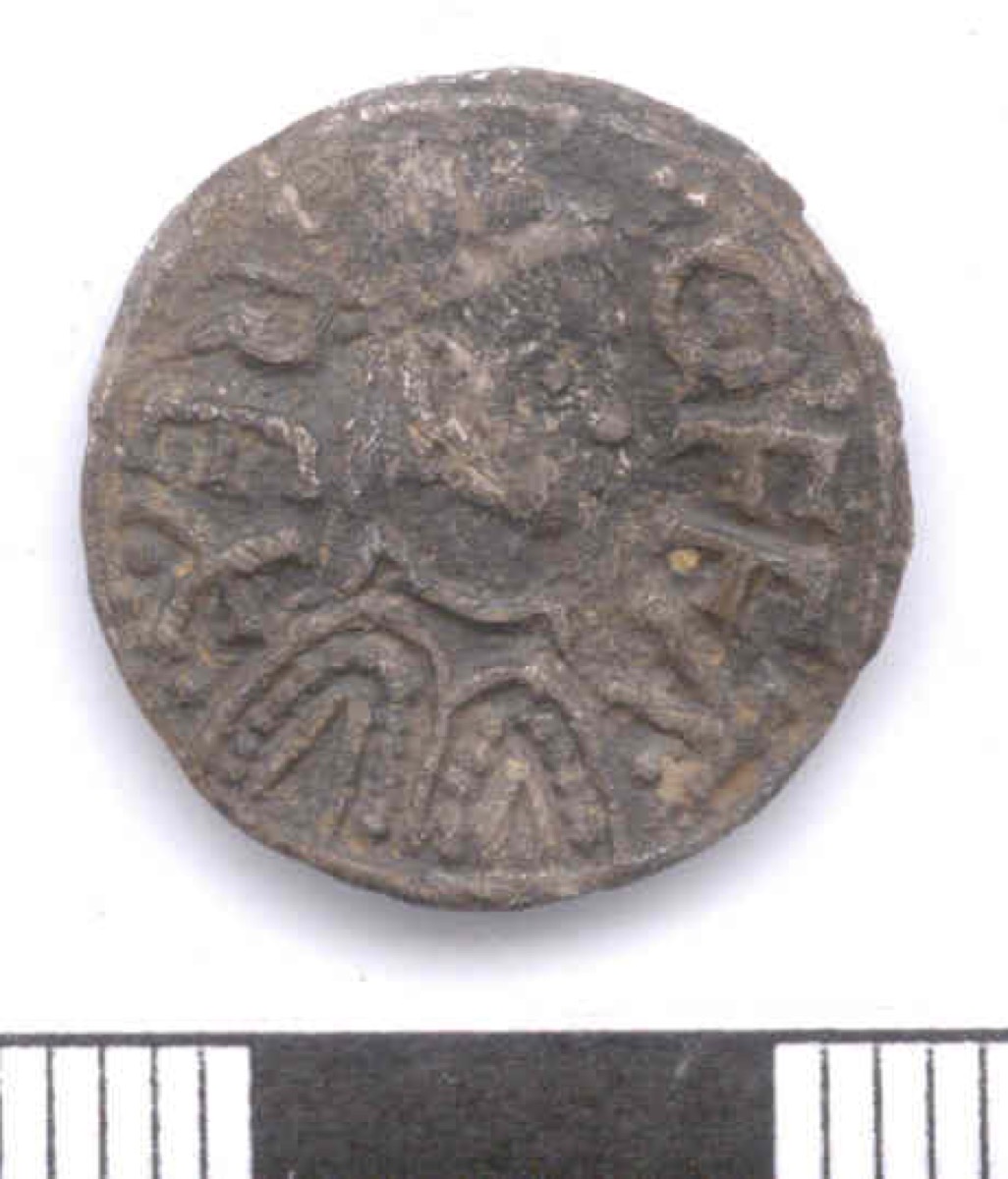
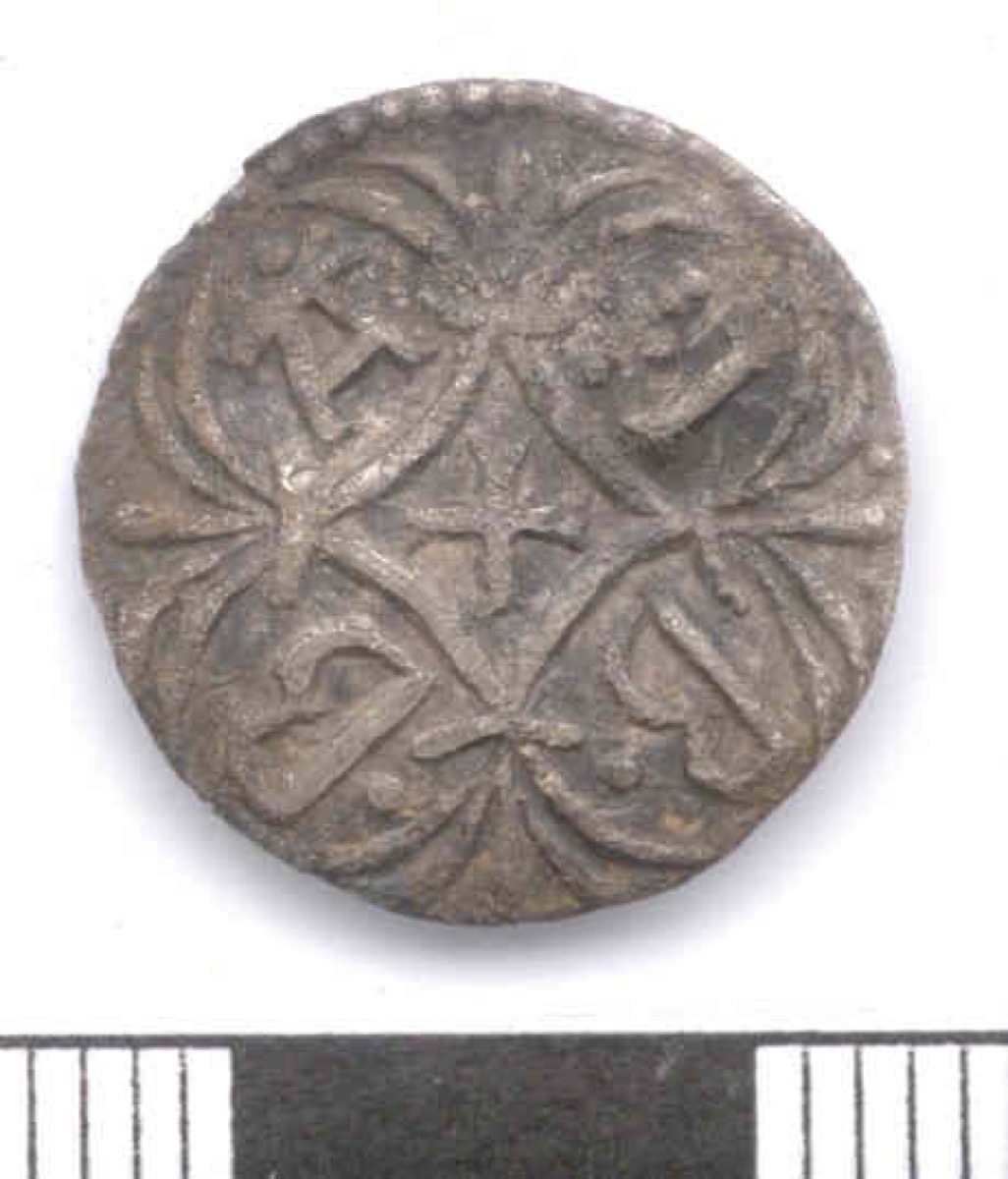
Around 775 King Offa’s silver penny
Offa ruled Mercia from 757 to 796. His kingdom occupied much of what is now central England. In the second half of the eighth century, particularly around 775, his mints produced silver pennies whose quality and portraits rank among the important achievements of Anglo-Saxon coinage.
Offa invented neither money in Britain nor the first Anglo-Saxon silver coins. Roman money and various earlier issues of the Anglo-Saxon kingdoms preceded him. His pennies nevertheless occupy a major place in the formation of the system from which the English pound would emerge.
For several centuries, the penny became the kingdom’s principal coin. It served trade, the payment of dues and the collection of taxes. Larger sums were expressed in units of account, without necessarily having a coin corresponding to each unit. [1]


The pound weight and the pound of account
The English name pound belongs to the same history as the Latin expression libra pondo, a pound by weight. Libra also explains the £ symbol: a stylised L crossed to indicate an abbreviation. Historically, versions with either one or two strokes can be found.
In the medieval system that became established, one pound represented 240 pennies. This division was connected with the number of coins struck from a reference weight of silver. It does not mean that every pound of account corresponded to an unchanged weight of pure silver for twelve centuries: coin weights, weighing standards and alloys evolved.
The Tower pound, used in medieval English coinage, weighed about 350 grams. This weight of monetary alloy must be distinguished from the fine silver it contained. When the sterling standard became established, it comprised 92.5% silver and a small proportion of other metals.
In markets and larger transactions, balances were used to check coins. A worn or clipped piece, or one of doubtful fineness, could be refused or accepted at a discount. The ruler’s portrait, the moneyer’s name, the weight and the fineness all contributed to its identification and acceptance.
Gold and silver limited production because the metal had to be obtained. They did not guarantee a general stability of prices: inflows of metal, harvests, wars and changes in weight or fineness could also cause prices to rise.
The Carolingians and the system of 240 deniers
The English system developed within a European setting in which the Frankish kingdoms were also reorganising their money. In the eighth century, Pepin the Short and then Charlemagne established and strengthened an account based on the pound, the shilling and the penny. Charlemagne’s reform of 793–794 was an important stage.
On both sides of the Channel, the same accounting relationship endured:
| English unit | Subdivision | Historic abbreviation |
|---|---|---|
| 1 pound | 20 shillings or 240 pence | £ |
| 1 shilling | 12 pence | s |
| 1 penny | 4 farthings | d |
The letters of the old system, often written £ s. d., refer to the Latin words libra, solidus and denarius. The solidus was notably the name of a gold coin introduced under Constantine in the fourth century; denarius was the name of the Roman silver coin. These terms survived in medieval accounts, without the English system being an unchanged reproduction of a Roman one.
Shilling has a Germanic origin, related to words such as skilling: it does not derive from the Latin solidus. It is the accounting abbreviation s that preserves the Latin vocabulary. Similarly, the penny was abbreviated d, for denarius, until decimalisation in 1971.
When small coins were in short supply, a penny was sometimes cut in half or into quarters. A halfpenny therefore represented half a penny, and a farthing a quarter. These fractions were also struck as separate coins at different periods.
Æthelstan and monetary unification in the tenth century
Under the rulers of the House of Wessex, England’s political unification was accompanied by growing control of the mints. Æthelstan, who ruled from 924 to 939 and extended his authority over England in 927, took part in this organisation.
His laws, generally dated to around 928, prescribed a uniform coinage within the kingdom and regulated where it could be struck. He reorganised an existing mint network: he did not create every local currency from nothing. The moneyer’s name and, increasingly, the mint’s name made it possible to identify those responsible for an issue. [2]
A pound then represented a considerable sum for most people. It appeared more readily in accounts, taxes and substantial payments than in everyday purchases. Equivalents in livestock or boats sometimes proposed require a precise date and source: the medieval pound had no fixed purchasing power.
In the late tenth and eleventh centuries, kings regularly renewed coin types. Striking and replacing coins provided revenue and helped control territory. When the Normans landed in 1066, they found a kingdom with an already developed monetary administration.
2 The Norman kings from 1066 to 1154
William the Conqueror preserves the English system
After his victory at Hastings in 1066, William the Conqueror changed who held power but retained the essentials of England’s monetary organisation. The pound remained divided into 20 shillings and 240 pennies; the silver penny remained the principal coin.
The new rulers took over the kingdom’s mints, moneyers and administrative practices. Coins bore the names and images of Norman kings. Accounts continued to use a pound that existed principally as a unit of calculation.
This continuity explains part of sterling’s reputation for antiquity: dynasties succeeded one another without the conquest requiring the complete replacement of the monetary unit.
Christmas 1124 and the punishment of Winchester’s moneyers
Under Henry I, king from 1100 to 1135, the quality of the coinage prompted serious complaints. Contemporary accounts mention, among other things, difficulties in getting certain English coins accepted in Normandy.
At Christmas 1124, moneyers were summoned to Winchester. Punishments took place during the winter of 1124–1125. Chronicles report the amputation of right hands and the castration of numerous craftsmen accused of making insufficiently good money. The episode is known as the Assize of the Moneyers.
The brutality of the punishment is well attested in the accounts, but the exact number of victims and each individual’s responsibility remain difficult to establish. The affair cannot be turned into a certain tally of half or most of the kingdom’s moneyers. It nevertheless shows the violence with which the Crown could punish those it held responsible for bad money. [3]
3 The Plantagenets and their successors from 1154 to 1485
Henry II and reforms of the penny
Henry II, the first Plantagenet king, ruled from 1154 to 1189. A recoinage in 1158 introduced the penny type now called the Tealby penny, named after a large hoard discovered much later in Lincolnshire. A further reform in 1180 established the Short Cross penny.
Sterling silver has a fineness of 925 parts per thousand: 92.5% silver and 7.5% other metals, generally copper. The alloy made coins more resistant than nearly pure silver would have done. Control of fineness and weight contributed to English money’s reputation.
Recoinage allowed damaged pieces to be withdrawn, a standard to be restored and authorised issues to be identified. It also imposed costs and constraints on money holders.
The name sterling emerges in the Middle Ages
Sterling first referred to English money, notably the penny, before extending to the pound and the monetary system. Its origin remains disputed.
One explanation connects it with a small star appearing on certain coins and the Old English word steorra. Another invokes the Easterlings, merchants from eastern Europe, often associated in popular accounts with German merchants and the Hanseatic League.
These hypotheses do not establish that Henry II adopted a fineness of 92.5% after admiring the coins of Hanseatic merchants who had come to buy cattle. That story should remain an etymological tradition, rather than be presented as an established event.
The full name pound sterling gradually distinguished the English pound from other pounds. Today, pound names the unit and sterling identifies the currency, particularly in relation to other currencies called pounds, such as the Egyptian and Lebanese pounds.
Henry III and Edward III introduce gold coins
Growing trade created demand for higher-value coins. In 1257, Henry III attempted to introduce a gold penny valued at 20 silver pennies. The chosen ratio between the metals made it unattractive to use, and the experiment did not become established. This was an early attempt at royal English gold coinage in the central Middle Ages, not the first gold coin ever struck on the island.
Under Edward III, king from 1327 to 1377, gold coinage developed more firmly. After an initial issue of gold florins in 1344, quickly abandoned, the noble became established in the same year. It was worth 6 shillings and 8 pence, one-third of a pound.
The penny remained useful for ordinary payments, while gold coins facilitated the settlement of larger sums. The kingdom now used both gold and silver coins, whose relative values had to be fixed by the authorities.
This coexistence caused recurrent difficulties: if the official ratio between the two metals diverged from prices abroad, some coins became more attractive to melt down or export than to spend in England. The appearance of nobles therefore did not amount to the establishment of the nineteenth-century gold standard.
Edward I and then Edward III strike the groat
A silver coin worth 4 pence, the groat, was tried as early as 1279 under Edward I. That first issue did not become firmly established. The groat was reintroduced in 1351, under Edward III, and then became a much more common denomination.
In England after the Black Death of 1348–1349, it facilitated larger payments without requiring large numbers of pennies. It supplemented rather than replaced gold coinage. The developments of 1344 and 1351 thus widened the range of coins available. [14]
In the late thirteenth century, London’s minting operations were concentrated within the Tower of London. The Royal Mint would remain there for several centuries; its history nevertheless predates that move and did not suddenly begin with the Norman Conquest.
Clipping and counterfeiting in the late Middle Ages
Clipping means removing a little metal from a coin’s edge and then returning it to circulation. Repeated across many coins, it could recover an appreciable quantity of silver or gold. Other users were left with underweight pieces.
Counterfeiting and certain forms of altering coins constituted high treason in English law. Penalties could be capital. Men faced hanging, including aggravated forms depending on the offence and period; women could be sentenced to burning.
The punishments prescribed in legal texts must be distinguished from their actual application. Not every man convicted of clipping was automatically quartered. The repression nevertheless remained particularly severe and continued well beyond the Middle Ages.
4 The Tudors from 1485 to 1603
Henry VII strikes the first sovereign in 1489
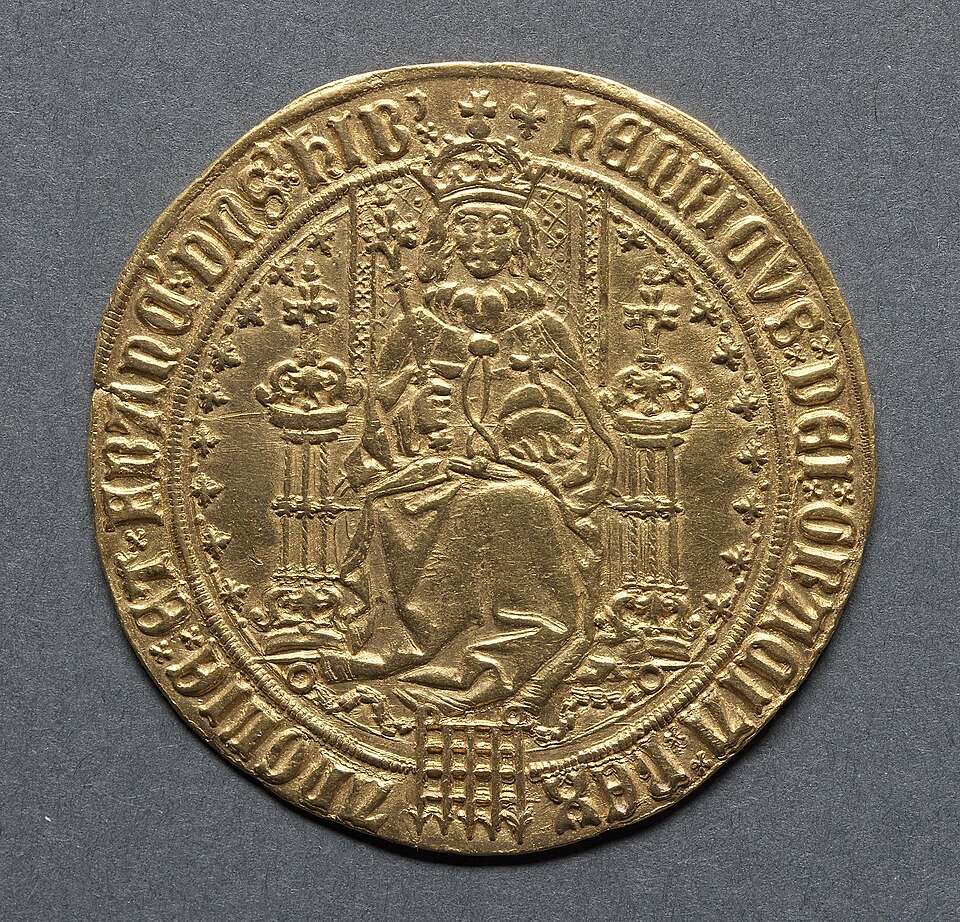
Henry VII founded the Tudor dynasty after his victory at Bosworth in 1485. In 1489, he issued a large gold coin called the sovereign, valued at 20 shillings, or one pound.
The distinction matters: the pound of account had existed for centuries before this one-pound coin appeared. Henry VII’s sovereign also represented royal power through a particularly elaborate image of the monarch.
Around 1504, towards the end of his reign, the testoon also appeared: a silver coin worth a shilling, whose name referred to the ruler’s head. Its profile portrait belonged to the artistic renewal of Renaissance coinage. Production developed under Henry VIII. The shilling, long merely a unit of account worth twelve pennies, thus acquired its own coin.
Henry VIII and the Great Debasement of the 1540s
Henry VIII ruled from 1509 to 1547. His wars against France and Scotland, court expenditure and the needs of government placed heavy demands on royal finances.
During the 1540s, particularly from 1544, the Crown sharply reduced the precious-metal content of coins. This was the Great Debasement. With the same quantity of silver, the mints could make more pieces and provide the king with additional revenue.
The fineness of some silver coins fell from about 92.5% to one-third under Henry VIII. Debasement continued under his son Edward VI, king from 1547 to 1553, reaching roughly one-quarter silver in certain issues of 1551.
On debased testoons, wear exposed copper beneath the silver-coloured surface. The relief of the king’s nose was particularly vulnerable: this feature gave rise to his nickname Old Coppernose.
The consequences were felt in prices and trade: good coins were sought after, while debased pieces aroused distrust. The deterioration contributed to contemporary inflation without explaining every sixteenth-century price increase on its own. [4]
Elizabeth I restores the coinage in 1560 and 1561
The first measures to restore better money began towards the end of Edward VI’s reign. But under Elizabeth I, queen from 1558 to 1603, a major recoinage in 1560–1561 withdrew debased pieces and restored silver money to sterling fineness.
The operation required old coins to be recovered, sorted and melted down. It restored their quality but did not instantly remove the economic consequences of earlier years or automatically return all prices to their former levels.
The reign also saw experiments with machine striking. These processes produced more regular coins than hammering, but their general adoption would take another century.
5 The Stuarts and the birth of the Bank of England from 1603 to 1714
James VI and I unites the crowns in 1603
When Elizabeth I died in 1603, James VI of Scotland also became James I of England. The two kingdoms now shared a ruler but retained their institutions and currencies.
The Scottish pound, or pound Scots, was not worth one pound sterling. It had depreciated over the centuries, and the ratio adopted in the early seventeenth century was 12 pounds Scots to 1 pound sterling. The union of the crowns therefore did not immediately create a single currency.
In the seventeenth century goldsmiths’ receipts become means of payment
In London, goldsmith-bankers accepted deposits of coins and precious metals. They issued written receipts allowing depositors to recover their funds. Some of these documents became transferable: instead of withdrawing coins, a depositor could hand the receipt to another beneficiary.
These practices contributed to the development of English bank paper. They preceded the foundation of the Bank of England: the Bank did not single-handedly invent every use of banknotes in Britain.
Paper facilitated large payments without transporting as much metal. Acceptance nevertheless depended on the issuing bank’s ability to honour its promise of repayment.
Charles II makes machine striking standard
After the civil wars, Charles I’s execution in 1649 and the republican period, the monarchy was restored in 1660 under Charles II.
From 1662–1663, machine striking became the normal method for producing royal coins. Their shapes and edges became more regular. Clipping became easier to detect, although older hammered coins continued to circulate for a long time.
The guinea appeared in 1663, a gold coin whose name recalled supplies of metal from the Guinea coast of West Africa. Initially valued at 20 shillings, it changed value as the relationship between the metals shifted, before being fixed at 21 shillings in 1717. [5]
William III and Mary II found the Bank of England in 1694
After the revolution of 1688, William III and Mary II occupied the throne. England was fighting in the War of the League of Augsburg against Louis XIV’s France. The government sought resources to finance military operations and the fleet.
In 1694, subscribers raised £1.2 million to lend to the government. In return, they received a charter establishing the Bank of England. The institution was then owned by private shareholders.
The Bank accepted deposits and issued notes. The earliest were partly handwritten, signed by a cashier, and could carry irregular amounts expressed in pounds, shillings and pence.
The promise to pay still printed on modern notes comes from this history. Originally, it referred to redeeming paper in metallic money. Today it no longer entitles the holder to demand gold: the Bank exchanges its notes according to their face value.
Issuing notes also opened new opportunities for fraud. Paper, signatures and engravings became further elements requiring protection against counterfeiters.
Isaac Newton takes part in the Great Recoinage of 1696
By the 1690s, much of the older silver coinage was worn or clipped. The authorities launched the Great Recoinage of 1696 to replace it with full-weight, machine-struck coins.
Isaac Newton was appointed Warden of the Mint in 1696 and Master of the Mint in 1699. The scientist dealt directly with monetary administration, metal assays and the pursuit of counterfeiters. Recoinage improved the coins but was expensive and disrupted circulation.
Newton collected testimony, questioned suspects and assembled evidence against counterfeiters. His most famous adversary was William Chaloner, convicted and hanged at Tyburn in 1699. Newton acted as investigator and Mint official; sentences were passed by the courts. [6]
Queen Anne and monetary union in 1707
In 1707, under Queen Anne, the Acts of Union created the Kingdom of Great Britain. England and Scotland no longer merely shared a ruler: they formed a single kingdom with a common Parliament.
Union required Scottish coinage to be brought into line with the English standard. Older coins were recalled and converted at the rate of twelve pounds Scots to one pound sterling.
Scotland nevertheless retained its banking institutions. The Bank of Scotland, founded in 1695, and the Royal Bank of Scotland, created in 1727, formed part of a banknote-issuing tradition that survives today. A common currency did not eliminate every Scottish banking distinction.
6 The Hanoverians from 1714 to 1837
George I and the 21-shilling guinea in 1717
The House of Hanover succeeded to the throne in 1714 with George I. Newton remained in charge of the Mint and submitted a report on gold and silver coins in 1717.
On his recommendation, the guinea’s value was reduced from 21 shillings and 6 pence to 21 shillings. The reduction nevertheless did not completely remove the overvaluation of gold against silver in British coinage.
Good silver coins remained profitable to melt down or export, while gold remained attractive for domestic payments. British circulation therefore moved gradually towards gold. Newton did not decree the modern gold standard in a single day: the 1717 reform was one stage in a development that would acquire a legislative basis in the nineteenth century. [7]
The guinea was now worth one pound and one shilling, or £1.05 in decimal subdivisions. This is a conversion between subdivisions, not an estimate of its present purchasing power. Even after the coin disappeared from ordinary circulation, prices in guineas remained in use in certain professions, art sales, luxury trades and transactions involving horses.
George III and the wars against France from 1793 to 1815
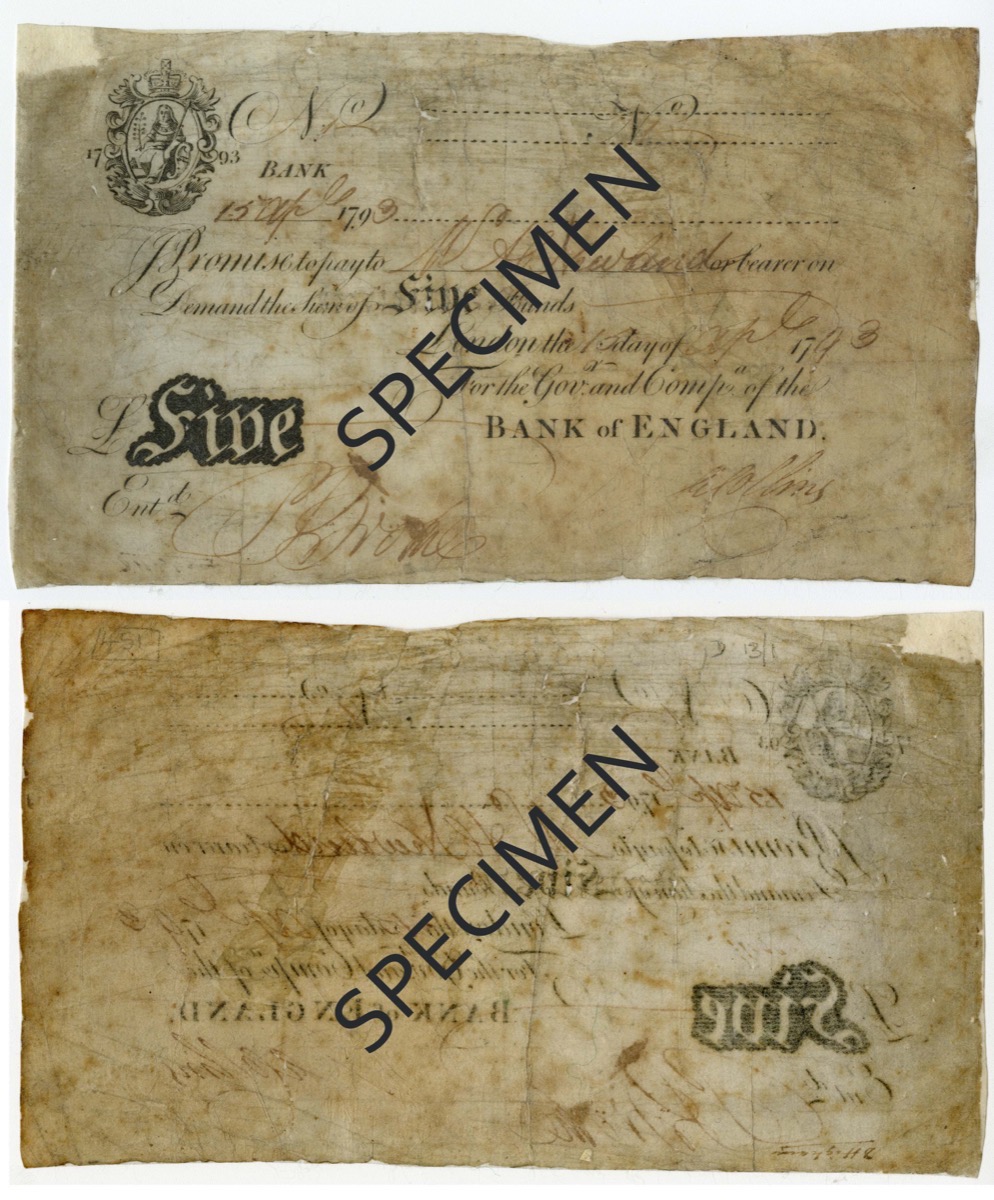
Under George III, king from 1760 to 1820, the wars against Revolutionary and then Napoleonic France required enormous funding. Military expenditure and gold outflows placed the Bank of England under pressure.
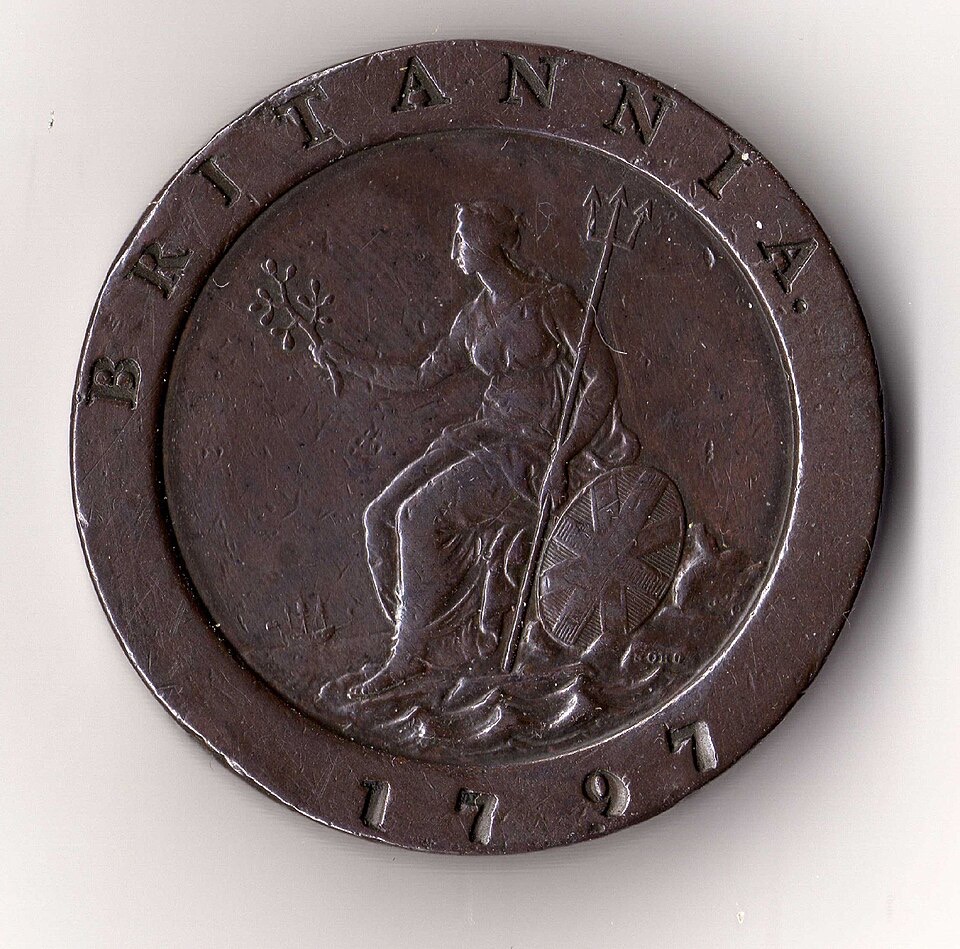
In 1797, amid fears of invasion and demands for withdrawals, the conversion of notes into gold was suspended. This began the Restriction Period, which lasted until 1821.
Notes continued to circulate, but holders could no longer normally obtain repayment in gold. Their value and the conditions for returning to convertibility fuelled debate in Parliament and among economists.
This period was a major break in the pound’s history. Long before 1914, the United Kingdom had already experienced more than twenty years during which notes were not freely convertible into gold.

The reforms of 1816 and 1817 establish the modern sovereign
After Napoleon’s defeat, the Coinage Act of 1816 reorganised the monetary system. Gold became the principal standard. Silver coins were subsidiary money: their face value exceeded the market value of their metal, and their legal-tender power was limited.
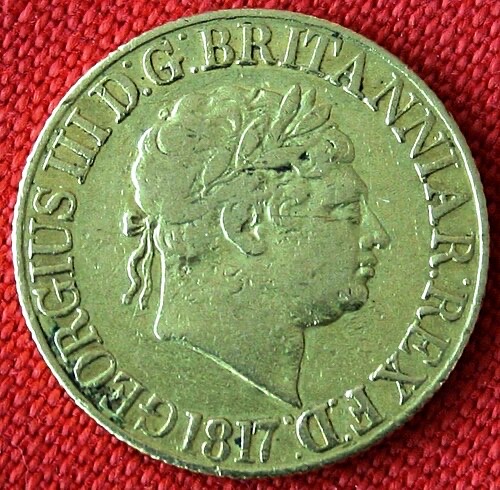
In 1817, a new gold sovereign, worth one pound, entered circulation. It replaced the guinea as the system’s principal gold coin. It revived the Tudor coin’s name but had different specifications.
The modern sovereign weighs approximately 7.99 grams, with a fineness of 22 carats, giving about 7.32 grams of fine gold. Its famous reverse showing St George slaying the dragon was designed by the engraver Benedetto Pistrucci.
In 1821, under George IV, the full conversion of notes into gold resumed. The pound’s metallic definition remained the reference until the upheavals of 1914, and was briefly restored from 1925 to 1931. [8]

7 Victoria and the pound’s international power from 1837 to 1901
London at the centre of trade and payments
Victoria’s reign, from 1837 to 1901, encompassed much of Britain’s industrial, commercial and imperial expansion. The Empire would cover approximately one-quarter of the world’s land area at its greatest extent, after the First World War.
London financed trade, transport and investment far beyond the United Kingdom. The City’s banks, insurers and trading houses handled payments and credit connected with international commerce. Sterling bills of exchange circulated among merchants on different continents.
The gold sovereign was struck in very large numbers and travelled throughout the Empire and beyond. Its familiar weight and fineness facilitated acceptance in ports, banks and major markets, from Asia to South America.
Sterling became the leading currency of trade finance and international reserves in this period. Its position rested on gold convertibility, British commerce and the depth of London’s markets. Percentages sometimes quoted for its share of “world trade” vary according to whether invoicing, financing or settlement is measured: they should not be confused.
The Bank Charter Act of 1844 regulates note issue
The Bank Charter Act of 1844, passed under Robert Peel’s government, separated the Bank of England’s Issue Department from its Banking Department. It regulated the quantity of notes that could be issued without metallic backing under the rules set out in the Act.
The reform strengthened the Bank of England’s position in note issue in England and Wales. It abolished neither deposit money created by commercial banks nor all issuing traditions elsewhere in the United Kingdom.
The gold standard and exchange-rate stability
When a country defines its currency by a weight of gold, parities with other gold currencies can be calculated from their metallic contents. The pound and the dollar thus had a parity of approximately $4.86 to £1.
The system reduced some exchange-rate uncertainty for traders and investors. It prevented neither banking crises, recessions nor changes in living costs. A pound defined by a constant gold weight did not guarantee that the same sum would always buy the same quantity of food or pay the same rent.
Victorian coins and everyday language
People in Britain still counted in pounds, shillings and pence. Several coins and expressions became familiar:
| Name | Value before 1971 |
|---|---|
| Farthing | One-quarter of a penny |
| Halfpenny | Half a penny |
| Threepence | 3 pence |
| Sixpence or tanner | 6 pence |
| Shilling or bob | 12 pence |
| Florin | 2 shillings |
| Half crown | 2 shillings and 6 pence |
| Crown | 5 shillings |
| Gold sovereign | 1 pound or 20 shillings |
| Guinea as a pricing unit | 1 pound and 1 shilling |
The florin, introduced in 1849, was worth one-tenth of a pound: it was an initial step towards possible decimalisation, more than a century before that change took place. Quid, meanwhile, was a familiar word for the pound and would survive the disappearance of shillings.
8 Edward VII and George V from 1901 to 1936
From the House of Saxe-Coburg and Gotha to Windsor
In 1901, Edward VII succeeded Victoria. Through his father, Prince Albert, he belonged to the House of Saxe-Coburg and Gotha. His son George V succeeded him in 1910.
In 1917, during the war against Germany, George V adopted Windsor as the royal family’s name. This dynastic change took place after the First World War had already profoundly altered British finances.
In 1914 gold leaves everyday circulation
At the start of the First World War, the government had to finance the army, the navy, supplies and overseas purchases. International payments were disrupted and gold became a resource to conserve.
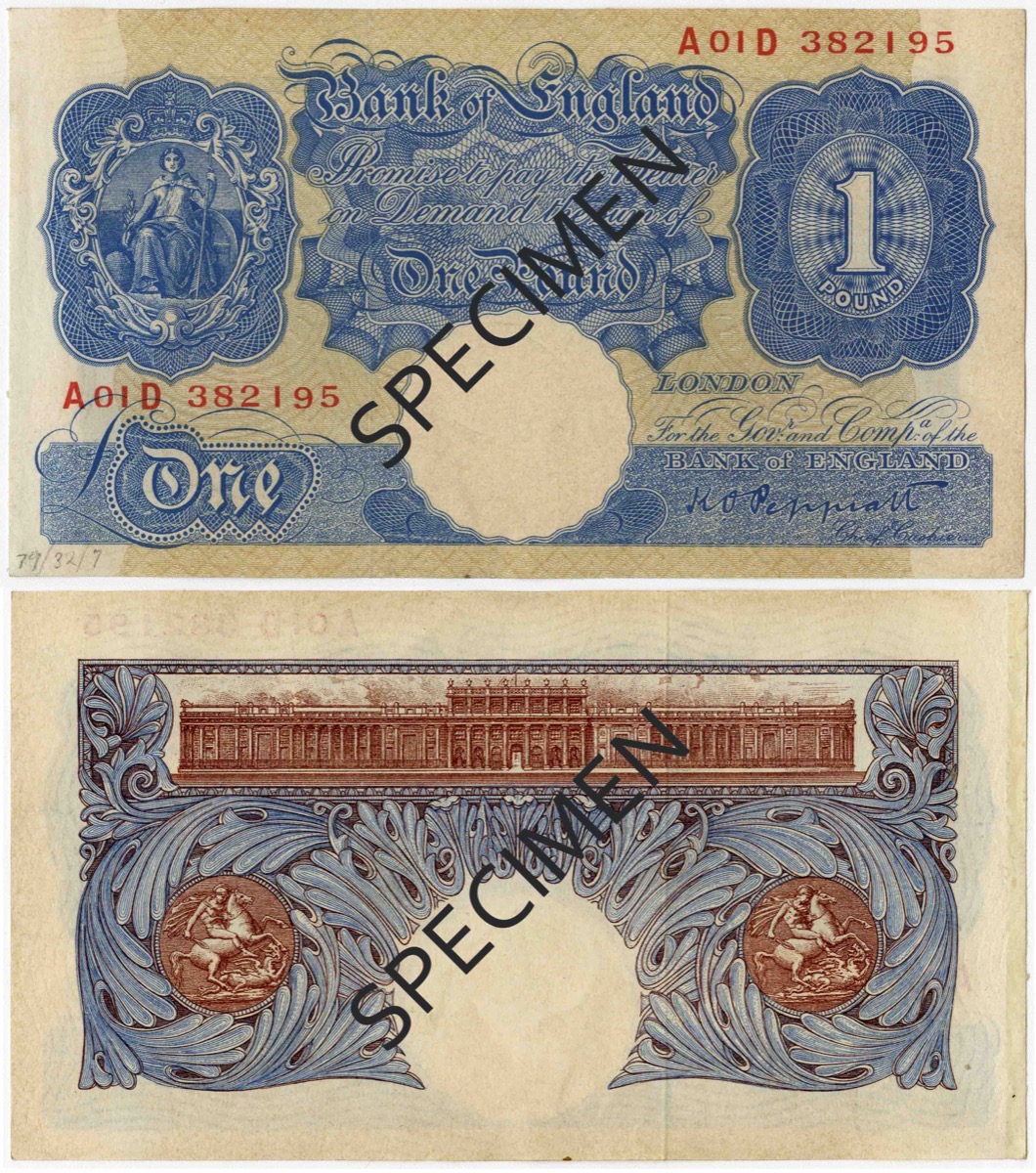
From August 1914, the normal mechanisms of the gold standard were interrupted. Treasury notes worth £1 and 10 shillings were issued to replace gold coins gradually disappearing from people’s pockets. These Treasury notes were nicknamed Bradburys, after John Bradbury’s signature printed on them.
The war was financed through taxation, borrowing and an expansion of means of payment. It greatly increased public debt and financial dependence on the United States. The pound’s international position emerged weaker.
Churchill restores the pre-war parity in 1925
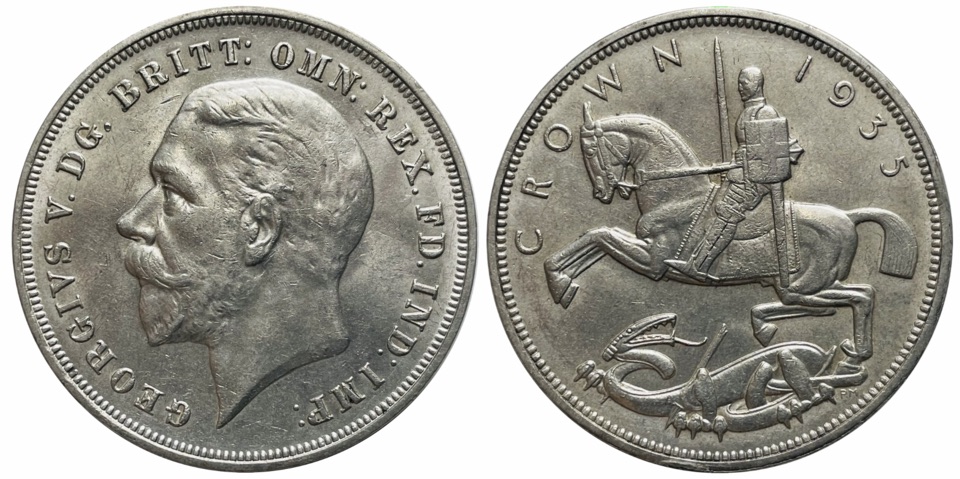
In 1925, Winston Churchill, then Chancellor of the Exchequer, restored the gold standard at the pre-war parity of about $4.86 to £1.
The return took a different form from the system before 1914: conversion involved large gold bars rather than the routine provision of sovereigns to individuals. Gold coins did not regain their customary place in everyday purchases.
The pound’s chosen level was fiercely disputed. John Maynard Keynes argued that it overvalued the currency and forced the economy to adjust through lower costs and wages. He set out his criticism in The Economic Consequences of Mr Churchill.
Pressure on exports and industries such as coal contributed to the social tensions that culminated in the General Strike of 1926. The crisis had several causes; restoring the old parity was an important factor, rather than the sole explanation.
On 21 September 1931 the United Kingdom leaves gold
The world crisis, capital outflows and loss of reserves made defending the parity unsustainable. On 21 September 1931, the United Kingdom again suspended gold convertibility. This time, the old system would not return.
The pound depreciated substantially over the following months. This was a market movement after the parity had been abandoned, not a uniform administrative reduction of 25% applied instantaneously.
Countries and territories linked to London maintained reserves and exchange relationships in sterling. This grouping gradually formed the sterling area. The pound therefore retained an important international role after the end of the gold standard.
In 1932, the Exchange Equalisation Account provided the British authorities with an instrument to intervene in foreign-exchange markets and moderate certain currency movements.

9 George VI and the transition to a dollar-dominated system from 1936 to 1952
The Second World War exhausts British resources
George VI came to the throne in 1936, following Edward VIII’s abdication. From 1939, war once again mobilised the country’s financial resources.
The United Kingdom sold assets, used reserves, borrowed and received substantial American assistance. From 1941, Lend-Lease enabled the United States to supply equipment and other goods. The programme should not be treated as an ordinary bank loan; it was distinct, in particular, from loans negotiated after the war.
At victory in 1945, the country retained considerable diplomatic and military influence, but its financial situation no longer allowed the pound to occupy its pre-1914 position.
Bretton Woods in 1944
In July 1944, representatives of the Allied countries meeting at Bretton Woods devised a new monetary order. Keynes notably advocated an international clearing unit, the bancor. The arrangement ultimately adopted gave the dollar a central position and created the framework for the International Monetary Fund and the World Bank.
Under the post-war system, currencies had fixed but adjustable parities. The dollar was convertible into gold for foreign monetary authorities at $35 per fine troy ounce. Sterling was fixed at approximately $4.03.
The dollar’s pre-eminence was thus consolidated, but its replacement of the pound as the leading international currency was a process already under way for decades, rather than a change accomplished in a single session at Bretton Woods.
Nationalisation in 1946 and the convertibility crisis of 1947
The Bank of England was nationalised in 1946. After more than two and a half centuries of private ownership, it became state-owned.
In 1947, the United Kingdom attempted to restore sterling convertibility for current payments as part of its post-war financial commitments. Demand for dollars quickly drained reserves and the experiment was suspended after a few weeks.
The devaluation of 18 September 1949
On 18 September 1949, the government reduced sterling’s parity from $4.03 to $2.80, a reduction of approximately 30.5%. Several currencies linked to sterling followed.
This established the $2.80 rate the country would defend for almost eighteen years. It is essential to understanding the subsequent devaluation in 1967.
10 Elizabeth II from 1952 to 1979
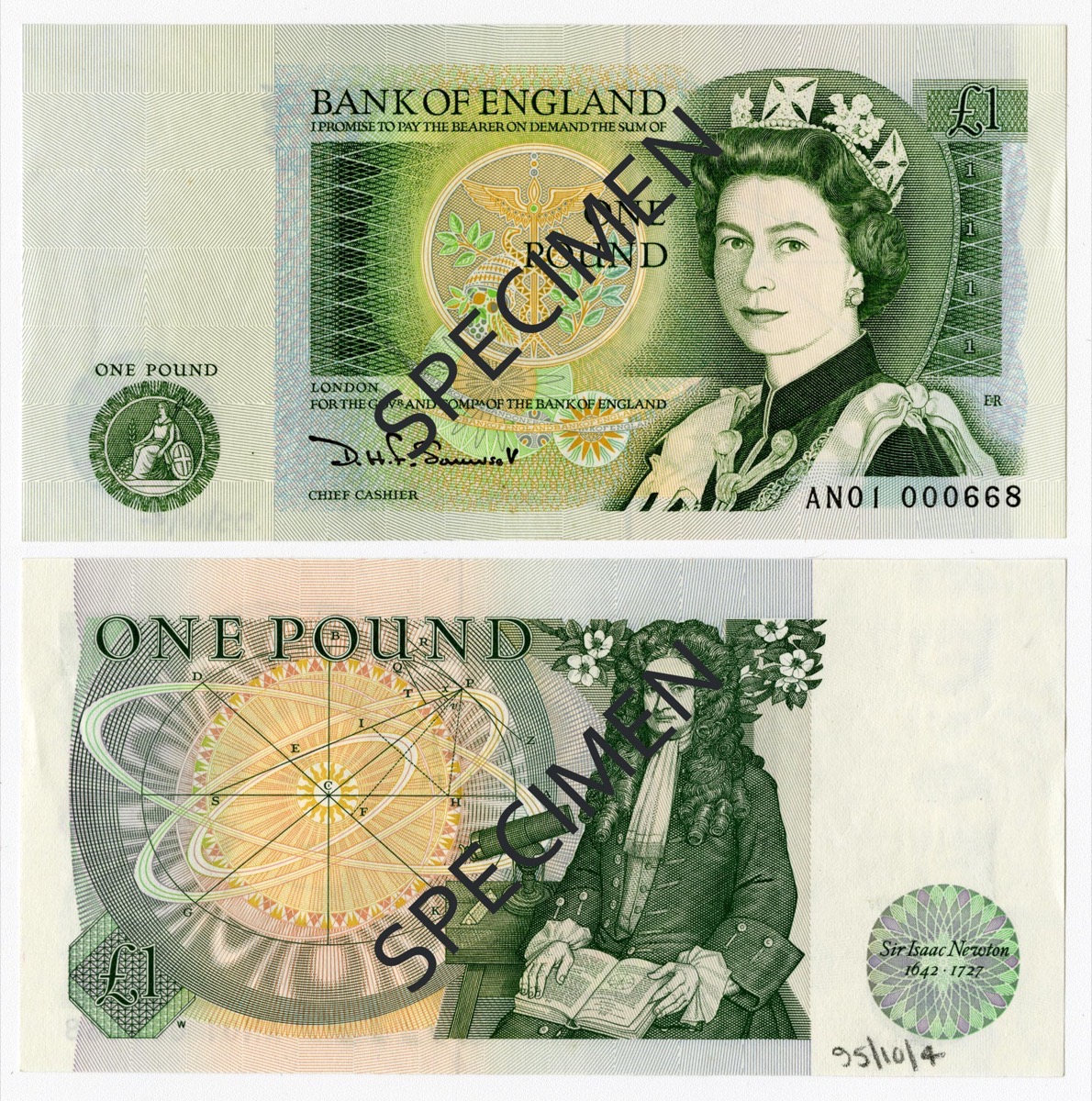
The Queen’s portrait appears on notes in 1960
Elizabeth II acceded to the throne in 1952. Her portrait appeared on new coins from 1953, but it was not until 17 March 1960 that she appeared on a Bank of England note.
She was the first monarch depicted on that institution’s notes. Her face therefore did not appear on them throughout all seventy years of her reign, despite the impression sometimes left by memories of successive portraits. In 1970, a £20 note featuring Shakespeare inaugurated the series of historical figures on the reverse.
Harold Wilson and the pound in your pocket in 1967
External imbalances, reserve losses and speculative attacks made the $2.80 parity difficult to maintain. On 18 November 1967, Harold Wilson’s Labour government devalued the pound from $2.80 to $2.40, about 14.3%.
The following day, Wilson explained on television that this did not mean the pound in people’s pockets, purses or banks had been devalued. The phrase would become closely associated with his career.
He was distinguishing the currency’s external value from the amount printed on a note or recorded in an account: one pound remained one pound in domestic payments. But imports became more expensive in sterling, which could gradually affect prices and living standards. It was this consequence that critics of his broadcast emphasised.
On 15 February 1971 the 240 pennies become 100 pence
The government announced its decision to decimalise the currency in 1966; an initial Act followed in 1967. The change required several years of preparation by banks, retailers, cash-register operators, accountants and the public.
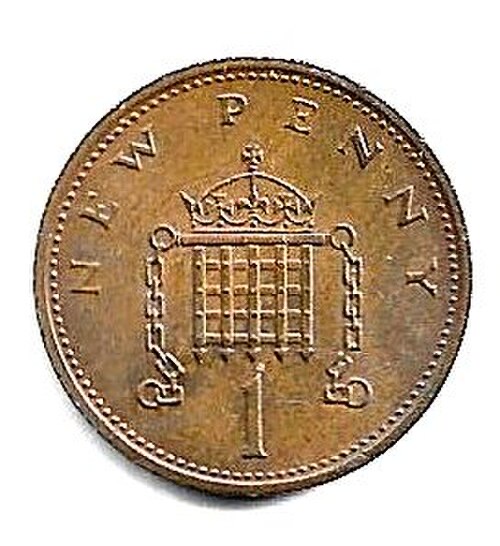
On 15 February 1971, Decimal Day, the pound was retained but became divided into 100 new pence, rather than 240 old pennies. The new abbreviation p replaced the d of the old pence.
| Old value | New value |
|---|---|
| 1 pound or 20 shillings | 100 new pence |
| 10 shillings | 50 new pence |
| 2 shillings or 1 florin | 10 new pence |
| 1 shilling | 5 new pence |
The reform was accompanied by information campaigns, television programmes, educational materials and the production of enormous quantities of coins. Some new coins circulated before the official day to help with the transition.
Old money did not disappear overnight. Shillings and florins, equivalent to 5p and 10p, remained usable for years. Other words gradually faded from everyday purchases; quid remained in common use.

In June 1972 the pound begins to float
In August 1971, the United States suspended the dollar’s official conversion into gold. Attempts to maintain an international system of fixed parities did not durably restore the old Bretton Woods arrangements.
The United Kingdom allowed sterling to float on 23 June 1972. Its rate now varied with market buying and selling, interest rates, inflation, trade and capital movements.
The authorities could still intervene, but no longer promised to maintain a single permanent parity against the dollar. This float preceded Black Wednesday in 1992 by twenty years.
Entry into the European Community in 1973 and the IMF in 1976
The United Kingdom joined the European Economic Community on 1 January 1973. It subsequently continued participating in European integration while retaining its currency.
The 1970s were marked by oil shocks, high inflation, industrial disputes and concern about public finances. Sterling fluctuated considerably.
In 1976, James Callaghan’s government negotiated an assistance programme with the International Monetary Fund, linked to economic-policy commitments. The credit requested amounted to $3.9 billion, frequently described at the time as equivalent to about £2.3 billion. The IMF approved the agreement on 3 January 1977. The episode became one of the symbols of Britain’s post-war difficulties. [15]
11 Elizabeth II from North Sea oil to the euro from 1979 to 1999
The Thatcher years and the transformation of the City
North Sea oil production became increasingly important in the 1970s and 1980s. Oil revenues and export prospects influenced the pound’s valuation in financial markets.
From 1979, Margaret Thatcher’s governments pursued policies to combat inflation and transform the economy, strongly influenced in their early years by monetarism. The Bank of England’s minimum lending rate reached 17% in November 1979. [16] High interest rates can support a currency, while a strong pound makes conditions harder for exporters. Oil alone cannot explain every exchange-rate movement: recession and international financial flows also played a part.
The Big Bang of 27 October 1986, which reformed the London Stock Exchange’s operations, accelerated the City’s transformation and the internationalisation of its institutions. Sterling trading became integrated into increasingly global financial markets.
Coins changed in people’s pockets too: the 20p appeared in 1982 and the round £1 coin in 1983. These changes to physical money were distinct from fluctuations in its exchange rate.
In 1985 the pound approaches parity with the dollar
In early 1985, a strong appreciation of the dollar drove sterling towards $1.05, an exceptionally low level at that point in its floating-rate history. This was part of an international rise in the dollar and cannot be reduced to Britain’s difficulties alone.
That autumn, the major monetary powers concluded the Plaza Accord on 22 September 1985, intended to encourage a fall in the dollar. The episode reminds us that GBP/USD depends on both currencies in the pair, rather than only on conditions in the United Kingdom.
In October 1990 sterling joins the European exchange-rate mechanism
On 8 October 1990, the United Kingdom entered the European Exchange Rate Mechanism, or ERM. Sterling had to remain within a band around agreed rates against the other participating currencies. The central rate was 2.95 Deutsche Marks to £1, with a permitted fluctuation margin around that reference.
The government sought to stabilise the exchange rate and strengthen its fight against inflation. But the entry level became difficult to sustain. Britain was in recession, while German reunification contributed to high interest rates in Germany.
Black Wednesday on 16 September 1992
On 16 September 1992, selling of sterling intensified. The Treasury and the Bank of England deployed reserves to support the rate. The government raised interest rates from 10% to 12%, then announced another increase to 15%.
The defence failed and Britain suspended its participation in the mechanism that evening. The announced increase to 15%, which was due to take effect the following day, was cancelled: it therefore never became the rate actually applied. [9]
George Soros and his fund were among the best-known participants to sell sterling heavily in anticipation of the defence’s failure. The strategy notably involved borrowing pounds, selling them and buying them back more cheaply after their fall. The profit associated with this operation is commonly estimated at around a billion dollars, earning Soros the nickname “the man who broke the Bank of England”. He was neither the only speculator nor the sole cause of the crisis.
Exit was a major political failure for John Major’s government. It also permitted subsequent interest-rate easing and contributed to a change in the framework for monetary policy.
Inflation targeting and operational independence in 1997
In October 1992, Britain adopted an explicit inflation target. Monetary policy was now organised around that objective rather than the defence of a European parity.
On 6 May 1997, the new Chancellor of the Exchequer, Gordon Brown, announced the Bank of England’s operational independence over interest rates. The Monetary Policy Committee, or MPC, would take the decisions needed to meet the target set by the government.
Independence meant neither privatisation nor freedom for the Bank to determine all its responsibilities alone. The government retained responsibility for setting the objective; the Bank had the autonomy to choose the instruments needed to pursue it. In 1997, the target was 2.5% on RPIX, which excludes mortgage-interest payments. The reference became 2% on the Consumer Prices Index, or CPI, in December 2003. Attributing that 2% target directly to the 1997 decision therefore confuses two separate stages. [17]
Britain retains the pound when the euro is created
The Maastricht Treaty, signed in 1992, provided Britain with an opt-out allowing it not to participate in the final stage of monetary union.
When the euro began in 1999 as money for accounts and markets, and when its notes and coins arrived in 2002, the United Kingdom retained sterling. It was then a member of the European Union: keeping the pound did not mean that Britain had remained outside the Union.
A new bimetallic £2 coin entered general circulation in 1998, completing the range of decimal coins.
12 The later reign of Elizabeth II and Brexit from 2000 to 2022
The banking crisis of 2008
Northern Rock’s crisis in 2007, followed by the major banks’ crisis in 2008, prompted public intervention and a sharp fall in sterling. After trading close to $2 in 2007 and during part of 2008, the pound was around $1.45 at the end of 2008. The Bank of England cut interest rates and began large-scale asset purchases, or quantitative easing, in 2009.
The Brexit referendum of 23 and 24 June 2016
On 23 June 2016, British voters chose to leave the European Union. The result became clear overnight and triggered one of sterling’s sharpest recent exchange-rate movements on 24 June.
Markets had given greater weight to the possibility of a vote to remain. Before the results were established, the pound had risen towards $1.50. It then fell well below $1.40. Between certain intranight highs and lows, the fall exceeded 10%; comparing one daily closing price with another gives a different percentage.
The vote began several years of negotiations and uncertainty about trade, investment and relations with European partners. Sterling reacted to announcements, but also to interest rates and movements in the dollar: it did not settle at a new permanent rate.
On 7 October 2016, a flash crash during the Asian trading session caused a further very rapid fall, followed by a partial recovery. The BIS measured approximately 9% across the episode it studied, a broader interval than the two minutes often cited for a 6% fall. Thin liquidity and the sequence of trading orders amplified the movement. [18]
The United Kingdom formally left the European Union on 31 January 2020; the transition period ended on 31 December 2020. Withdrawal did not restore a national currency that had disappeared: Britain had kept the pound throughout its EU membership. It continued with a floating currency and monetary policy conducted by the Bank of England.
Polymer notes from 2016 to 2021
The Bank of England replaced its cotton-based paper notes with polymer, which is more durable and incorporates transparent windows, metallic elements, holograms and raised printing. These protections make counterfeiting harder without making it impossible.
| Denomination | Person on the reverse | First polymer issue |
|---|---|---|
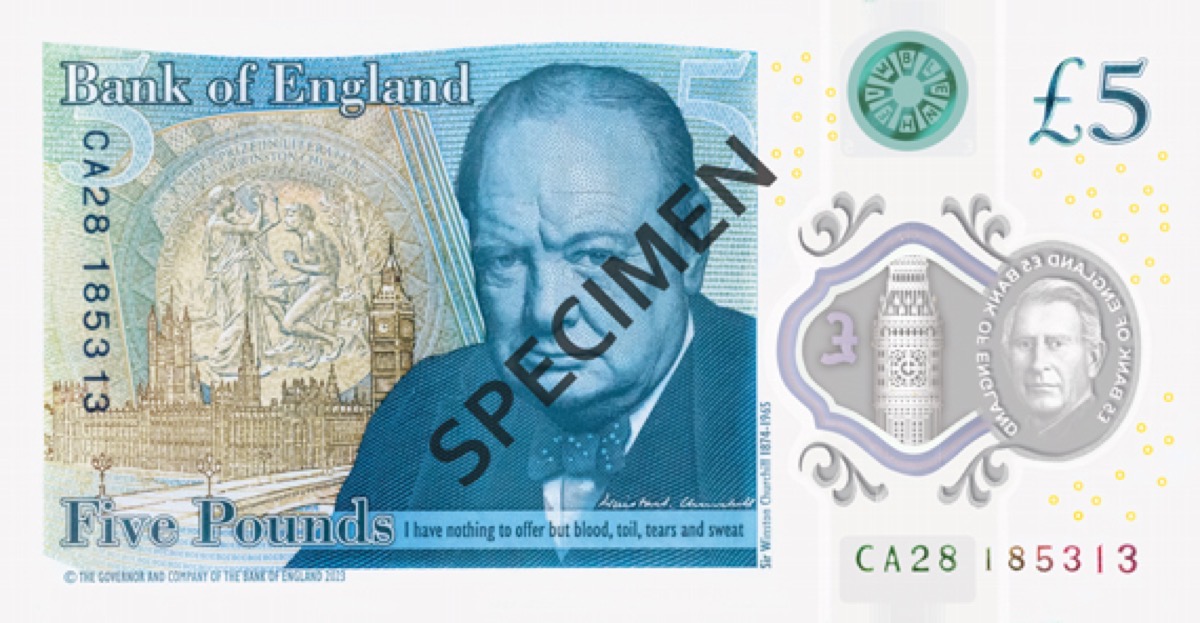
| £5 | Winston Churchill | 13 September 2016 |
| £10 | Jane Austen | 2017 |
| £20 | J. M. W. Turner | 2020 |
| £50 | Alan Turing | 2021 |
In 2017, the twelve-sided £1 coin replaced the round 1983 design, notably to improve resistance to counterfeiting.
13 Charles III since 2022
The succession and the notes of 2024
Charles III succeeded Elizabeth II on 8 September 2022. A few weeks later, Liz Truss’s government’s fiscal programme triggered a crisis: on 26 September, sterling briefly fell to approximately $1.035. On 28 September, the Bank of England announced temporary government-bond purchases to stabilise that market, notably in response to difficulties at certain pension funds. The intervention concerned bonds, rather than the direct defence of an exchange-rate parity. [19]
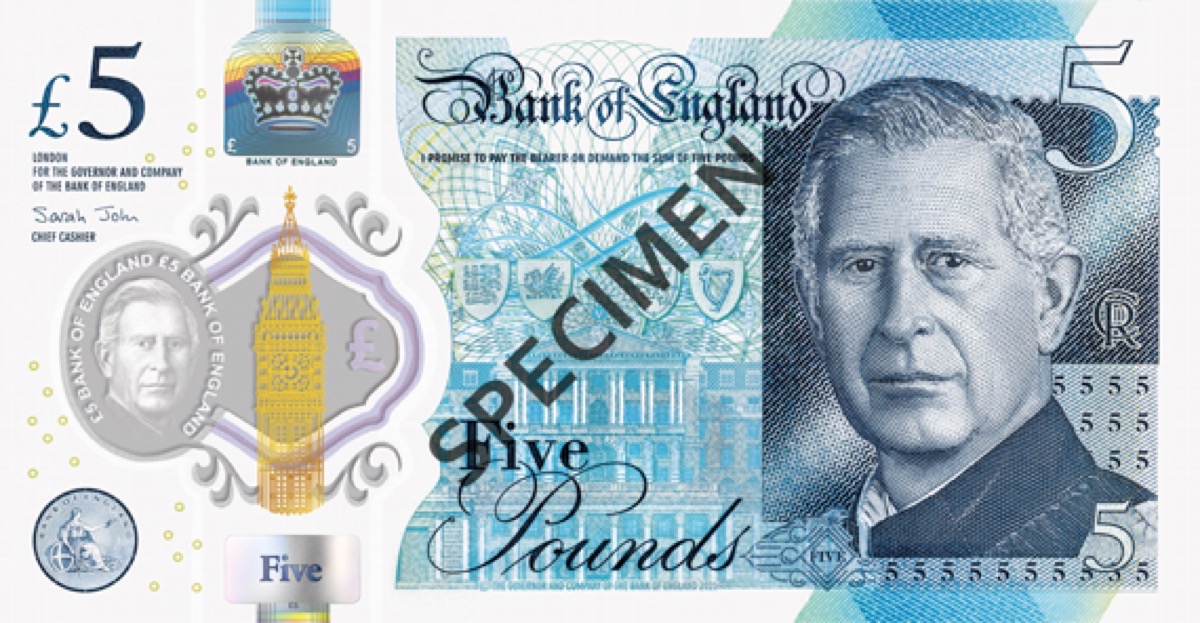
Notes featuring Charles III entered circulation on 5 June 2024, retaining the same figures on the reverse. Elizabeth II notes remain valid: gradual replacement limits costs and environmental impact. [10]
On 8 October 2026, the Bank announced four animals for a future series — the Atlantic puffin, barn owl, buff-tailed bumblebee and European hedgehog — while retaining the monarch’s portrait. The announcement does not withdraw existing notes. [11]
Four denominations, both sides to compare
These four pairs document Bank of England polymer notes, rather than every sterling issue. The £5 pair is the Elizabeth II issue of 2016; the other three pairs are the Charles III issue of 5 June 2024. Each pair shows both sides of the same issue, without claiming to depict one individual physical note.
Each note is shown in full. Select either side to open its local image for a closer look. Dimensions refer to the actual notes; these images are not shown to scale.
£5 Winston Churchill
Elizabeth II issue · 13 September 2016 · Polymer · 125 × 65 mm
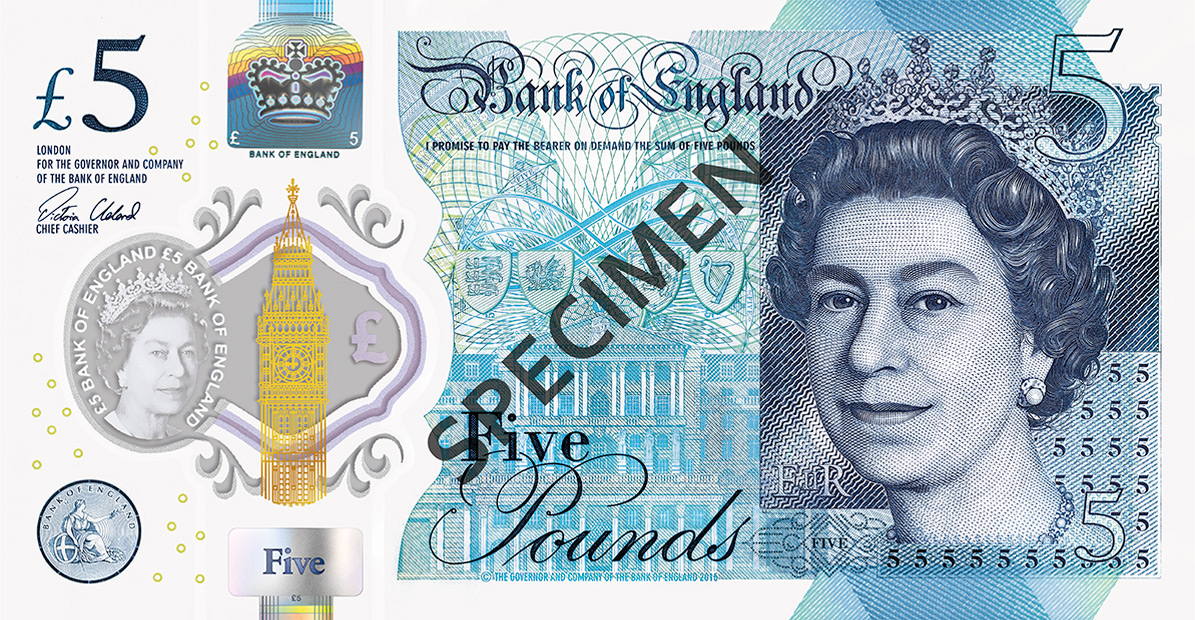
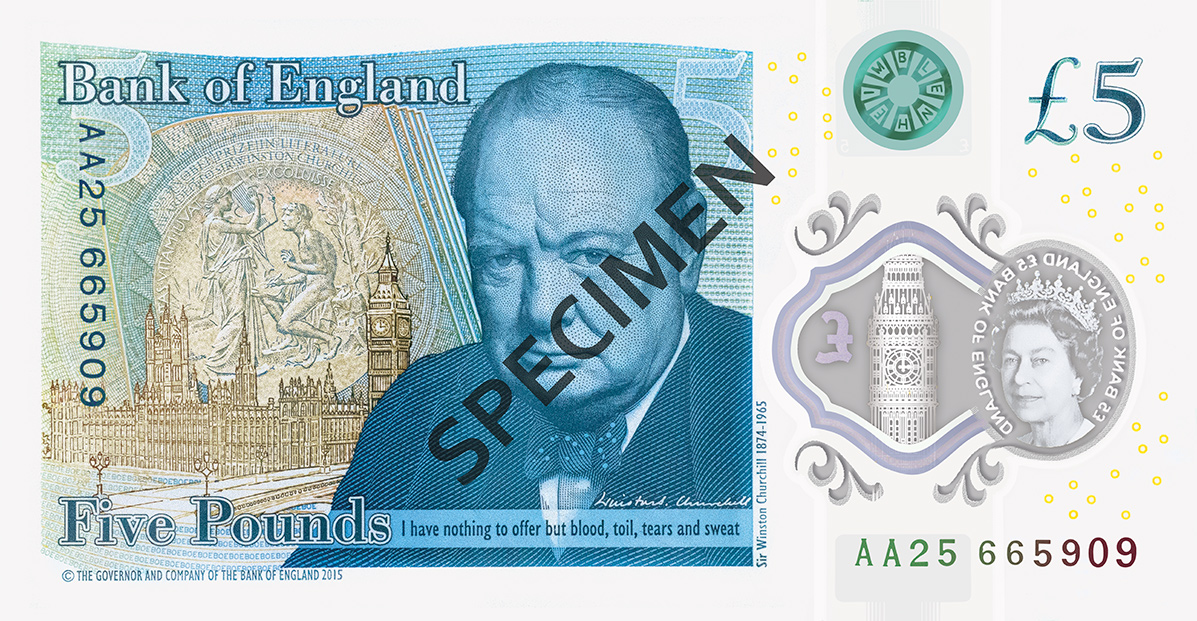
The first polymer £5, introduced on this date.
© Bank of England · SPECIMEN · Official note details and images · Reproduction conditions
£10 Jane Austen
Charles III issue · 5 June 2024 · Polymer · 132 × 69 mm
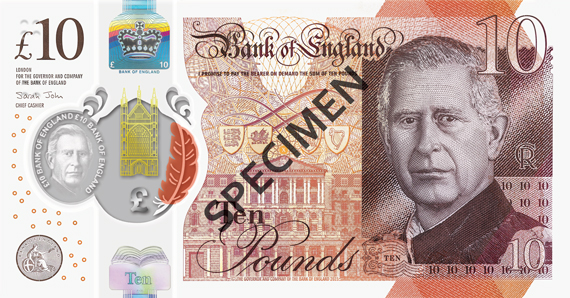
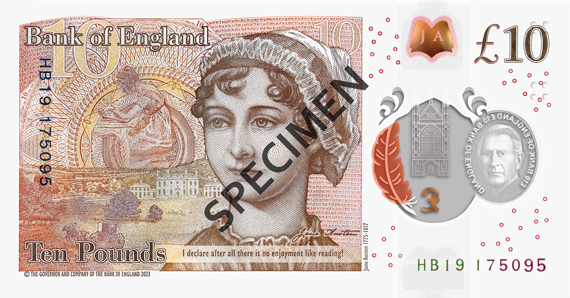
First polymer issue of this design under Elizabeth II: 14 September 2017.
© Bank of England · SPECIMEN · Official note details and images · Reproduction conditions
£20 J. M. W. Turner
Charles III issue · 5 June 2024 · Polymer · 139 × 73 mm
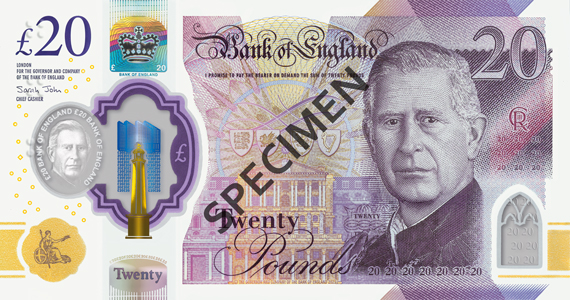
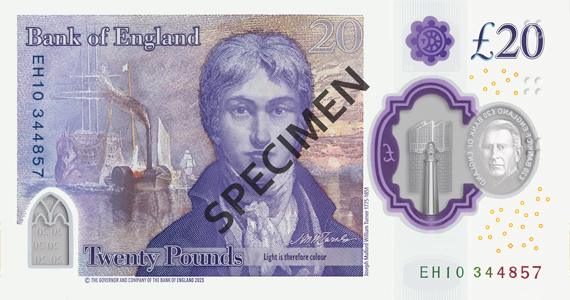
First polymer issue of this design under Elizabeth II: 20 February 2020.
© Bank of England · SPECIMEN · Official note details and images · Reproduction conditions
£50 Alan Turing
Charles III issue · 5 June 2024 · Polymer · 146 × 77 mm
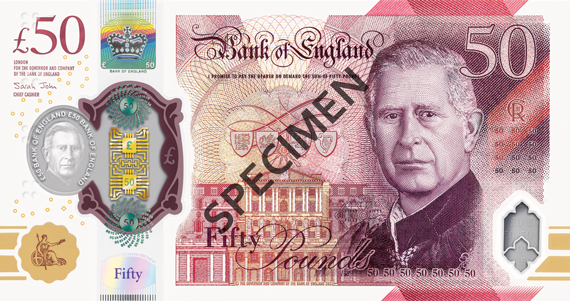
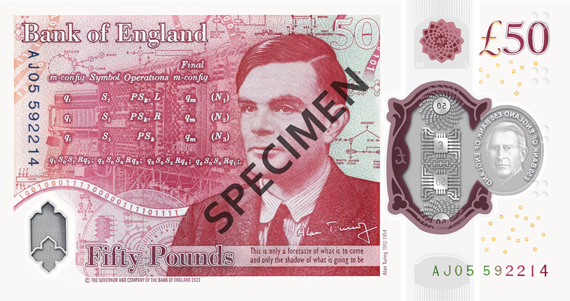
First polymer issue of this design under Elizabeth II: 23 June 2021.
© Bank of England · SPECIMEN · Official note details and images · Reproduction conditions
Why an Elizabeth II £5? When checked on 16 October 2026, the file offered as the Charles III reverse on the official £5 page showed Elizabeth II in its window. As a Charles III reverse could not be validated in the resources consulted, a matching Elizabeth II pair is shown here. Both issues remain in circulation. Current banknotes.
Documentary check: 16 October 2026. Official images with their markings retained, reproduced digitally under conditions; no open licence is claimed.
One pound and several issuing traditions
A distinctive inheritance from Scotland’s history survives: six commercial banks, three in Scotland and three in Northern Ireland, issue their own sterling notes. They must set aside assets covering at least the value of their issues, under Bank of England supervision. This is the same currency, without a separate exchange rate. [12]
Legal tender technically concerns the settlement of debts; it does not oblige a retailer to accept any banknote offered. Bank of England notes have this status in England and Wales. Scottish and Northern Irish notes circulate by acceptance without having that status, even in their own territories. [13]
The Royal Mint produces the circulating 1p, 2p, 5p, 10p, 20p, 50p, £1 and £2 coins. A change of monarch does not automatically invalidate previous coins. Commemorative and investment issues, sometimes also having monetary status, are not necessarily intended for everyday purchases.
Sterling in the international market
The international code GBP identifies the pound sterling. GBP/USD expresses dollars per pound, while EUR/GBP expresses pounds per euro. A unit worth more than a dollar is not itself proof of strength: other currencies have higher-valued units. International importance is better assessed through trading, reserves and market depth.
In the BIS survey for April 2025, sterling was the fourth most traded currency, behind the dollar, euro and yen. It appeared on one side of 10.2% of transactions, compared with 12.9% in 2022. Each transaction involves two currencies, so these shares add up to 200%. [20]
From Offa’s pennies to Charles III’s notes, the chronology passes through the Norman kings’ silver, Plantagenet gold, Tudor sovereigns, Stuart banknotes, the Hanoverian gold standard and the transformations of the Windsor reigns. The pound has retained its name through these changes, after losing its former position as the leading international currency.
Chronological milestones
| Date | Reign or period | Event |
|---|---|---|
| Around 775 | Offa of Mercia | Development of the silver pennies associated with the pound’s origins |
| Around 928 | Æthelstan | Organisation of a uniform coinage in the kingdom |
| 1066 | William I | The Norman Conquest preserves the English accounting system |
| Winter 1124–1125 | Henry I | Punishment of the moneyers at Winchester |
| 1158 and 1180 | Henry II | Tealby and then Short Cross pennies |
| 1257 | Henry III | Attempt to introduce a gold penny |
| 1279 | Edward I | First groat issue and concentration of London minting in the Tower |
| 1344 | Edward III | Gold florin followed by the noble |
| 1351 | Edward III | Lasting development of the fourpenny groat |
| 1489 | Henry VII | First gold sovereign worth one pound |
| Around 1504 | Henry VII | Appearance of the twelvepenny testoon |
| 1544–1551 | Henry VIII and Edward VI | Great Debasement |
| 1560–1561 | Elizabeth I | Major recoinage of the silver currency |
| 1603 | James VI and I | Union of the English and Scottish crowns |
| 1662–1663 | Charles II | General adoption of machine striking and appearance of the guinea |
| 1694 | William III and Mary II | Foundation of the Bank of England and its first note issues |
| 1696 | William III | Great Recoinage of silver and Newton’s arrival at the Mint |
| 1699 | William III | Newton becomes Master of the Mint and Chaloner is executed |
| 1707 | Anne | Union of England and Scotland and alignment of the coinage |
| 1717 | George I | Guinea fixed at 21 shillings |
| 1797–1821 | George III and then George IV | Suspension of notes’ conversion into gold |
| 1816 and 1817 | George III | Legislative reform followed by the modern sovereign |
| 1821 | George IV | Resumption of gold convertibility |
| 1844 | Victoria | Bank Charter Act regulates note issue |
| 1849 | Victoria | Introduction of the two-shilling florin |
| 1914 | George V | War interrupts the normal operation of the gold standard |
| 1917 | George V | Royal family adopts the name Windsor |
| 1925 | George V | Return to the pre-war gold parity |
| 21 September 1931 | George V | Final abandonment of gold convertibility |
| 1944 | George VI | Bretton Woods conference |
| 1946 and 1947 | George VI | Bank nationalised, followed by the failed convertibility experiment |
| 18 September 1949 | George VI | Devaluation from $4.03 to $2.80 |
| 1960 | Elizabeth II | First royal portrait on a Bank of England note |
| 1966 and 1967 | Elizabeth II | Decimalisation announced and its first Act passed |
| 18 November 1967 | Elizabeth II | Devaluation from $2.80 to $2.40 |
| 15 February 1971 | Elizabeth II | Decimal Day and a pound divided into 100 pence |
| August 1971 | Elizabeth II | End of the dollar’s official conversion into gold |
| 23 June 1972 | Elizabeth II | Sterling returns to floating |
| 1973 | Elizabeth II | Entry into the European Economic Community |
| 1985 | Elizabeth II | Sterling approaches $1.05 |
| 1986 | Elizabeth II | The City’s Big Bang |
| 8 October 1990 | Elizabeth II | Entry into the European Exchange Rate Mechanism |
| 16 September 1992 | Elizabeth II | Black Wednesday and exit from the mechanism |
| 6 May 1997 | Elizabeth II | Announcement of the Bank of England’s operational independence |
| 1999 and 2002 | Elizabeth II | Euro launched, followed by its cash, without British participation |
| 23–24 June 2016 | Elizabeth II | Brexit referendum and sharp fall in sterling |
| 13 September 2016 | Elizabeth II | First Bank of England polymer note |
| 7 October 2016 | Elizabeth II | Sterling flash crash |
| 2017 | Elizabeth II | Twelve-sided £1 coin and polymer £10 note |
| 2020 and 2021 | Elizabeth II | Polymer £20 and then £50 notes |
| 31 January 2020 | Elizabeth II | Formal withdrawal from the European Union |
| September 2022 | Charles III | Royal succession and mini-budget crisis |
| 5 June 2024 | Charles III | Notes featuring the King enter circulation |
Sources and verification references
Starting text: History of the British Pound.
- Royal Mint Museum — Penny — history of the penny and Offa’s coinage.
- Athelstan Museum — Athelstan silver penny — organisation of the mints under Æthelstan.
- Hampshire Cultural Trust — Henry I silver penny struck at Winchester — context of the punishment of the moneyers.
- Royal Mint Museum — Henry VIII silver trial plate and Royal Mint — The Great Debasement and the Tudor Monetary Revolution — changes in coin fineness under the Tudors.
- Royal Mint Museum — Charles II — machine striking and the guinea.
- Royal Mint Museum — Isaac Newton — Newton’s offices, recoinage and prosecutions.
- The Newton Project — Newton’s report of 21 September 1717 — primary source on the relationship between gold and silver coins.
- Royal Mint Museum — George III and the modern sovereign — reform and the coin’s introduction in 1817.
- Bank of England — History — institutional milestones, leaving gold, nationalisation, portraits and Black Wednesday, including the cancellation of the announced rise to 15%.
- Bank of England — Banknotes — circulating denominations, polymer and coexisting royal portraits.
- Bank of England — Announcement of four animals for the next banknote series, 8 October 2026.
- Bank of England — Scottish and Northern Ireland banknotes — six issuers and backing assets.
- Bank of England — What is legal tender — scope of legal tender and acceptance of cash.
- Royal Mint — The Oldest Coins Struck by The Royal Mint — groats of 1279 and 1351.
- UK Parliament — International Monetary Fund, 24 March 1977 — request for $3.9 billion and approval on 3 January 1977.
- Bank of England — Economic commentary, June 1980 — the 17% rate in November 1979.
- House of Lords — Making an independent Bank of England work better — distinction between the targets of 1997 and 2003.
- BIS — Report on sterling flash event — analysis of 7 October 2016.
- Bank of England — Financial stability buy sell tools: a gilt market case study — the bond-market crisis and intervention of September 2022.
- BIS — OTC foreign exchange turnover in April 2025 — sterling’s rank and share of foreign-exchange transactions.
Full credits: images-manifest.json. Banknote reproductions are © Bank of England and used under its reproduction conditions.