A remote island at the centre of ocean routes
A copper halfpenny, a large commemorative 25 pence and a pound bearing a seabird open three quite different chapters of St Helena’s monetary history. The first speaks for a trading company; the second recalls a royal charter; the third links two islands through everyday money. What connects them is the practical business of maintaining exchange over great distances.
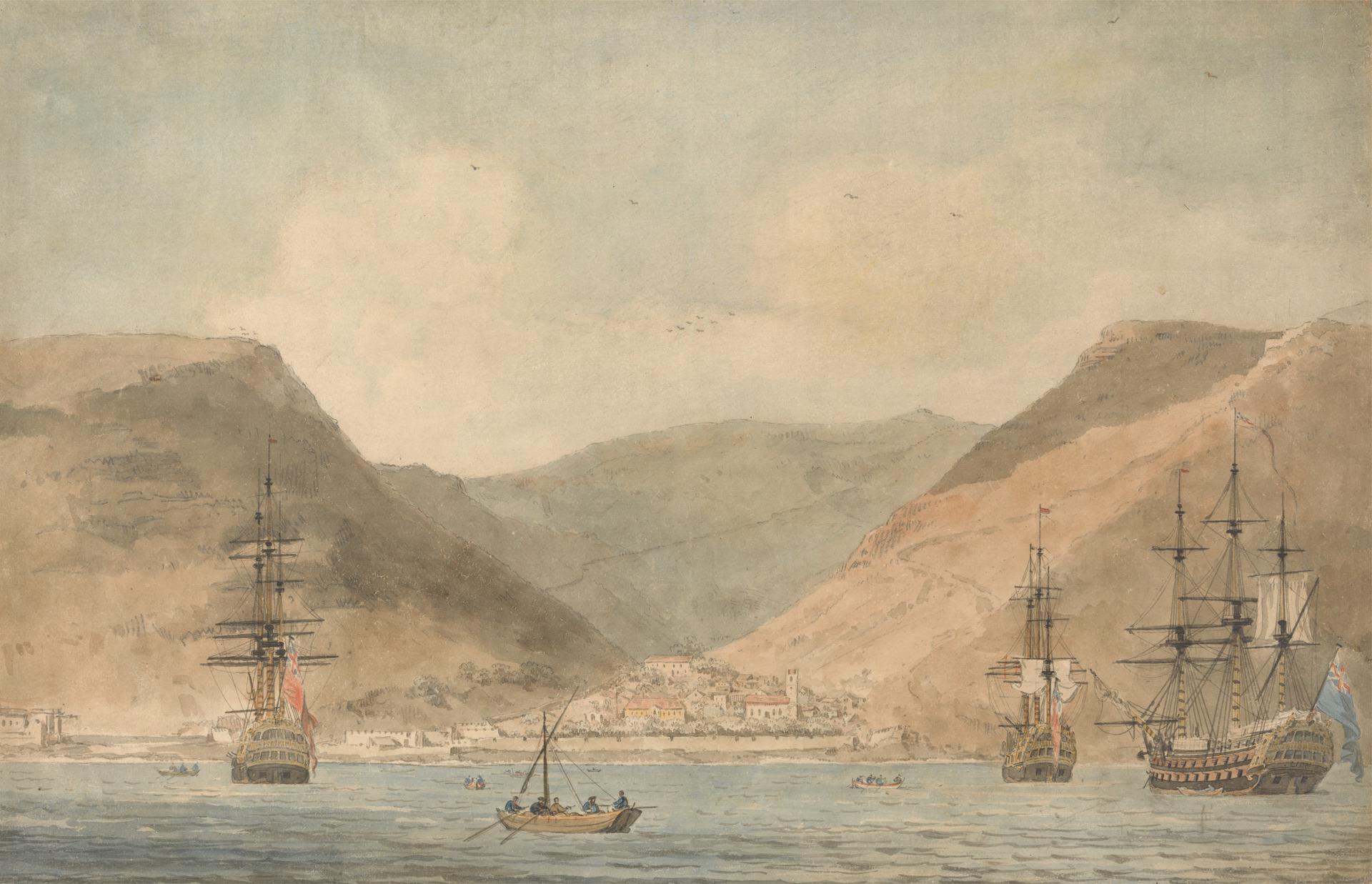
When Portuguese navigators reached St Helena in 1502, it had no known permanent population. Its monetary history developed with ships seeking water and provisions. The East India Company established a settlement in 1659. Jamestown became a staging post on the India route, where crews, a garrison, suppliers and administrators all required ways to settle payments.
Remoteness should therefore not be mistaken for an absence of connections. Distance could make deliveries irregular and cash supplies difficult, yet the island was embedded in ocean trading networks. Its money records those external relationships as clearly as it expresses a local identity. The surviving objects tell a more revealing story than the image of a self-contained island economy.

Company rule: accounts, payments and credit
Colonial money involved far more than coins. Company records preserve inventories, accounts, debts and written obligations. A consultation in 1741 records a forty-pound debt and the loss of the document acknowledging it. The episode shows how a sum could exist as a claim between individuals without being represented at every moment by a corresponding pile of metal.
We also need to distinguish the unit used in an account from the object handed over in payment. Keeping books in pounds does not demonstrate that every transaction was settled with a British coin of the appropriate denomination. At a port of call, credit and acceptance of money brought from elsewhere could supplement official supplies.
In his 1984 numismatic account, Trevor Hearl mentions earlier local currency, including copper bars in 1683, of which he knew no surviving examples. That is documentary evidence for a reported practice, rather than an identified surviving coin. No photograph in this dossier is presented as showing such an object. The distinction matters whenever a rare issue is better known through written descriptions than through securely identified specimens.
The island’s society was also shaped by slavery and, later, by different forms of constrained labour and migration. A monetary account cannot by itself describe living conditions. A shared accounting unit did not mean that everyone was free to negotiate employment or enjoyed equal access to earnings. The history of payment belongs within that wider social history.
Archives : registres de 1741–1742 / Records, 1741–1742 · Trevor W. Hearl, St Helena Coinage, 1984 · Cultural Heritage Detailed Assessment, Appendix 11.1

1821: an island name on a copper halfpenny
The halfpenny dated 1821 offers a particularly clear material witness. One side names St Helena and states the denomination; the other carries the East India Company’s arms. The little copper coin brings together a place of use, a fraction of the monetary unit and the authority standing behind its issue.
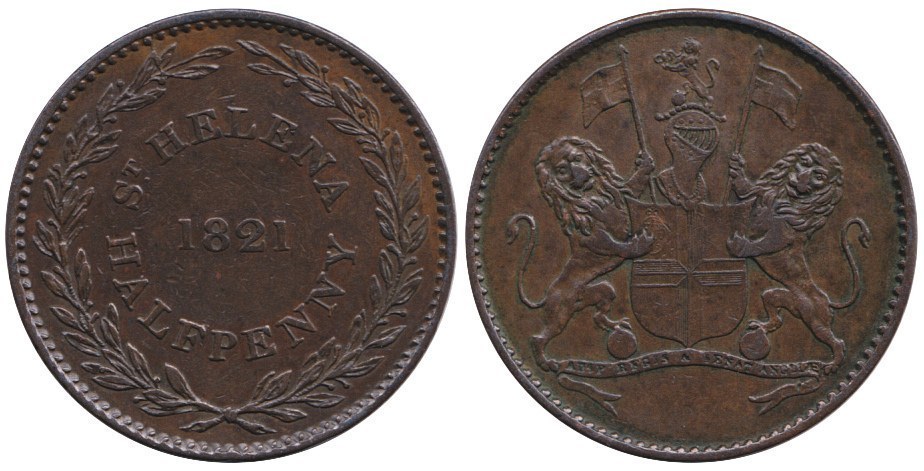

The record for this specimen attributes its manufacture to the Soho Mint at Handsworth in Britain. Money intended for the island was therefore made far away. This separation between issuing territory and manufacturing workshop would remain important: a distinctive currency does not require a local mint or banknote factory.
Copper was suitable for small denominations, where precious metal could be inconvenient or too costly for ordinary purchases. But the word halfpenny must be read in its original monetary setting. Under the old British system, a pound comprised twenty shillings, each divided into twelve pence. This coin represented half of one of those old pennies, rather than half of a modern decimal penny.
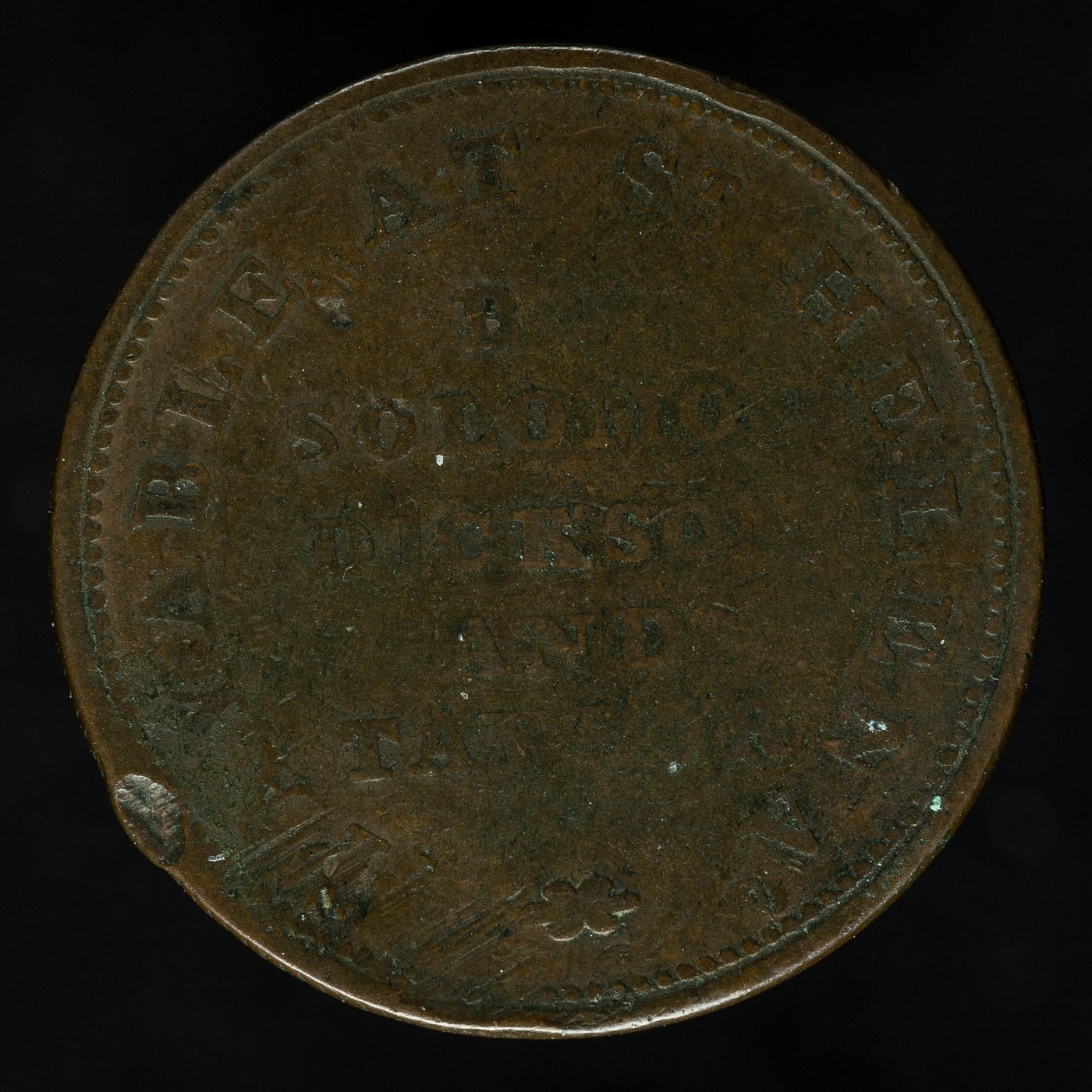
Hearl also records commercial tokens bearing the names Solomon, Dickson and Taylor. The undertaking behind a merchant token depended on a trader’s credit. Distinguishing such pieces from Company coinage reveals the different authorities that could stand behind superficially similar copper objects. In a collection, reading the issuer can be as revealing as reading the date.
Napoleon, the Crown and the long sterling connection
The date 1821 also marks Napoleon’s death on 5 May, after the exile that began in 1815. For many readers, that makes the halfpenny especially evocative. It does not make it a Napoleonic commemorative coin: its inscriptions concern the Company and its monetary value. Sharing a date is not evidence that a coin was designed to commemorate an event.
Captivity made St Helena a major place of European remembrance. Personal relics in museum collections, such as the British Museum’s brooch containing Napoleon’s hair, nevertheless belong to a different category from circulating currency. Keeping those categories distinct prevents the Emperor’s story from overwhelming every other aspect of the island’s material history.
On 22 April 1834, administration passed from the East India Company to the Crown under the arrangements established in 1833. The preamble to the 2009 Constitution specifically recalls that date. The political transfer was significant, but it was not the birth of today’s SHP currency.
During the long period that followed, British coins supplied everyday needs and accounting remained within the sterling world. Reading an old account still requires care: pounds, shillings and pence cannot simply be read as modern decimal denominations. Britain’s decimalisation in 1971 eventually replaced 240 old pence with 100 new pence to the pound. The pound continued, while the arithmetic of small change changed fundamentally.
British Museum : broche avec cheveux de Napoléon / Napoleon hair brooch · Constitution de 2009, préambule / 2009 Constitution, preamble · Royal Mint Museum : St Helena and Ascension · Royal Mint Museum : Decimalisation
1973: a royal charter becomes a collector’s coin
Before the modern local notes, a commemorative issue brought the island’s name into renewed focus. A 25 pence piece in 1973 marked the tercentenary of the Royal Charter of 1673, which had confirmed the Company’s rights on St Helena. The chosen anniversary presented a foundational act of colonial government.
The object is documented in the sources below; its image is not reproduced here.

This large coin belongs to the commemorative crown tradition. Its 25 pence denomination is decimal, while its format retains a relationship with the former British five-shilling crown. Money here becomes a means of preserving an anniversary and giving a historical narrative a durable physical form.
A commemorative coin may have a face value without being something frequently encountered in market change. Presentation packs, special finishes and retention by collectors follow a different pattern from everyday circulation. That distinction is essential when approaching the many later issues bearing St Helena’s name.
The anniversary also supplies a useful bridge between periods. It looks back to Company government while using a modern denomination and a royal portrait. Continuity and change sit on the same object: an older political memory expressed through the coin-making and collecting conventions of the twentieth century.
1975–1976: modern local notes and their later series
The modern framework was established by the Currency Ordinance of 1975. The St Helena pound is divided into 100 pence and has parity with sterling. Currency Commissioners issue cash on behalf of the government. That issuing authority must be distinguished from the bank providing accounts to residents and businesses.
The first notes of the modern period entered circulation on 2 February 1976. Catalogues distinguish the 1976–1979 issues, the series of the 1980s and the renewal of 2004. The allocation of particular early denominations between 1976 and 1979 is not presented here as completely settled: the consulted summaries do not all give the same chronology.
One-pound and fifty-pence notes recall a time when amounts now associated with coins could be paid in paper. The expansion of metallic denominations gradually changed that division of work. A twenty-pound note appears in the 1980s series; ten- and twenty-pound designs were subsequently renewed in 2004.
Identifying a banknote requires more than recognising its portrait. Denomination, size, signatures, serial prefixes and any printed date all matter. A date printed on a note can differ from its actual release: BanknoteDB catalogues a ten-pound note dated 2012 as issued in 2014, with De La Rue identified as printer. That distinction helps prevent every signature or date change from being mistaken for a monetary reform.
The notes have their own iconographic history. A royal portrait can remain while signatures, security elements and compositions change. Motifs therefore need to be identified series by series: the island’s Napoleonic heritage cannot by itself explain the full range of imagery on its money.
Currency Ordinance, 1975 — consolidated text · Saint Helena Island Info : Industries · ATS Notes : catalogue des séries / series catalogue · BanknoteDB : 10 pounds, 2012 (2014)
1984: pocket money for St Helena and Ascension
A circulating coin series entered use on 3 January 1984. The Royal Mint helped prepare and strike it. Queen Elizabeth II appeared on the obverse, while reverse designs by Mike Hibbit drew on island wildlife and plants. The values and shapes fitted familiar British monetary conventions.
The object is documented in the sources below; its image is not reproduced here.

On the 1984 pound, the royal portrait establishes the political setting. Turning the coin changes the scale of the story: the viewer moves from the monarchy to a seabird familiar in the South Atlantic. A common authority and a strongly local subject meet on an everyday object.
The object is documented in the sources below; its image is not reproduced here.

The sooty tern is known on Ascension as the wideawake. Coin inscriptions bring St Helena and Ascension together, while notes name the St Helena Government. These are not two unrelated pounds but a shared area of use for the local currency.
The first series must not be treated as a description of every later issue. The wirebird, turtles, donkey and flowers appear according to denomination and period. A careful inventory dates its observations: stating simply that “the five pence depicts…” can become misleading when a reverse design changes. A photograph is evidence for the specimen shown, rather than for all coins of that value.
Tristan da Cunha requires a separate distinction. Its administration uses sterling as its primary and reporting currency. Membership of the same British territory does not automatically imply the same circulating-cash arrangements as St Helena and Ascension. Political geography and monetary geography do not align in every detail.
Trevor W. Hearl, St Helena Coinage, 1984 · Royal Mint Museum : St Helena and Ascension · Tristan da Cunha : Treasury and Finance Department
2026: Charles III, Jonathan and the St Helena ebony
On 12 January 2026, the government announced polymer five-, ten- and twenty-pound notes featuring Charles III, with introduction planned during that month. Existing notes were to circulate alongside them and be replaced gradually. This was a renewal of materials and designs within the same monetary unit.
The proclamation of 15 January specifies the physical designs. All three values measure 135 × 65 mm: the five is blue, the ten pink and the twenty light brown. Charles III and a shield in a transparent window appear on the front; Jonathan the tortoise and the ebony flower appear on the back. The printed year is 2025, distinct from the 2026 announcement.
| Value | Colour | Tactile shape |
|---|---|---|
| £5 | Blue | Square |
| £10 | Pink | Triangle |
| £20 | Light brown | Circle |
The raised dots help users distinguish denominations through touch. Their inclusion is a reminder that a banknote is handled, recognised in different lighting conditions and used by people with different visual abilities. Public imagery, security and accessibility all meet in the design of a small practical object.
Jonathan and the ebony direct attention towards living heritage. The tortoise represents an enduring presence in island life; the flower evokes an endemic plant closely associated with conservation. The island tells its story through familiar creatures and its natural environment, widening the focus beyond the history of exile.
These notes also demonstrate why three dates may need separating in a catalogue: the year printed within the design, the legal specification and the public announcement. Treating them as interchangeable would obscure the actual sequence of a new issue.
Annonce des billets, 12 janvier 2026 / Banknote announcement, 12 January 2026 · Gazette : Legal Notice 2 of 2026, 15 January · Bank of St Helena : Merchant Information · History and Heritage
Issuing cash and running a bank are different jobs
Bank of St Helena was established on 1 April 2004, inheriting the assets and liabilities of the earlier savings banks on St Helena and Ascension. It provides services to individuals and businesses. Its establishment is a separate event from the introduction of local notes in 1976 and circulating coins in 1984.
The bank’s 2004–2005 report shows that financial modernisation preceded the airport. It already records lending, cash advances against international cards and improved overseas payments. Those services connected local accounts to transactions beyond the islands.
Understanding parity requires separating two questions. One concerns the unit: a local pound corresponds to a pound sterling. The other concerns the physical cash system: who commissions, distributes, sorts and replaces notes? The Currency Fund and Commissioners belong to the issuing framework; the bank participates in financial services and everyday circulation.
A stable relationship with sterling does not shelter local prices from the outside world. The government’s budget explains how changes in sterling against suppliers’ currencies, especially the South African rand, affect import costs. Monetary parity therefore does not mean unchanging prices or independence from external trading conditions.
The first scheduled commercial flight arrived on 14 October 2017, after the airport became operational in 2016. That was a major change in human connections. It did not create the bank, introduce the currency or establish a new SHP-to-GBP relationship. Access infrastructure and monetary institutions intersect, but each has its own chronology.
Bank of St Helena : About Us · Bank of St Helena : rapport 2004–2005 / annual report · Budget Book 2025/26–2027/28 : parité et importations / parity and imports · Premier vol régulier, octobre 2017 / First scheduled flight · Gouvernement : Travel Information
Reading collector issues as historical objects
St Helena’s name now appears on issues intended for an international numismatic audience. The Royal Mint, for example, lists a 2021 St Helena silver proof coin on the theme of Una and the Lion. This is a different setting from that of a worn copper halfpenny or the small coins passed across a shop counter.
First identify the category of object: circulating coin, commemorative issue, private token or medal. Then separate face value, precious-metal content and the price charged to a collector. These can be very different figures. The presence of a pound sign does not by itself explain how an object is actually used.
It is equally useful to distinguish issuer, manufacturer and distributor. A territory may authorise an issue, a mint manufacture it and a separate business market it. A commercial name on an advertisement is not sufficient evidence for the place of striking. The captions and references here state what has been identified for the objects shown.
A clear reproduction also needs documentary provenance. The locally stored photographs in this dossier allow details to be examined, while credits identify their sources and licences. Contemporary banknote images whose commercial reuse could not be established have not been reproduced. The notes remain part of the narrative through official design descriptions and catalogues.
From Company copper to the polymer series announced under Charles III, St Helena’s pound expresses a durable relationship: local forms of money supporting exchanges closely connected with the wider world. Its coins and banknotes carry maritime history, political authority and natural heritage into the palm of a hand.
Sources and credits
Photographs are stored in the assets folder and display offline. Source and licence links require internet access. Notes are described without reproducing images whose commercial reuse rights remain uncertain.
Sources consulted on 15 October 2026. Institutional records, legal texts and contemporary testimony are distinguished from catalogues and local historical summaries. Photograph credits are given beneath each figure.
- Royal Mint Museum : Decimalisation
- History and Heritage
- Constitution de 2009, préambule / 2009 Constitution, preamble
- Archives : registres de 1741–1742 / Records, 1741–1742
- Trevor W. Hearl, St Helena Coinage, 1984
- Royal Mint Museum : St Helena and Ascension
- Currency Ordinance, 1975 — consolidated text
- Annonce des billets, 12 janvier 2026 / Banknote announcement, 12 January 2026
- Gazette : Legal Notice 2 of 2026, 15 January
- Bank of St Helena : About Us
- Bank of St Helena : rapport 2004–2005 / annual report
- Bank of St Helena : Merchant Information
- Premier vol régulier, octobre 2017 / First scheduled flight
- Gouvernement : Travel Information
- ATS Notes : catalogue des séries / series catalogue
- BanknoteDB : 10 pounds, 2012 (2014)
- Saint Helena Island Info : Notes and Coins
- Saint Helena Island Info : Industries
- Budget Book 2025/26–2027/28 : parité et importations / parity and imports
- Cultural Heritage Detailed Assessment, Appendix 11.1
- British Museum : broche avec cheveux de Napoléon / Napoleon hair brooch
- Royal Mint : Una and the Lion, St Helena, 2021
- Tristan da Cunha : Treasury and Finance Department