Tutankhamun’s mask on a modern coin, camels on an early note and a mosque on polymer bring different periods of Egypt together. Created in the nineteenth century, the pound belongs to a much older monetary history. Following it means learning to look closely at the objects that pass from hand to hand.
01 / EGPBefore coins: accounting, weighing and payment
Long before a ruler’s face was struck into metal, Egypt had ways to measure value. Harvests were stored, services recorded and quantities of grain and metal compared. The deben found in ancient texts was a unit of weight. A “one-deben coin” in the pocket of a pyramid builder would be an anachronism.
Describing the entire pharaonic economy as straightforward barter is also misleading. An object could be valued in a weight of copper and paid for with several different goods whose values were added together. Accounts, credit, payments in kind and weighed metal could coexist. A shared measure of value helped transactions go beyond the chance meeting of two people who wanted each other’s goods.
A striking example from the records of Deir el-Medina concerns a coffin valued at 25.5 deben of copper, paid for with goats, a pig, wood and copper. The Royal Ontario Museum uses this transaction to explain the difference between the unit in which a price was stated and the things actually handed over. That distinction runs through monetary history: money is never merely the physical object used to settle a payment.
Chapter sources: UCL — Measuring weight in Ancient Egypt · Royal Ontario Museum — Weight
02 / EGPAlexandria: the portrait and the eagle
The earliest coins struck in Egypt date to the Late Period and were probably produced in part to pay Greek soldiers. Regular coinage developed under the Ptolemies, the dynasty that emerged from the division of Alexander’s empire. Circulation expanded particularly from Ptolemy II onwards. Weights and accounts did not disappear: they gained another instrument.
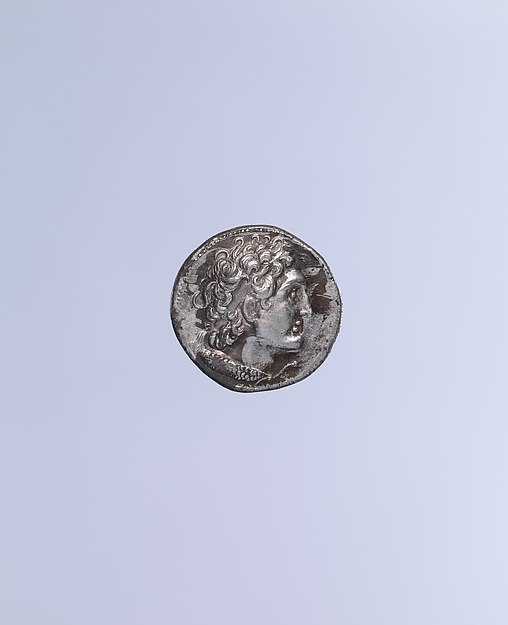
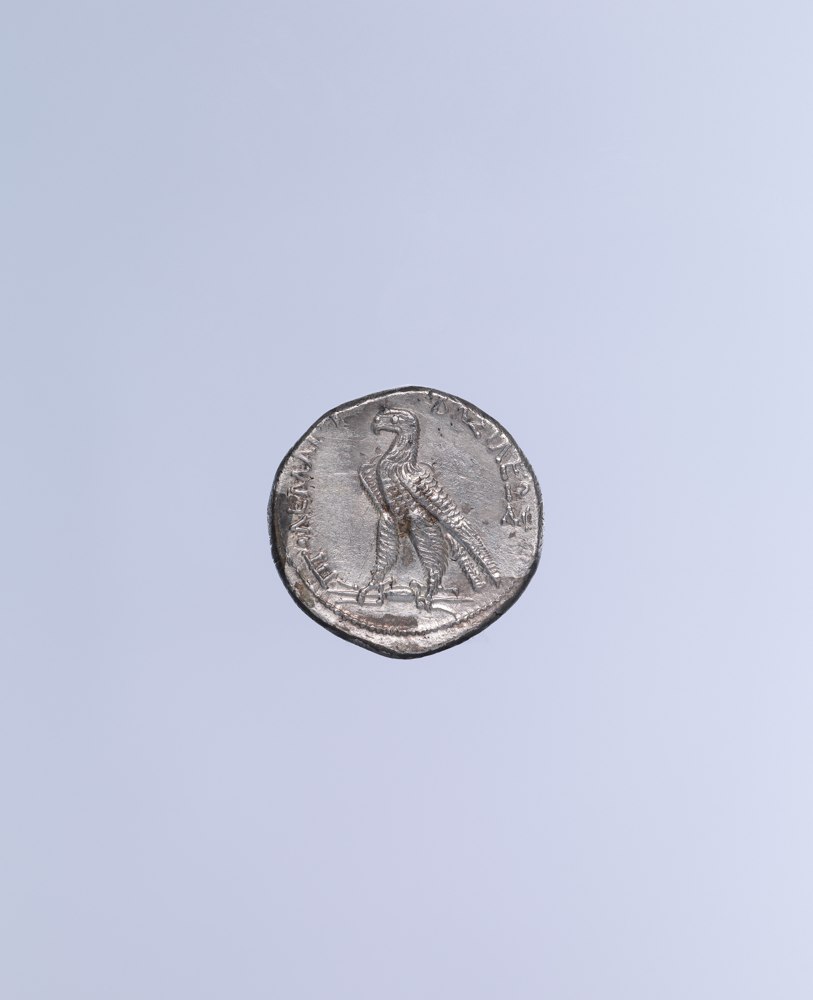
The tetradrachm, literally four drachms, helps explain the change. A coin carried an identifiable authority. The dynastic portrait and the eagle on a thunderbolt established images recognisable from one issue to the next. The Ptolemy VIII example shown here, dated by the Metropolitan Museum to 164–145 BCE, also illustrates how Ptolemaic coinage reached beyond modern Egypt: the museum tentatively places its mint in Cyrenaica.
Egypt lacked abundant silver deposits. Bronze coins therefore played an important role in local exchanges; a coin’s monetary value cannot always be explained by the weight of its metal alone. After the Roman conquest in 30 BCE, Alexandria remained a minting centre. Tetradrachms now carried the imperial portrait, as on the British Museum’s example of Diocletian. A denomination could survive for centuries while its metal, issuing authority and payment networks changed.
Chapter sources: UCL — Coins of the Ptolemies · British Museum — Diocletian, Alexandrian tetradrachm IOLC.4738
03 / EGPDinars and dirhams: authority in the inscriptions
In the seventh century Egypt became part of the world governed by Muslim rulers. Byzantine and Sasanian coins initially provided both models and means of payment. The Umayyad caliph Abd al-Malik’s reform subsequently gave Arabic inscriptions a central role; the gold dinar of AH 77, or 696–697 CE, was a landmark. Gold dinars, silver dirhams and copper coins served different purposes.
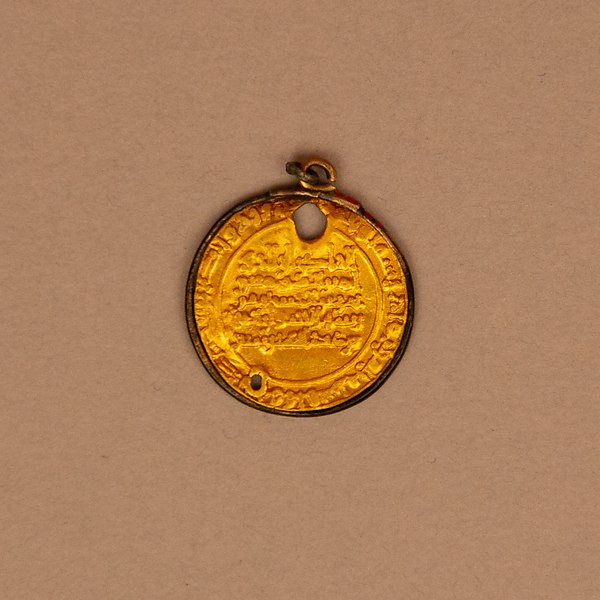
Under the Fatimids, established in Egypt in the tenth century, gold connected trading centres across a wide Mediterranean region. The al-Hakim dinar illustrated here is dated AH 388, or 998 CE, and attributed to Tyre. Calling it “minted in Cairo” would be incorrect. It documents the reach of a dynasty centred in Egypt and the movement of precious metal between its provinces and ports.
Inscriptions performed a political as well as a religious function: they named an authority and asserted legitimacy. Yet imagery did not disappear completely. A Baybars dinar displayed by Egypt’s Ministry of Antiquities includes a lion, the Mamluk sultan’s personal emblem. Long before mosques and pharaohs appeared on modern banknotes, coins already embodied decisions about what the issuing authority wanted people to see.
Chapter sources: Ministry of Tourism and Antiquities — Gold dinar of Baybars · The Met — Dinar, 388 AH / 998 CE, 39.72
04 / EGP1834–1836: Muhammad Ali’s reform
At the beginning of the nineteenth century Egypt formally remained part of the Ottoman Empire, while Muhammad Ali was building a largely autonomous government. Collecting taxes, maintaining an army and organising trade called for more consistent monetary references in a country where several kinds of coin circulated.
Two dates need to be kept separate. A decree in 1834 provided for a gold-and-silver system; the Egyptian pound was struck and placed in circulation in 1836, according to the central bank’s chronology. Bimetallism meant that both metals helped define the monetary system. It also required an official relationship between them, even though their commercial values could move differently.
The pound was therefore not created by the British occupation of 1882 or the opening of the Suez Canal in 1869. Those events changed its surroundings, not its birth date. English-speaking readers should also resist treating it as another name for sterling: the Egyptian unit has a history of its own.
Reform did not immediately remove foreign coins. The central bank explains that local mints could not supply all the requirements of large transactions and overseas trade, so the authorities legally rated foreign coins accepted in domestic payments. Monetary unification was a practical process, dependent on supplies of coins as well as the wording of a decree.
Chapter sources: Central Bank of Egypt — Banknote history
05 / EGPReading denominations: pound, piastre and millieme
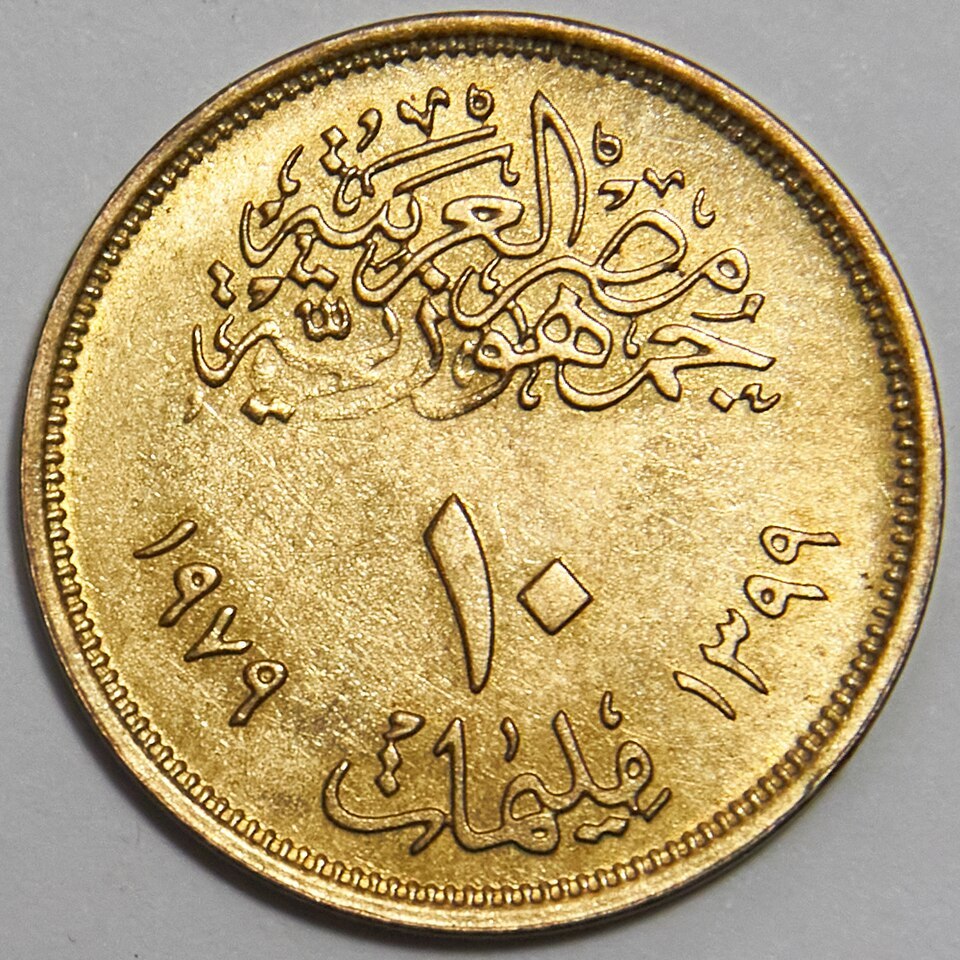
The pound is the main unit, the piastre its hundredth part and the millieme its thousandth. But describing all three as a fully formed invention of 1834 would flatten their history. The piastre, or qirsh, predates the pound. Small denominations inherited from the Ottoman period should not be projected unchanged onto every later issue.
| Unit | Nominal relationship | On coins and notes |
|---|---|---|
| 1 pound | 100 piastres | جنيه · pound · LE / E£ · EGP |
| 1 piastre | 10 milliemes | قرش · qirsh · piastre |
| 1 millieme | 1/1,000 pound | مليم · millieme |
These relationships help identify denominations; they do not measure purchasing power across time. Farouk’s ten-qirsh coin, illustrated below, represents one tenth of a pound in nominal terms, but its place in a household budget was different from that of the same nominal amount today. Collectors’ prices, metal value and face value are also separate concepts.
Readers will encounter Arabic numerals and lettering alongside Latin-script wording, and sometimes two dates. A Hijri year and a Gregorian year are not necessarily conflicting mint dates. Lunar and solar years do not align exactly, so conversion requires care. On older coins a ruler’s accession date must also be distinguished from the actual year of striking.
06 / EGP1899: paper enters the picture
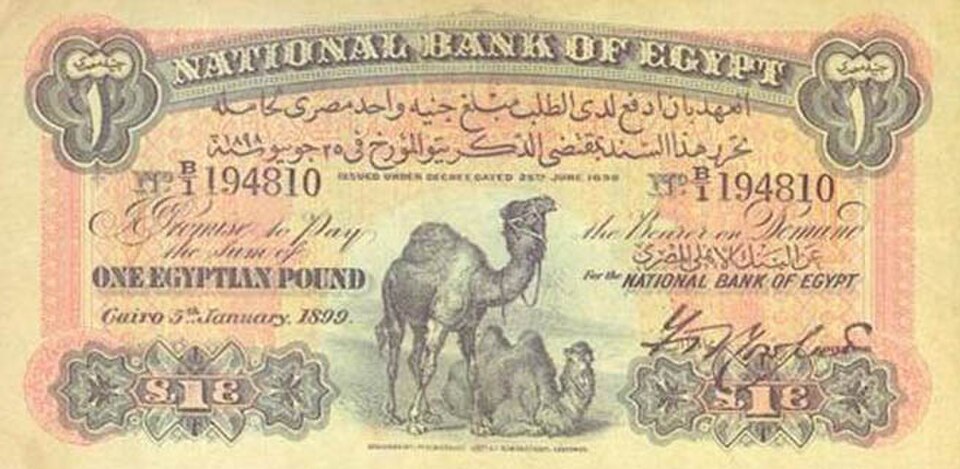
At the end of the nineteenth century, large payments were still closely associated with gold coins. Metal was familiar and tangible; a banknote required trust in an institution’s promise. Established in 1898, the National Bank of Egypt received the privilege of issuing notes convertible into gold. Its first banknotes appeared on 3 April 1899.
The camel note belongs to this world. Its frame, signatures, numbers and inscriptions are more than decoration: they identify the issuer and give material form to its undertaking. The bank’s foundation in 1898 must be distinguished from the first issue in 1899, a confusion that appears even in some image descriptions.
The bank’s English name reflects Egypt’s international financial connections and the setting of British domination. It does not make the note sterling. Two currencies can be linked through their use and conversion arrangements while remaining separate units.
On 2 August 1914, against the background of the First World War, a decree made Egyptian banknotes legal tender and suspended gold convertibility. This changed the basis of payment: handing over a note no longer implied the same right to demand its metallic equivalent. Gold receded from transactions as the paper pound became the system’s central reference.

Chapter sources: Central Bank of Egypt — Banknote history
07 / EGPThe kingdom: portraits, watermarks and small change
The declaration of independence in 1922 and the establishment of the kingdom changed the symbols of sovereignty without requiring a new monetary unit. Coins could carry a ruler’s name and portrait; banknote imagery followed a different chronology. Fuad’s likeness on a coin does not imply the existence of a matching portrait banknote.
The Egyptian Presidency recalls a distinctive issue of 1926: the one-pound note commonly called the “peasant pound”, associated with a man named Idris. It brought an ordinary human presence into an official object. Colourful stories about the model’s identity or subsequent fortune are not needed to appreciate the change: currency could depict an inhabitant rather than only an emblem or a building.
Watermarks entered Egyptian banknotes in 1930. Authentication no longer depended solely on an intricate design: a property of the paper itself became a security feature. The illustrated reverse of the 1930 pound shows how the monument fits between spaces reserved for the denomination and watermark.
Farouk, who became king in 1936, appeared on coins and on banknotes towards the end of the monarchy. The ten-qirsh piece offers another visual language: portrait, title and denomination. Both sides need to be read together. The likeness identifies an authority; the value and inscriptions locate the object within a monetary system.
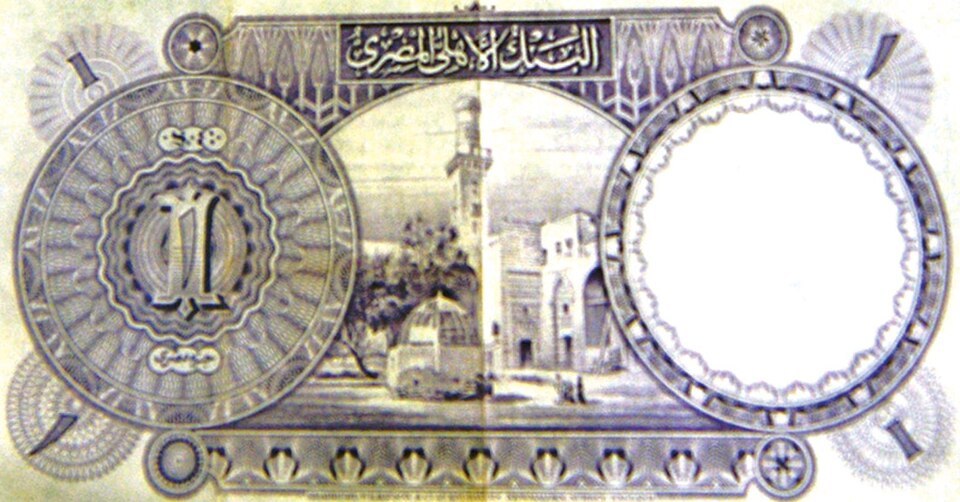

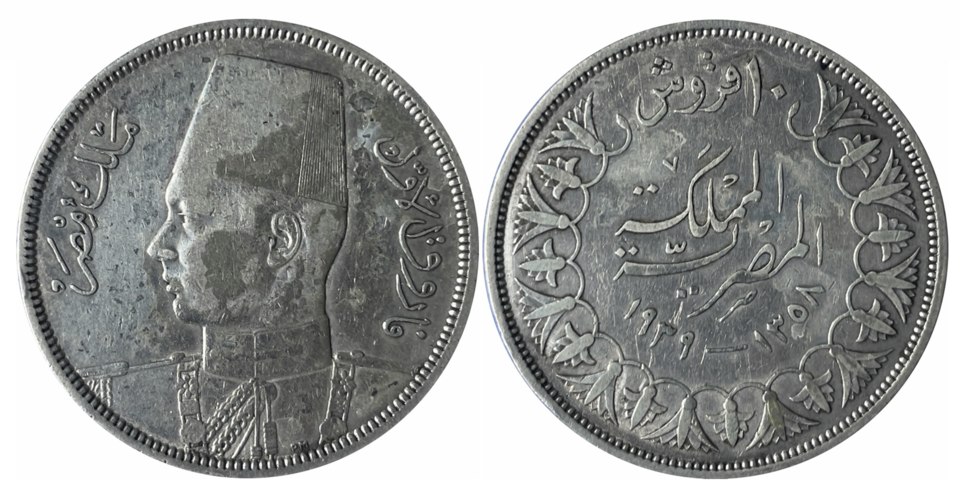

Chapter sources: Présidence égyptienne / Egyptian Presidency — Histoire monétaire / Currency history (arabe / Arabic) · Central Bank of Egypt — Banknote history
08 / EGPThe republic: making its own money
The 1952 revolution and the proclamation of the republic in 1953 transformed Egypt’s institutions and public imagery. The pound remained. For a note holder, a new political regime did not automatically mean a new unit or the removal of zeros from accounts. The currency’s name provided continuity across a major political break.
Sovereignty also depended on workshops. Legislation establishing a modern national mint was passed in 1950, before the republic; its coins began entering circulation in the middle of 1954. The interval is a reminder that an industrial institution is not created simply by an opening ceremony. Machines must be acquired, teams organised and production mastered.
The establishment of the Central Bank, provided for by 1960 legislation, separated currency issuance from the National Bank of Egypt’s commercial activity. A banknote’s issuer is therefore an important historical clue. The 1967 pound illustrated below is a Central Bank document, rather than a new issue of the bank founded in 1898.
A second industrial project concerned paper money. The Central Bank dates the opening of its printing house to 1967. Its institutional pages differ over the detailed start of denomination production in December 1967 or December 1968. Retaining the 1967 opening is more accurate than presenting a misleadingly precise production date. The underlying change is clear: Egypt was bringing a security-printing operation previously undertaken abroad onto its own territory.
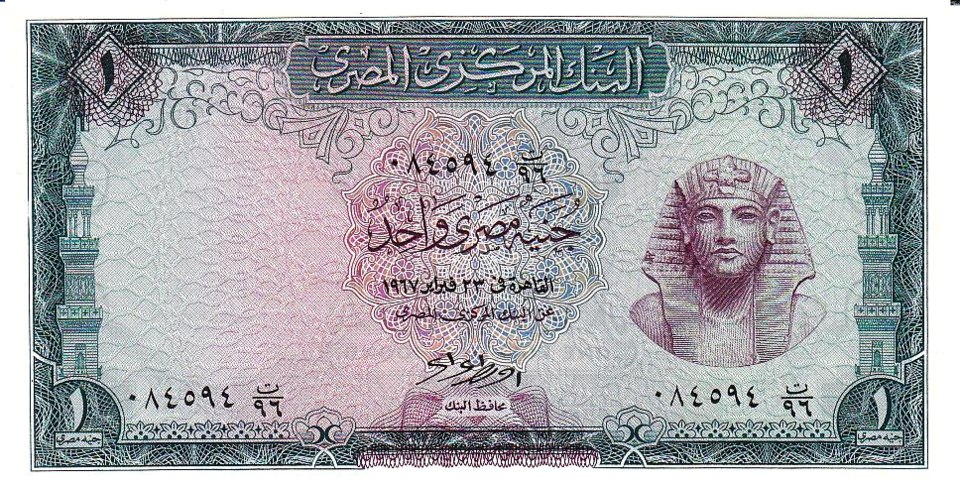

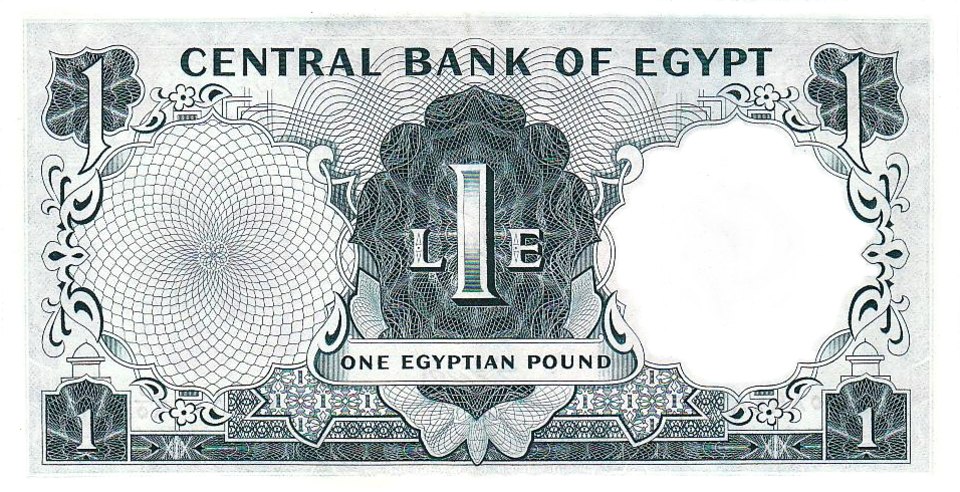

Chapter sources: Egyptian Mint — History (arabe / Arabic) · Central Bank of Egypt — Printing House, history · Central Bank of Egypt — Printing House, history (arabe / Arabic) · Central Bank of Egypt — Banknote history
09 / EGPMosques and antiquity: two sides of a shared story
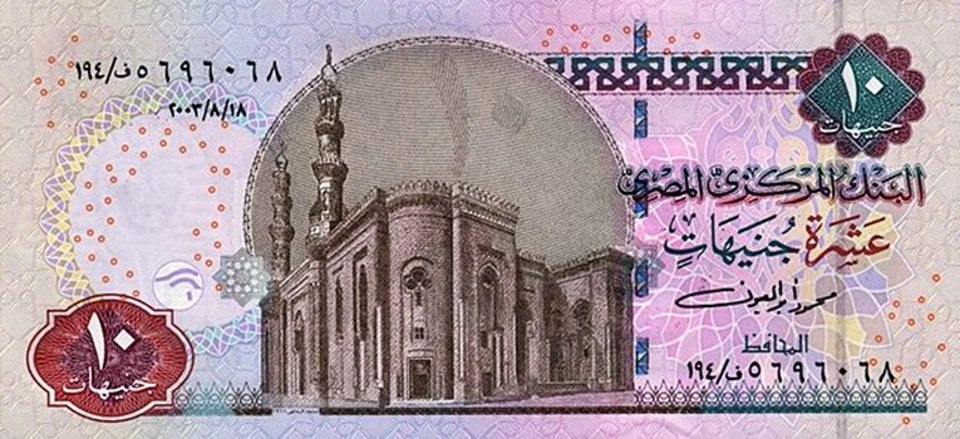
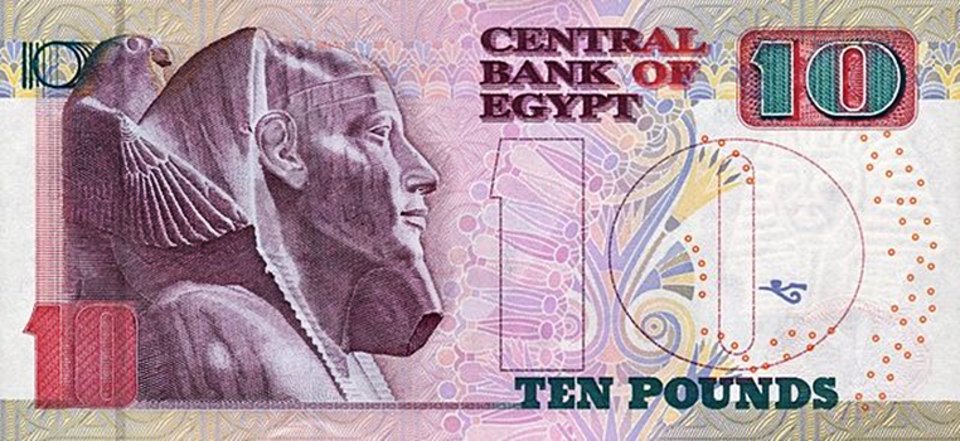
Egyptian banknotes offer compact journeys across different periods. Their designs often pair a mosque with imagery from ancient Egypt. The arrangement should not be read as one civilisation erasing another: it brings together inheritances that coexist within the country’s identity.
The pound redesigned in 1979 provides a precise example: Sultan Qaitbay’s mosque appears on one face and Abu Simbel on the other. On paper, monuments change scale. Façades, statues and arabesques are adapted to engraving, the positioning of numerals and the space required for security features. A banknote interprets heritage graphically rather than simply photographing a building.
Choosing monuments rather than living leaders helps give the designs a longer visual life. Arabic and English inscriptions also make denominations readable to different audiences. Identifying an issue nevertheless requires looking at the whole object: a colour or monument may survive changes of signature and technical revisions.
Higher denominations arrived in stages. The Central Bank’s issuance chronology gives May 1977 for twenty pounds, May 1979 for one hundred, March 1993 for fifty and May 2007 for two hundred. An English printing-house page incorrectly groups twenty and one hundred pounds together in 1979. This dossier follows the issuance chronology, cross-checked against the Arabic printing-house history. These dates describe the enlargement of the note range; they do not, by themselves, explain the full history of prices.


Chapter sources: Présidence égyptienne / Egyptian Presidency — Histoire monétaire / Currency history (arabe / Arabic) · Central Bank of Egypt — Banknote history · Central Bank of Egypt — Printing House, history (arabe / Arabic)
10 / EGPTutankhamun in the hand: coins and commemorations
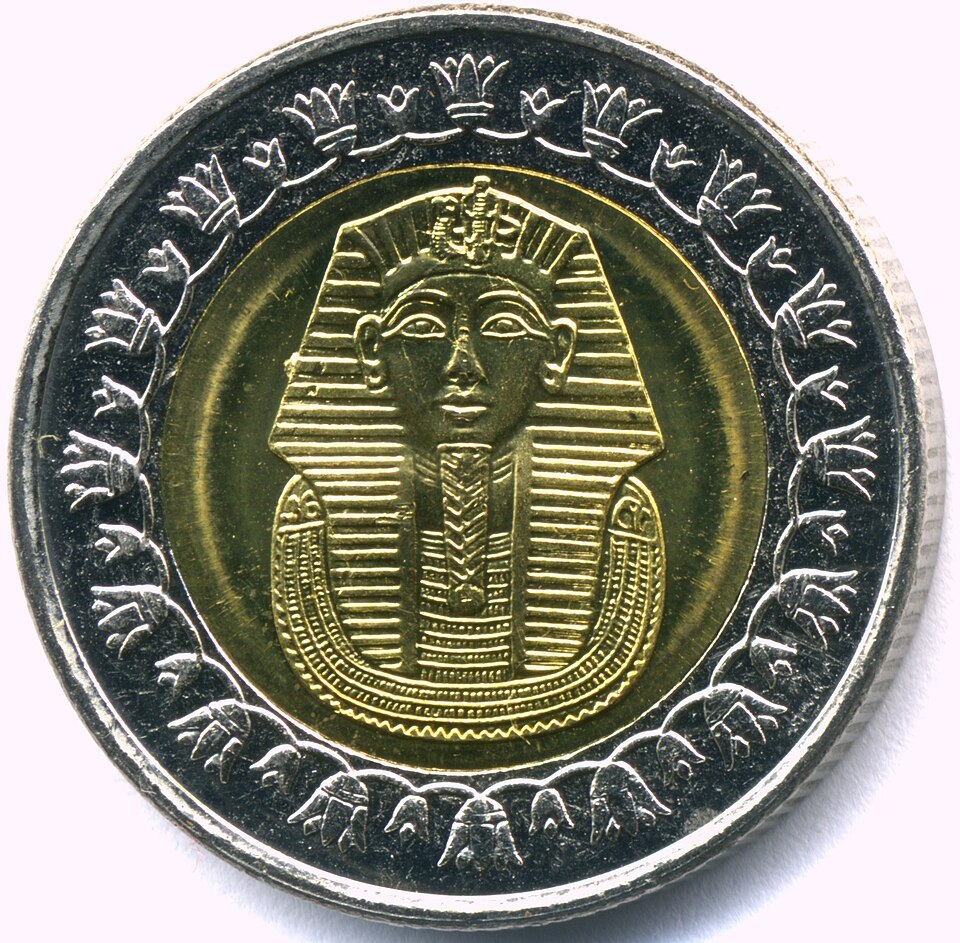
The bimetallic one-pound coin places national memory in an object recognisable by touch. Its centre and outer ring create an immediate contrast, while Tutankhamun’s mask gives the denomination a familiar face. This is not an excavated pharaonic coin or an ancient gold piece. It is a modern object using an image from antiquity.
The distinction matters: the age of the motif is not the age of the object. John Alan Elson’s 2014 scan illustrates the type; the date of digitisation must not automatically become the coin’s mint date. Careful cataloguing distinguishes the image, the monetary design, the individual specimen and its date of manufacture.
Commemorative issues give minting another role. The Egyptian Mint lists a circulating one-pound coin dated 2015 celebrating the opening of the New Suez Canal. A contemporary engineering project is commemorated through the same compact medium used for ancient heritage: one side of a coin, a denomination and a readily shared image.
Other issues are not intended to pass from hand to hand. In October 2025 the Ministry of Finance announced a non-circulating gold-and-silver series for the Grand Egyptian Museum, with face values ranging from one to one hundred pounds. A denomination does not make these objects ordinary small change. Materials, production, presentation and a collectors’ audience alter their function. A circulating commemorative and a collector issue should therefore not be treated as equivalent.


Chapter sources: Egyptian Mint — One pound, New Suez Canal, 2015 · Ministère des Finances / Ministry of Finance — Grand Egyptian Museum commemorative coins, 29 October 2025
11 / EGP2022–2023: the transparency of polymer
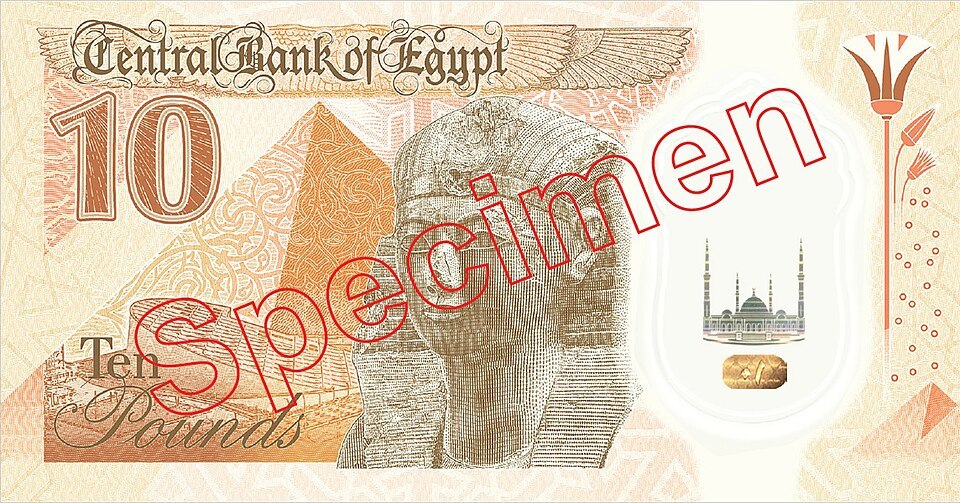
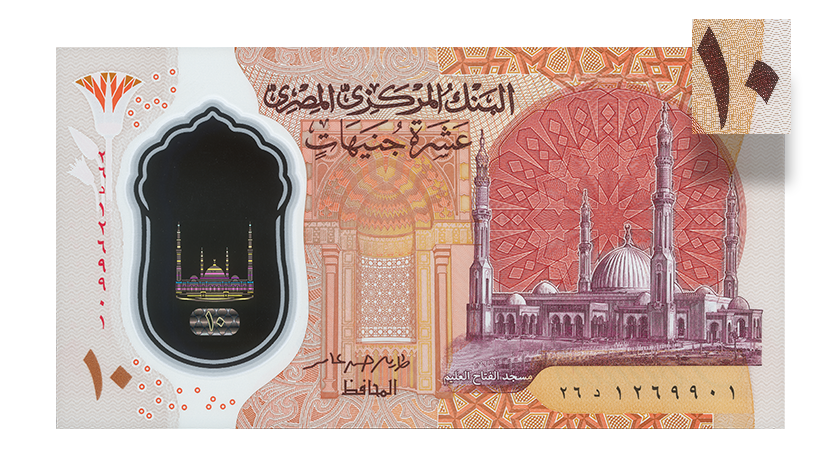
On 5 July 2022 the Central Bank introduced its first polymer banknote, the ten-pound denomination. The change could be seen and felt: plastic replaced the paper substrate and made a transparent window possible. This was a new way to manufacture a note with the same face value, rather than a new Egyptian pound.
Presented by the Central Bank through the International Association of Currency Affairs, the issue pairs the Al-Fattah Al-Alim Mosque in the New Administrative Capital with Hatshepsut. Recent architecture meets ancient heritage. The window and its optical features make the material itself part of both the image and the security system.
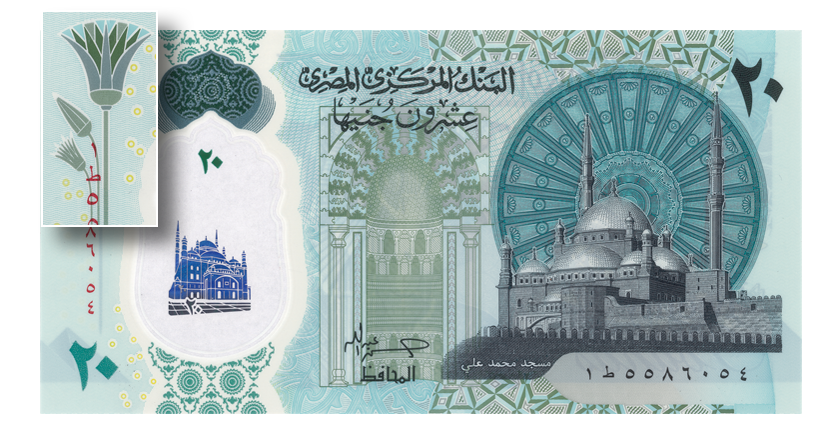
The 20 June 2023 launch of a polymer twenty-pound note extended the approach. One face features Muhammad Ali’s mosque; the other includes Cleopatra, the pyramids and other ancient imagery. Tactile markers help blind and partially sighted users recognise the denomination. A banknote has to work for hands as well as eyes.
At launch, the Central Bank explicitly stated that the paper twenty-pound note remained valid alongside the polymer version. A new material did not automatically withdraw the previous one. The announced benefits of resistance and durability explain the technical choice; they do not constitute a reform of the unit of account. From weighed metal to transparent windows, changing features help make monetary objects recognisable and trustworthy.

Chapter sources: IACA / Central Bank of Egypt — Egypt 10 Pound · Central Bank of Egypt — 20-pound polymer, 20 June 2023
The banknotes in pictures
12 / EGPExchange-rate reforms: the same name, different rules
Continuity in the name “pound” does not imply an unchanging external value. Rules for exchanging it against other currencies have changed repeatedly. Three histories need to be distinguished: the unit itself, its physical objects and its exchange-rate regime.
On 29 January 2003 the authorities moved from a currency band to a more flexible arrangement. The IMF’s historical account documents subsequent difficulties and adjustments. The 2016 float therefore cannot accurately be presented as Egypt’s first attempt to give market pricing a greater role.
On 3 November 2016 a further liberalisation brought a sharp depreciation. Households felt the effects particularly through imported goods and expenditure dependent on foreign-currency costs. For a business, replacing stock could become more expensive before sales receipts had adjusted. These are tangible consequences that can be explained without a list of daily rates destined to become obsolete.
The strains of 2022–2024 and the renewed move towards flexibility in March 2024 show why an announced reform does not permanently guarantee a unified currency market. Describing 2016 as the irreversible disappearance of parallel trading would be misleading. Calling these episodes a succession of new currencies would be equally wrong: notes remained denominated in Egyptian pounds. An exchange-rate movement is different from a redenomination that removes zeros.
This long history offers two complementary lessons. An institution and a denomination can endure while the conditions of their use change. Coins and banknotes preserve visible evidence of those changes through their issuers’ names, materials, imagery and security features.
Chapter sources: IMF — Achieving Exchange Rate Flexibility, Egypt · IMF — Egypt, Extended Arrangement, 2017 · IMF — Egypt, First and Second Reviews, April 2024
13 / EGPA chronology to keep in view
| Milestone | What changed |
|---|---|
| Pharaonic Egypt | Weights and accounts measured value before widespread coinage. |
| Ptolemaic period | Regular issues, dynastic portraits and the eagle; expanding coin circulation. |
| 1834 / 1836 | Bimetallic decree, followed by the striking and circulation of the pound. |
| 1898 / 1899 | Foundation of the National Bank of Egypt, followed by its first banknotes. |
| 1914 | Legal-tender status for notes and suspension of gold convertibility. |
| 1930 | Watermarks introduced into banknotes. |
| 1950 / 1954 | Legal establishment of the modern mint, then circulating production. |
| 1960 / 1967 | Legislation establishing the Central Bank; opening of its printing house. |
| 2003 / 2016 / 2024 | Exchange-rate reform milestones without a new currency name. |
| 2022 / 2023 | Polymer ten- and then twenty-pound notes. |
Sources and credits
Research checked on 15 October 2026. References accompany the chapters; collection records identify the objects. Documentary links require a connection, but the full article and every illustration can be read offline.
- UCL — Measuring weight in Ancient Egypt
- Royal Ontario Museum — Weight
- UCL — Coins of the Ptolemies
- British Museum — Diocletian, Alexandrian tetradrachm IOLC.4738
- The Met — Dinar, 388 AH / 998 CE, 39.72
- Ministry of Tourism and Antiquities — Gold dinar of Baybars
- Central Bank of Egypt — Banknote history
- Présidence égyptienne / Egyptian Presidency — Histoire monétaire / Currency history (arabe / Arabic)
- Egyptian Mint — History (arabe / Arabic)
- Central Bank of Egypt — Printing House, history
- Central Bank of Egypt — Printing House, history (arabe / Arabic)
- IACA / Central Bank of Egypt — Egypt 10 Pound
- Central Bank of Egypt — 20-pound polymer, 20 June 2023
- IMF — Achieving Exchange Rate Flexibility, Egypt
- IMF — Egypt, Extended Arrangement, 2017
- IMF — Egypt, First and Second Reviews, April 2024
- Egyptian Mint — One pound, New Suez Canal, 2015
- Ministère des Finances / Ministry of Finance — Grand Egyptian Museum commemorative coins, 29 October 2025
Illustrations are documentary reproductions and are not to scale. Photograph and scan licences appear below each image. Currency-design status is distinguished from reproduction rights in the image manifest. For Egyptian issues, the adopted basis is the official-document classification described by Commons, Egypt section. CC BY-SA photographs retain their licences. The README records historical decisions and documentary limitations.
Back to top ↑